Calculating Frequency of a Simple Pendulum | Length 80cm

  • Thread starter Thread starter CannonSLX
  • Start date Start date
  • Tags Tags
    Harmonic
Click For Summary
SUMMARY

The discussion centers on calculating the frequency of a simple pendulum with a length of 80 cm (0.8 m). The user applied the formula for frequency, f = 1/period, and derived a period of 4/7π seconds, resulting in a frequency of approximately 0.577 Hz. While the method used is correct, participants suggest verifying the final frequency value to ensure accuracy. The importance of adhering to forum formatting rules is also emphasized.

PREREQUISITES
  • Understanding of simple harmonic motion principles
  • Familiarity with pendulum physics
  • Knowledge of frequency and period calculations
  • Basic mathematical skills for manipulating fractions and π
NEXT STEPS
  • Review the derivation of the period for a simple pendulum
  • Explore the impact of pendulum length on frequency
  • Learn about the effects of mass and amplitude on pendulum motion
  • Investigate advanced pendulum models, such as the physical pendulum
USEFUL FOR

Students studying physics, educators teaching mechanics, and anyone interested in the dynamics of oscillatory motion.

CannonSLX
Messages
40
Reaction score
0
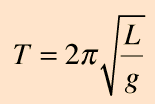
I'm asked to Calculate the frequency of oscillation of a simple pendulum of length 80cm.

As its a pendulum I used
d0bf1eb21c9fa3bfd80bef3cf865ae45.png


To calculate the time. To which I got 4/7π

I then used f=1/period and converted 80cm to 0.8m and got a frequency of 0.577Hz, is this correct ?
 
Physics news on Phys.org
CannonSLX said:
I'm asked to Calculate the frequency of oscillation of a simple pendulum of length 80cm.

As its a pendulum I used
d0bf1eb21c9fa3bfd80bef3cf865ae45.png


To calculate the time. To which I got 4/7π

I then used f=1/period and converted 80cm to 0.8m and got a frequency of 0.577Hz, is this correct ?
In future be sure to make use of the formatting template! This is a requirement as stated in the forum rules (which you read of course, right?).

Regarding your question, your method is fine but you might want to recheck the final value. Could be just a typo rather than a calculation error...
 
How many oscillations takes for this time value?
 

Similar threads

  • · Replies 27 ·
Replies
27
Views
2K
  • · Replies 14 ·
Replies
14
Views
2K
  • · Replies 9 ·
Replies
9
Views
2K
  • · Replies 7 ·
Replies
7
Views
5K
  • · Replies 6 ·
Replies
6
Views
4K
Replies
3
Views
2K
  • · Replies 20 ·
Replies
20
Views
2K
  • · Replies 1 ·
Replies
1
Views
16K
  • · Replies 4 ·
Replies
4
Views
2K
  • · Replies 32 ·
2
Replies
32
Views
2K