easyyy
- 1
- 0
Hello guys. Please look at this, it's a VERY SIMPLE problem and I've almost solved it, but sth is not right...
It's a simple problem but i am confused regarding the method that I'm supposed to use to solve this kind of problems. So the problem is:
V1 , V2 , V3 and V4, E1, E2 are given. They are the voltages before closing the switches. We have to find the same voltages V1', V2', V3' and V4' after closing the switches. The values with - ' - are the values AFTER closing the switches.
so, MY WORK UP TO HERE:
I have the following equations:
(1) Q1+Q2+Q3+Q4=Q1'+Q2'+Q3'+Q4 , because the total charge won't change after closing the switches
(2) -E1+V1'+V2'+E2-V3'+V4'=0 , because of the 2nd rule of Kirchoff
(3) Q1 + Q2=Q1'+Q2' (because these two capacitors are in linear connection)
Equations (1) and (3) can be rewritten using that Q=C*V and Q'=C*V' , because the capacity will not change after closing the circuit.
So we have 3 equations and 4 variables (V1' , V2', V3', V4' ). So how am I supposed to find these variables?? Maybe the equation (3) or is not correct, or even the (2) but that's alla I could do...
I would be gratefull if anyone could help because it's not just for this problem, I want to see the way I should work to solve this. Thnx in advance :)
// The circuit is here: as an image:
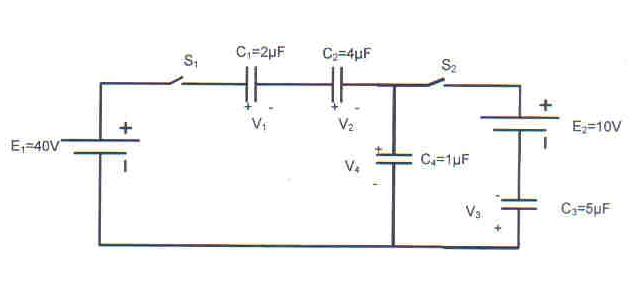
URL is: http://img.photobucket.com/albums/v446/easyyy/circuit.jpg"
It's a simple problem but i am confused regarding the method that I'm supposed to use to solve this kind of problems. So the problem is:
V1 , V2 , V3 and V4, E1, E2 are given. They are the voltages before closing the switches. We have to find the same voltages V1', V2', V3' and V4' after closing the switches. The values with - ' - are the values AFTER closing the switches.
so, MY WORK UP TO HERE:
I have the following equations:
(1) Q1+Q2+Q3+Q4=Q1'+Q2'+Q3'+Q4 , because the total charge won't change after closing the switches
(2) -E1+V1'+V2'+E2-V3'+V4'=0 , because of the 2nd rule of Kirchoff
(3) Q1 + Q2=Q1'+Q2' (because these two capacitors are in linear connection)
Equations (1) and (3) can be rewritten using that Q=C*V and Q'=C*V' , because the capacity will not change after closing the circuit.
So we have 3 equations and 4 variables (V1' , V2', V3', V4' ). So how am I supposed to find these variables?? Maybe the equation (3) or is not correct, or even the (2) but that's alla I could do...
I would be gratefull if anyone could help because it's not just for this problem, I want to see the way I should work to solve this. Thnx in advance :)
// The circuit is here: as an image:
URL is: http://img.photobucket.com/albums/v446/easyyy/circuit.jpg"
Last edited by a moderator: