nauman
- 98
- 5
- TL;DR
- Sine dipole formation using two hydrophones
Hi all. I am trying to do MATLAB simulations for generation of SINE Dipole using two hydrophones spaced distance 'd' apart for signal coming from direction 'DOA'. The MATLAB code is given below. The confusion is that there is constant phase difference of 90 degree b/w SINE Dipole generated using difference of two hydrophones and simple SINE Dipole generated by multiplication of signal with sin(DOA). There is also a difference b/w amplitude of two Dipoles. The resultant graph of MATLAB code is also attached.
Am i doing right or something is not right in my understanding?
[CODE lang="matlab" title="MATLAB Code for Sine Dipole Formation"]clc
clear
close all
f_sig = 800;%signal frequency in Hz
f_samp = 64000; %Sampling rate
N=81920;%no of data points
c=1500;%sound speed in water in m/s
d=50e-3;%spacing b/w two omni directional hydrophones
DOA=135;%Direction of signal in deg
t=(0:N-1)/f_samp;
lemda=c/f_sig;
Hyd_1=sin(2*pi*f_sig*t+2*pi*(d/2)*sind(DOA)/lemda);
Hyd_2=sin(2*pi*f_sig*t-2*pi*(d/2)*sind(DOA)/lemda);
%Formation of Sinusoidal dipole using two hydrophones Hyd_1 & Hyd_2
Sine_Dipole_1=(Hyd_1-Hyd_2);
%Formation of Sinusoidal by multiplying with sin(DOA)
Sine_Dipole_2=sin(2*pi*f_sig*t)*sind(DOA);
plot(Sine_Dipole_1(1:1000))
hold on
plot(Sine_Dipole_2(1:1000),'r')[/CODE]
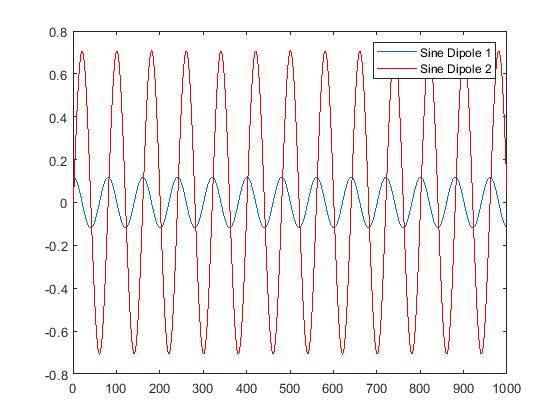
Am i doing right or something is not right in my understanding?
[CODE lang="matlab" title="MATLAB Code for Sine Dipole Formation"]clc
clear
close all
f_sig = 800;%signal frequency in Hz
f_samp = 64000; %Sampling rate
N=81920;%no of data points
c=1500;%sound speed in water in m/s
d=50e-3;%spacing b/w two omni directional hydrophones
DOA=135;%Direction of signal in deg
t=(0:N-1)/f_samp;
lemda=c/f_sig;
Hyd_1=sin(2*pi*f_sig*t+2*pi*(d/2)*sind(DOA)/lemda);
Hyd_2=sin(2*pi*f_sig*t-2*pi*(d/2)*sind(DOA)/lemda);
%Formation of Sinusoidal dipole using two hydrophones Hyd_1 & Hyd_2
Sine_Dipole_1=(Hyd_1-Hyd_2);
%Formation of Sinusoidal by multiplying with sin(DOA)
Sine_Dipole_2=sin(2*pi*f_sig*t)*sind(DOA);
plot(Sine_Dipole_1(1:1000))
hold on
plot(Sine_Dipole_2(1:1000),'r')[/CODE]