Single Loop Potential difference -- sign issue

Click For Summary
SUMMARY

The discussion focuses on the potential difference in a single loop circuit, specifically addressing the sign convention for electromotive forces (emfs) and current direction. The user initially calculated the potential difference Vab as 10V clockwise and 2V counterclockwise, leading to confusion. The resolution emphasizes that the sign of the emf should be determined by its polarity, with potential drops occurring when moving from positive to negative. The correct approach involves consistently applying the sign convention for potential changes based on the direction of current flow and the orientation of the emfs.

PREREQUISITES
  • Understanding of Kirchhoff's Voltage Law
  • Familiarity with electromotive force (emf) concepts
  • Basic knowledge of circuit analysis techniques
  • Proficiency in interpreting circuit diagrams
NEXT STEPS
  • Study the application of Kirchhoff's Voltage Law in complex circuits
  • Learn about the impact of polarity on circuit analysis
  • Explore advanced circuit analysis techniques using mesh and nodal analysis
  • Review examples of potential difference calculations in various circuit configurations
USEFUL FOR

Electrical engineering students, circuit designers, and anyone involved in analyzing and troubleshooting electrical circuits will benefit from this discussion.

simphysics
Messages
7
Reaction score
0
Homework Statement
Find Va-Vb in the following circuit.
R=3 OHM
Ɛ1=10V
Ɛ2=4V
Relevant Equations
Va-Vb=Ɛ1
Va-Vb=iR-Ɛ2
Hello everyone, I've been struggling with this problem for 1 hour so far.
klvproblem.jpg
Here's how I've tried to solve it. as i supposed, the current flows counterclockwise and i=2A.
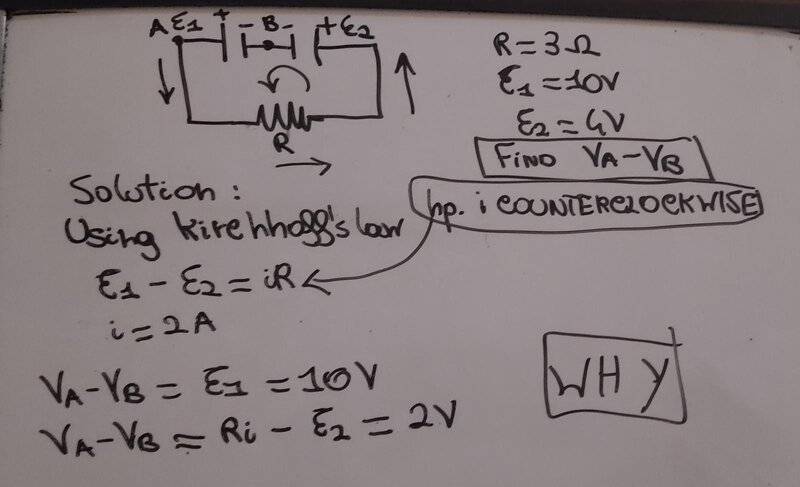
it doesn't matter which path i take, cause i should always arrive at the same potential but i actually don't and i can't get why.
If taking Vab clockwise:
Va-Vb=Ɛ1 and i assume it positive since the current flows through it from the negative pole to the positive one. so Va-Vb=10V
If taking Vab counterclockwise
Va-Vb=iR-Ɛ2=6V-4V=2V
I'm assuming Ɛ2 negative since the current flows through it from the positive pole to the negative pole.
The values are different and I can't get why.
Thank you! :)
homework-and-exerciseselectric-cir
 
Physics news on Phys.org
Current direction is irrelevant for the emfs. All that matters is the polarity. You therefore has the wrong sign for the second emf.
 
Got it, so what's the rule for the polarity?Thank you!
 
If you go from + to -, potential drops. If you go from - to +, potential increases.
 
sorry but i still can't get over it...
when i calculate Vab counterclokwise i go from + to -, so why should i take it positive?
thank you
 
Last edited:
Why did you take the other emf positive?
 
well...i don't know at this point
 
Which direction you go and how you count is conventional. Computing Vab = Va - Vb you can either go from a to b and count potential drops or go from b to a and count potential gains. Since you say you want to go ccw from a to b, you should be counting potential drops. The drop across the resistor is iR because you are going in the direction of the current. The drop across the emf is E2 because going from + to - you get a potential drop.

Same thing happens when you take the other way across the other emf. You get E1 because you get a drop of E1 going from + to -.
 
everything's clear now, thank you so much!
 

Similar threads

  • · Replies 4 ·
Replies
4
Views
1K
Replies
3
Views
7K
  • · Replies 7 ·
Replies
7
Views
2K
  • · Replies 3 ·
Replies
3
Views
2K
  • · Replies 1 ·
Replies
1
Views
6K
Replies
6
Views
17K
  • · Replies 5 ·
Replies
5
Views
1K
Replies
2
Views
1K
  • · Replies 30 ·
2
Replies
30
Views
3K
Replies
2
Views
3K