Sketching Root Locus: n=2, m=1, Angle?

  • Thread starter Thread starter Tekneek
  • Start date Start date
  • Tags Tags
    Root Root locus
Tekneek
Messages
70
Reaction score
0
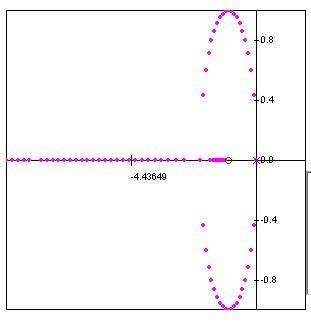
The characteristic equation is 1+K(S+1)/S2 Below is the root locus diagram. I don't get why there are two branches when there is only one pole, at 0. Does it count as having two poles even if it is the same because of s^2 ? If it does then why doesn't the angle of departure make sense?

number of poles(n) = 2
number of zeros(m) = 1

angle = (2h+1)/n-m * 180 = keep getting the same angle, 180

The angle certainly does not look like 180 as it departs from its pole...
95whgh.jpg
 
Engineering news on Phys.org
Tekneek said:
The characteristic equation is 1+K(S+1)/S2 Below is the root locus diagram. I don't get why there are two branches when there is only one pole, at 0. Does it count as having two poles even if it is the same because of s^2 ? If it does then why doesn't the angle of departure make sense?

number of poles(n) = 2
number of zeros(m) = 1

angle = (2h+1)/n-m * 180 = keep getting the same angle, 180

The angle certainly does not look like 180 as it departs from its pole...

Yes, there are two poles, s2 = (s+0)(s+0)

The mentioned angle is the angle between the two branches (180°), not the angle between a branch and the real-axis.

I don't recognize this formula: angle = (2h+1)/n-m * 180°.

Rule 1) If the number of poles in the same point = n, then the angle between the n branches = 360°/n.

Rule 2) There will be a root-curve on the real-axis at a point, if the number of real (zeroes+poles) to the right of that point is odd.
 
Last edited:
Hesch said:
Yes, there are two poles, s2 = (s+0)(s+0)

The mentioned angle is the angle between the two branches (180°), not the angle between a branch and the real-axis.

I don't recognize this formula: angle = (2h+1)/n-m * 180°.

Rule 1) If the number of poles in the same point = n, then the angle between the n branches = 360°/n.

Rule 2) There will be a root-curve on the real-axis at a point, if the number of real (zeroes+poles) to the right of that point is odd.

What does it mean by root-curve on the real axis? Also how would I know the root locus moves in a circular pattern?
 
Tekneek said:
What does it mean by root-curve on the real axis?

Look at your attached figure: There is a root-curve (actually 2) on the real axis (imaginary part = 0) for s < -1, because there is 1 zero and 2 poles to the right of all points on the real axis when s < -1.

Tekneek said:
Also how would I know the root locus moves in a circular pattern?

Poles will repel roots and zeros will attrack roots as the amplification in a control-loop is increased. Say you have three poles in the same point. If not the roots should leave these poles in a mutual angle of 120°, what should they do instead, and why?

Having left the startpoint (at some distance from the startpoint) the roots will no longer spread symmetrically because they then "can sense" other poles (repelling) and zeros (attracking).

Recommendation: Invent some sets of poles and zeroes and "play" with them on your screen. See what the root-curves will do in different combinations. Confirm the rules in #2.

Examples here:

https://www.google.com/search?q=roo...KcsgH064D4CQ&ved=0CAcQ_AUoAQ&biw=1366&bih=635
 
Last edited:

Similar threads

  • · Replies 3 ·
Replies
3
Views
2K