Slab resting on two supports: Maximum weight added without tipping?

  • Thread starter Thread starter tjosan
  • Start date Start date
  • Tags Tags
    Maximum Weight
Click For Summary

Homework Help Overview

The discussion revolves around a physics problem involving a slab resting on two supports and the maximum weight that can be added without tipping. The subject area includes concepts of moments, forces, and equilibrium in mechanics.

Discussion Character

  • Mixed

Approaches and Questions Raised

  • Participants explore the calculation of moments and forces, questioning the use of symbols and the arrangement of terms in their expressions. There is an attempt to clarify the relationship between weights and distances in the context of tipping.

Discussion Status

Some participants are providing guidance on the approach to calculating moments, suggesting that working with the sum of moments may reduce errors. There is an ongoing exploration of how different placements of weight affect the tipping point, indicating a productive direction in the discussion.

Contextual Notes

Participants are grappling with the implications of weight placement and the geometry of the slab, including how the width may influence the tipping behavior. There is mention of potential errors in calculations and the need for clarity in the definitions used.

tjosan
Messages
32
Reaction score
2
Homework Statement
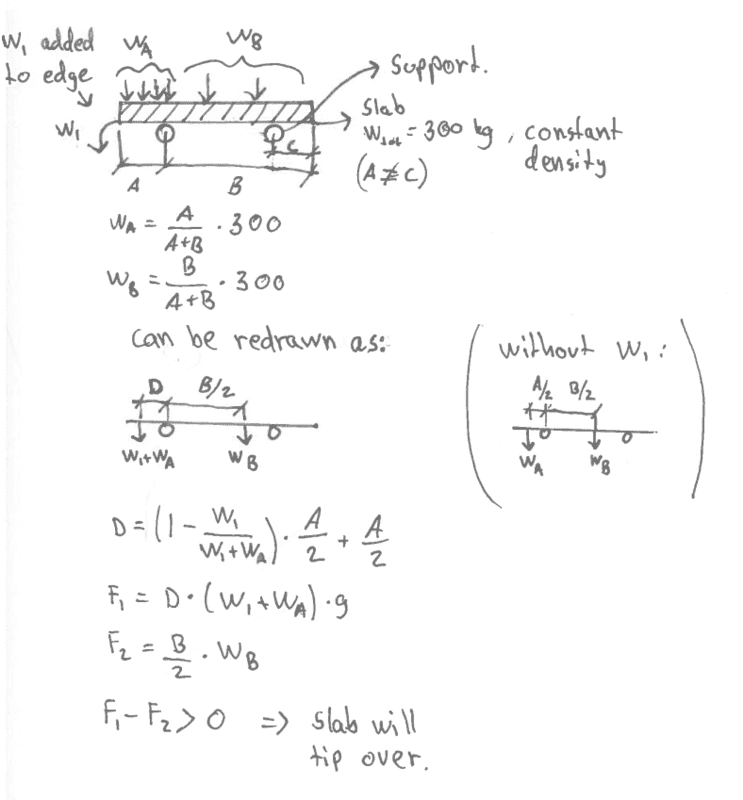
A slab is placed on two supports. At one edge, a weight is added. How large can the weight be before the slab tips over? The slab weighs 300 kg, and the density is constant. See image for attempted solution and a drawing of the slab.
Relevant Equations
F_1*d_1=F_2*d_2
Hi,

My attempted solution is in the image:

I choose the edge on the left side, but the solution should be similar on both sides (just substitute C for A).

(I missed to multiply by "g" in F_2.)

Is this the correct way of thinking? I'm not sure about the distance "D".
slabsupport.png
 
Physics news on Phys.org
Hello,

I can't follow what you do on the left side:
On the right side you calculate a moment (not a force, so the use of the symbol F is misleading) WB * g * B/2

If I work out your expression for F1 I get WA * g * A + W1 * g * A/2
and it should be the other way around...
 
  • Like
Likes   Reactions: tjosan
BvU said:
Hello,

I can't follow what you do on the left side:
On the right side you calculate a moment (not a force, so the use of the symbol F is misleading) WB * g * B/2

If I work out your expression for F1 I get WA * g * A + W1 * g * A/2
and it should be the other way around...
Thank you.

Yeah, made a mistake and wrote it as a force.

Are you saying it should be:
WA * g * A/2 + W1 * g * A ?

What I did on the left side, or what I tried to do, was to add the extra lever distance resulting from the weight W1, by calcuting the ratio of W1 to W1+WA and adding it to A/2 - if this makes any sense?
 
I suppose it makes sense but was processed erroneously.

Anyway, you should work with the sum of moments without having to fall back to shifting lever distances ! Much less error-prone :wink:
 
  • Like
Likes   Reactions: tjosan
Would it requie more or less weight if W1 was placed on the corner of the slab? Is it dependent on the width?
 
For the direction we did the analysis in it makes no difference. For a direction into the paper we have no information
 

Similar threads

Replies
46
Views
6K
Replies
6
Views
3K
Replies
8
Views
7K
  • · Replies 10 ·
Replies
10
Views
2K
  • · Replies 13 ·
Replies
13
Views
6K
  • · Replies 25 ·
Replies
25
Views
13K
  • · Replies 3 ·
Replies
3
Views
3K
  • · Replies 5 ·
Replies
5
Views
6K
Replies
5
Views
7K
  • · Replies 4 ·
Replies
4
Views
2K