Sliding/toppling of a block on a ramp

  • Thread starter Thread starter melpomenne
  • Start date Start date
  • Tags Tags
    Block Ramp
Click For Summary

Homework Help Overview

The problem involves a uniformly loaded crate on an inclined plane, where a horizontal force is applied. Participants are exploring whether the crate will slide or topple first, given the weight of the crate and the coefficient of friction.

Discussion Character

  • Mixed

Approaches and Questions Raised

  • Participants discuss the equations of motion for sliding and toppling, including the need for moment balances. There are attempts to calculate the force required for both scenarios, with some participants expressing confusion over discrepancies between their calculations and textbook answers.

Discussion Status

Several participants have shared their calculations and reasoning, with some suggesting different approaches to the moment balance. There is ongoing exploration of the conditions under which sliding or toppling occurs, and guidance has been offered to clarify the moment balance process.

Contextual Notes

Participants are working under the constraints of homework rules, which may limit the information they can share or the methods they can use. There is also a noted stress among participants regarding the accuracy of their calculations compared to provided answers.

melpomenne
Messages
9
Reaction score
0
1. A uniformly loaded crate of weight 1000N is held at rest on an inclined place. A gradually increasing force P is applied horizontally as shown. If coefficient of friction, u, = 0.2, determine whether the crate first slides or topples and the least force required
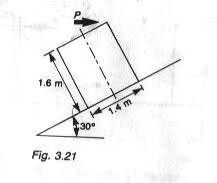
34fiedg.jpg

I am unable to find the least force required. please help me solve this - the answer is 726 N
3. Reaction R = 1000 cos 30 + P sin 30
F = uR
P cos 30 - F -mg sin 30 = 0
 
Physics news on Phys.org
Welcome to PF!

Welcome to PF! :smile:

(have a mu: µ :wink:)
melpomenne said:
3. Reaction R = 1000 cos 30 + P sin 30
F = uR
P cos 30 - F -mg sin 30 = 0

Yes, that looks ok for the sliding equation …

now you need a toppling equation …

Hint: it will start to topple when the reaction force is at the corner, so take moments :smile:
 
Hiya! Thanks for replying..

According to the way I've worked it out... P comes out to be 697 N.. while the book's answer is 726 N.. this is stressing me out.. I can't figure out where's the mistake..

For the toppling bit, i guess i'll have to do a moment balance about the corner.. and if P < P for the sliding bit, then the block topples.. am i right?
 
melpomenne said:
For the toppling bit, i guess i'll have to do a moment balance about the corner.. and if P < P for the sliding bit, then the block topples.. am i right?

Yes. :smile:

(but you can do a moment balance about any point … it makes no difference … just choose the point which you think will involve the least amount of arithmetic :wink:)
According to the way I've worked it out... P comes out to be 697 N.. while the book's answer is 726 N.. this is stressing me out.. I can't figure out where's the mistake..

Show us your full calculations, and then we can see what went wrong, and we'll know how to help! :smile:
 
Hiya! Thanks for replying..
I found P to be 697 N.. which does not coincide with that of the book.. its stressing me out :s
 
Alright will do that...

∑V = 0
R = 1000 cos 30 + P sin 30
= 866 + 0.5 P

F = µR
= 0.2 ( 866 + 0.5P)
= 173.2 + 0.1P

∑H = 0
P cos 30 = F + 1000 sin 30
= 173.2 + 0.1P + 500

P = 673.1/(0.1 + cos 30)
= 697N
 
Last edited:
Hiya! Thanks for replying..
I found P to be 697 N.. which does not coincide with that of the book.. its stressing me out :s
 
melpomenne said:
∑H = 0
P cos 30 = F + 1000 sin 30
= 173.2 + 0.1P + 500

P = 673.1/(0.1 + cos 30)

Nope … (-0.1 + cos 30) :wink:
 
tiny-tim said:
Nope … (-0.1 + cos 30) :wink:

Thanks loads! You saved my day ;) OOps now P is coming to 878 N :s
 
  • #10
melpomenne said:
Thanks loads! You saved my day ;) OOps now P is coming to 878 N :s

Don't panic!

it's probably the other P, then :smile:
 
  • #11
Ah i give up.. Thanks for your kind help sir :)
 
  • #12
melpomenne said:
Ah i give up.. Thanks for your kind help sir :)

But you haven't done the moment equation yet …

that'll probably give you a P that's less than 697N :smile:
 
  • #13
Attempting a moment balance about far right corner :p

(P cos 30 x 1.6) = (1000 cos 30 x 0.7) + ( P sin 30 x 0.7) + ( 1000 sin 30 x 0.8)
P = 971 N .. doesn't sound right
 
  • #14
I get P = 753 for the minimum tipping force. I don't think the answer in your book is right.
Let x=1.4, y=1.6, w=1000N. Then the torque = (W/2) (x sin 30 + y cos 30) - P y cos 30.
This gives P = (W/2) ( x/y tan 30 +1) = 753 for zero torque.
 
  • #15
melpomenne said:
Attempting a moment balance about far right corner :p

(P cos 30 x 1.6) = (1000 cos 30 x 0.7) + ( P sin 30 x 0.7) + ( 1000 sin 30 x 0.8)
P = 971 N .. doesn't sound right

can't follow this :confused:

you need the perpendicular distance from the corner to the line of the external force to equal the perpendicular distance from the corner to the vertical line through the centre of mass (because both the friction force and the tipping-normal force have zero moment).

Try again. :smile:
 
  • #16
tiny-tim said:
can't follow this :confused:

you need the perpendicular distance from the corner to the line of the external force to equal the perpendicular distance from the corner to the vertical line through the centre of mass (because both the friction force and the tipping-normal force have zero moment).

Try again. :smile:

(P cos 30 x 1.6) = (1000 cos 30 x 0.7) + (1000 sin 30 x 0.8)
P = 726 N! Wheee! At last!.. .. thanks a lot for the walk through! Ah I'm not really a lumiere when it comes to mechanics.. You're an Ace!
 
Last edited:

Similar threads

Replies
2
Views
334
  • · Replies 4 ·
Replies
4
Views
3K
  • · Replies 1 ·
Replies
1
Views
3K
  • · Replies 4 ·
Replies
4
Views
4K
Replies
10
Views
2K
  • · Replies 9 ·
Replies
9
Views
4K
Replies
8
Views
11K
  • · Replies 6 ·
Replies
6
Views
2K
  • · Replies 8 ·
Replies
8
Views
4K