Slipping block on a slipping ramp: final speed

Click For Summary

Homework Help Overview

The problem involves a block of mass m that slips down a frictionless ramp of mass M inclined at an angle θ from a height h. The original poster seeks to prove a specific expression for the ramp's speed when the block leaves it, based on conservation laws.

Discussion Character

  • Exploratory, Assumption checking, Problem interpretation

Approaches and Questions Raised

  • The original poster attempts to apply conservation of momentum and mechanical energy to derive the ramp's speed but arrives at a different expression than expected. Participants question the origin of certain terms in the equations and the assumptions made regarding the motion of the block relative to the ramp.

Discussion Status

The discussion includes various interpretations of the problem setup and equations. Some participants have pointed out potential issues with the original poster's derivation, while others have referenced a related thread that may provide clarity. There is no explicit consensus on the correct approach yet.

Contextual Notes

Participants are exploring the implications of the conservation laws in a system where both the block and ramp are in motion. The original poster's derivation includes terms that some participants question, indicating a need for clarification on the definitions and assumptions used in the analysis.

DavideGenoa
Messages
151
Reaction score
5
Hi, friends! A block having mass ##m## frictionlessly slips from height ##h## on a ramp of mass ##M##, which has an angle ##\theta## with the floor, where it slips with no friction.
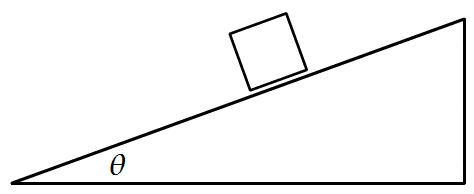
inclineWithTheta.gif


I would like to prove that, as my book says, the ramp's speed when the block leaves it is

##V=\sqrt{\frac{2m^2gh\cos^2\theta}{(m+M)(M+m\sin^2\theta)}}.##​

But I cannot reach this result. Because of the conservation of momentum in the direction parallel to the floor, which is a direction where no external force act on the system block-ramp, I would say that the speed ##v## of the block when it leaves the ramp is such that ##mv\cos\theta=M V## and, because of the conservation of mechanical energy, I would think that ##mgh=\frac{1}{2}mv^2+\frac{1}{2} MV^2=\frac{1}{2}\big(\frac{M^2V^2}{m\cos^2\theta} +MV^2\big)##, and therefore ##V=\sqrt{\frac{2m^2gh\cos^2\theta}{(m+M)(M^2+Mm\cos^2\theta)}}##
which is a wrong result. Where am I wrong?

I ##\infty##-ly thank you for any help!
 
Physics news on Phys.org
Where do you get the (m+M) term?
 
  • Like
Likes   Reactions: DavideGenoa
Relative to the ground, what direction will the block be moving?
 
  • Like
Likes   Reactions: DavideGenoa
paisiello2 said:
Where do you get the term (m+M) term?
I assumed that was a typo.
 
  • Like
Likes   Reactions: DavideGenoa
See thread https://www.physicsforums.com/threads/wedge-and-block-initial-momentum.806992/. It is the same problem as yours.
Decide what you denote by v. The block slides on the ramp which is moving horizontally with velocity -V. If the relative velocity of the block with respect to the ramp is u, the horizontal component is ucos(θ) and in the rest frame of reference it is ucos(θ)-V.
 
  • Like
Likes   Reactions: DavideGenoa
Thank you all, friends! ehild's linked post answers the issue.
 

Similar threads

Replies
9
Views
833
  • · Replies 7 ·
Replies
7
Views
1K
  • · Replies 5 ·
Replies
5
Views
1K
  • · Replies 17 ·
Replies
17
Views
4K
  • · Replies 2 ·
Replies
2
Views
1K
Replies
3
Views
2K
  • · Replies 4 ·
Replies
4
Views
3K
Replies
1
Views
1K
  • · Replies 11 ·
Replies
11
Views
2K
  • · Replies 11 ·
Replies
11
Views
3K