Slope of Tangent line to Polar curve

Click For Summary
SUMMARY

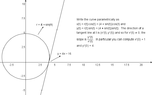
The discussion focuses on finding the slope of the tangent line to the polar curve defined by the equation r = 4 + sin(θ) at the point (4,0). The derivation provided utilizes the formulas for dy/dθ and dx/dθ, leading to the expression for dy/dx. By substituting θ = 0 into the derived formula, users can compute the specific slope at that angle. The use of Wolfram Alpha for visualizing the curve is also mentioned as a helpful tool.

PREREQUISITES
  • Understanding of polar coordinates and equations
  • Familiarity with differentiation in calculus
  • Knowledge of trigonometric functions and their derivatives
  • Experience with graphing tools like Wolfram Alpha
NEXT STEPS
  • Learn how to derive slopes for other polar equations
  • Explore the use of Wolfram Alpha for advanced mathematical visualizations
  • Study the implications of tangent lines in polar coordinates
  • Investigate the relationship between polar and Cartesian coordinates
USEFUL FOR

Mathematicians, calculus students, and anyone interested in the analysis of polar curves and their properties.

JProgrammer
Messages
20
Reaction score
0
I am trying to find the slope of the tangent line of this polar equation:

r = 4 + sin theta, (4,0)

I put the equation into wolfram alpha and it gives me a 3D plot.

If someone could help me find the slope of the tangent line, I would really appreciate it.
Thank you.
 
Physics news on Phys.org

Attachments

  • 120norr.jpg.png
    120norr.jpg.png
    8.2 KB · Views: 137
Last edited by a moderator:
JProgrammer said:
I am trying to find the slope of the tangent line of this polar equation:

[tex]r \:=\: 4 + \sin\theta\;\; (4,0)[/tex]
Here is the derivation of the formula you want.

[tex]\begin{array}{cccccc}<br /> y \;=\;r\sin\theta & \Rightarrow & \dfrac{dy}{d\theta} \;=\;r\cos\theta + r'\sin\theta \\<br /> x \;=\;r\cos\theta & \Rightarrow & \;\;\dfrac{dx}{d\theta} \;=\;-r\sin\theta + r'\cos\theta \end{array}[/tex]

[tex]\text{Therefore: }\;\frac{dy}{dx} \;=\;\dfrac{\dfrac{dy}{d\theta}}{\dfrac{dx}{d\theta}} \;=\; \dfrac{r\cos\theta + r'\sin\theta}{-r\sin\theta + r'\cos\theta}[/tex][tex]\text{For this problem: }\;r \:=\:4 + \sin\theta,\;r' \:=\:\cos\theta[/tex]

[tex]\text{We have: }\;\dfrac{dy}{dx} \;=\;\dfrac{(4+\sin\theta)\cos\theta + \cos\theta\sin\theta}{-(4+\sin\theta)\sin\theta + \cos\theta\cos\theta}[/tex]

Now substitute [tex]\theta = 0.[/tex]
 

Similar threads

  • · Replies 14 ·
Replies
14
Views
2K
  • · Replies 53 ·
2
Replies
53
Views
7K
Replies
5
Views
3K
  • · Replies 5 ·
Replies
5
Views
2K
  • · Replies 1 ·
Replies
1
Views
2K
  • · Replies 1 ·
Replies
1
Views
1K
  • · Replies 2 ·
Replies
2
Views
2K
  • · Replies 1 ·
Replies
1
Views
2K
  • · Replies 6 ·
Replies
6
Views
2K
  • · Replies 1 ·
Replies
1
Views
2K