Small error in calculating the value of g with an Atwood machine

Click For Summary
The discussion centers on calculating gravitational acceleration using an Atwood machine, where a value of 9.27 m/s² was obtained, deviating from the expected 9.81 m/s². Participants suggest that while the experiment assumes no friction, real-world conditions may introduce minor frictional forces affecting the results. They emphasize the importance of providing detailed information about the experimental setup, including the length of the rope and how acceleration was measured. Additionally, they recommend considering other potential forces that could influence the outcome. Overall, the conversation highlights the need for thorough data analysis to identify sources of error in the gravitational acceleration measurement.
Ellio
Messages
19
Reaction score
1
Homework Statement
none
Relevant Equations
none
Hello, I hope you are very well !

I have a physics practical test where I have to find the gravitational acceleration with the Atwood machine:
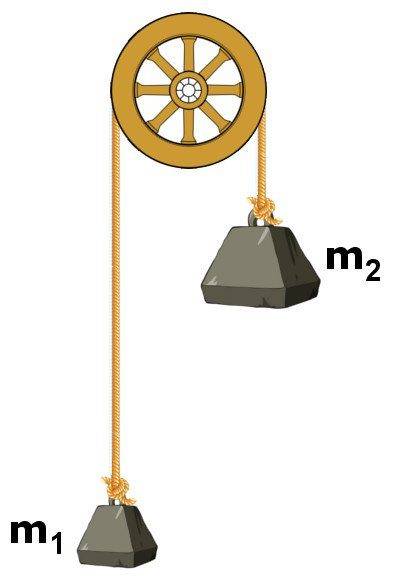
An-ATWOODs-machine-concept.jpg


I've found 9.27 m/s² and have to say what could have caused this slight gap. They say that there is no friction in this experiment.

I can't really manage to find any (the time has by the way been measured with an ultra slow mo camera...).

If you could help me I would be very thankful!
 
Last edited by a moderator:
Physics news on Phys.org
Apart from the fact that frictionless doesn't exist in real life, what do you think might have been responsible? And how long was the rope? How was the acceleration measured?
 
Ellio said:
I've found 9.27 m/s² and have to say what could have caused this slight gap. They say that there is no friction in this experiment.
I think investigating the effects of friction would be a good start. Can you post the relevant equations for friction in this experiment, and deduce whether including the forces of friction would give you a higher or lower value for the gravitational acceleration constant g? Can you think about any other forces that might have been present? How fast did the weights end up going?
 
You are looking for an error of 5.5%. If we are to help you will need to post full details of the set-up, the process, the data collected, and your calculation.
 
The book claims the answer is that all the magnitudes are the same because "the gravitational force on the penguin is the same". I'm having trouble understanding this. I thought the buoyant force was equal to the weight of the fluid displaced. Weight depends on mass which depends on density. Therefore, due to the differing densities the buoyant force will be different in each case? Is this incorrect?

Similar threads

Replies
2
Views
2K
  • · Replies 29 ·
Replies
29
Views
5K
  • · Replies 3 ·
Replies
3
Views
5K
Replies
17
Views
9K
  • · Replies 3 ·
Replies
3
Views
6K
Replies
9
Views
7K
Replies
3
Views
4K
  • · Replies 1 ·
Replies
1
Views
4K
  • · Replies 1 ·
Replies
1
Views
12K
  • · Replies 1 ·
Replies
1
Views
3K