Small error in calculating the value of g with an Atwood machine

Click For Summary

Homework Help Overview

The discussion revolves around a physics practical test involving an Atwood machine, where the original poster has calculated the gravitational acceleration to be 9.27 m/s². They are seeking to understand potential sources of error that could account for this discrepancy, given that the experiment is stated to be frictionless.

Discussion Character

  • Exploratory, Assumption checking

Approaches and Questions Raised

  • Participants question the validity of the frictionless assumption and explore other potential sources of error. They inquire about the specifics of the experimental setup, including the length of the rope and the method of measuring acceleration.

Discussion Status

There is an ongoing exploration of possible errors, with some participants suggesting that the effects of friction should be investigated. Others emphasize the need for more detailed information about the experimental setup and data collection to provide meaningful assistance.

Contextual Notes

Participants note that real-life conditions may introduce friction, despite the experiment's assumptions. There is a mention of a 5.5% error margin that the original poster is trying to account for.

Ellio
Messages
19
Reaction score
1
Homework Statement
none
Relevant Equations
none
Hello, I hope you are very well !

I have a physics practical test where I have to find the gravitational acceleration with the Atwood machine:
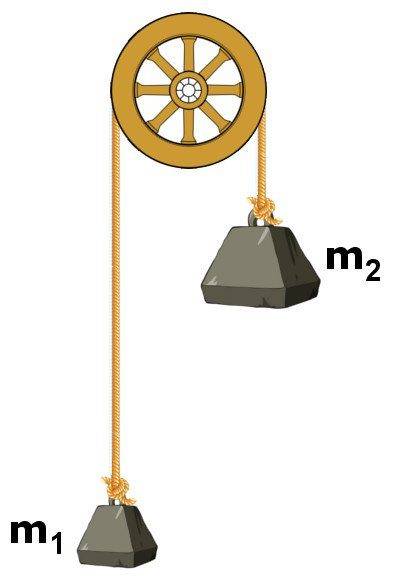
An-ATWOODs-machine-concept.jpg


I've found 9.27 m/s² and have to say what could have caused this slight gap. They say that there is no friction in this experiment.

I can't really manage to find any (the time has by the way been measured with an ultra slow mo camera...).

If you could help me I would be very thankful!
 
Last edited by a moderator:
Physics news on Phys.org
Apart from the fact that frictionless doesn't exist in real life, what do you think might have been responsible? And how long was the rope? How was the acceleration measured?
 
Ellio said:
I've found 9.27 m/s² and have to say what could have caused this slight gap. They say that there is no friction in this experiment.
I think investigating the effects of friction would be a good start. Can you post the relevant equations for friction in this experiment, and deduce whether including the forces of friction would give you a higher or lower value for the gravitational acceleration constant g? Can you think about any other forces that might have been present? How fast did the weights end up going?
 
You are looking for an error of 5.5%. If we are to help you will need to post full details of the set-up, the process, the data collected, and your calculation.
 

Similar threads

Replies
2
Views
2K
  • · Replies 29 ·
Replies
29
Views
5K
  • · Replies 3 ·
Replies
3
Views
6K
Replies
17
Views
9K
  • · Replies 3 ·
Replies
3
Views
6K
Replies
9
Views
7K
Replies
3
Views
4K
  • · Replies 1 ·
Replies
1
Views
4K
  • · Replies 1 ·
Replies
1
Views
12K
  • · Replies 1 ·
Replies
1
Views
3K