Small oscillation equation derivation

  • Context: Graduate 
  • Thread starter Thread starter unscientific
  • Start date Start date
  • Tags Tags
    Derivation Oscillation
Join the discussion
Ask a follow-up here, or get your own question answered by working scientists, mathematicians and engineers — people, not an autocomplete.
Real named experts · corrections over time · the nuance an AI answer skips
21 replies · 5K views
unscientific
Messages
1,728
Reaction score
13
Hi guys, I have been trying to find the "floppy" resonant mode frequency of a simple oscillator. The displacement is in the order of nanometers, while the dimensions of the oscillator is in cm. I think small angle approximations apply here. I got to the point of the equation of motion, but I have no idea how to solve it.The equation for the shear modulus is defined. I used it to find the force.

I related force to torque.

I used maclaurin's expansion on cos θ and tan θ to approximate the equation in terms of θ.
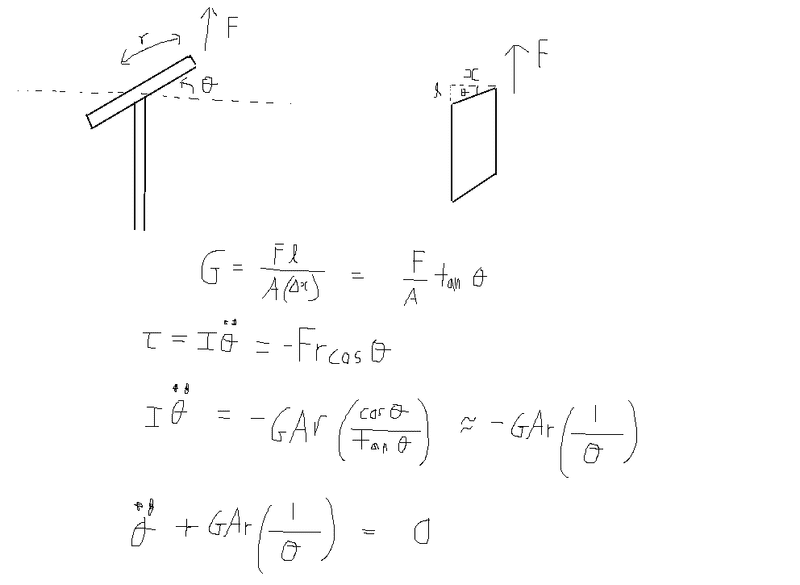
oscillator1.png


Would appreciate any help.
 
Last edited:
Physics news on Phys.org
hi unscientific! :smile:

you have θ'' = -C/θ

the standard trick to get a first integral is to multiply both sides by θ' to get …

θ'θ'' = -Cθ'/θ …

which integrates, and square-roots, to θ' = √(B - 2C*lnθ) :wink:

(how you get past that, I've no idea :redface:)
 
  • Like
Likes   Reactions: 1 person
Thanks tim, I've tried wolframalpha but it gave a non-analytical solution..
 
Expand C/θ in Taylor series around its equilibrium position and consider (by decree) that the higher order terms are negligible (That's what is usually meant by small oscillations)
 
No, wait, you can't do that. There seems to be something wrong with your equation. Expand cosθ around its equilibrium position instead.
 
Yes, there's definitely something wrong with your equation. The torque should be proportional to θ, not its inverse. Double check
 
dauto said:
Yes, there's definitely something wrong with your equation. The torque should be proportional to θ, not its inverse. Double check

I can't see what's wrong with my equation..
 
You should have sinθ in your equation instead of cosθ. The angle θ in your picture is not the angle between F and r.
 
dauto said:
You should have sinθ in your equation instead of cosθ. The angle θ in your picture is not the angle between F and r.

the torque is r x F, which gives cosθ instead.
 
nasu said:
Can you do a better (clearer) drawing? And what is the relationship between the two figures?

The figure on the right represents the part of the rod that's connected to the bob.
 
So that' part of a rod? I am sorry, I cannot imagine your system from these drawings.
Maybe someone else.

Is there a real system you are trying to model?
 
nasu said:
So that' part of a rod? I am sorry, I cannot imagine your system from these drawings.
Maybe someone else.

Is there a real system you are trying to model?

A force is applied on the disc, which is attached to the rod. As a result, the rod flexes.
 
nasu said:
So what represent the right side of your drawing? The disk or the rod?

the right side represents the flexing of the rod.
 
nasu said:
I am sorry. It's even more confusing for me. It looks like a sort of shear deformation to me.

Ok. The picture on the right is simply the part of the rod that is connected to the bob at the top. When the bob rotates, the rod flexes.
 
I cannot see any picture at all.
 
voko said:
I cannot see any picture at all.

It's in the first post.
 
unscientific said:
It's in the first post.

It does not work for me. Can you attach it here or use some other image hosting facility?
 
voko said:
It does not work for me. Can you attach it here or use some other image hosting facility?


Does this work?

28rmvc6.png
 
There are multiple problems with the derivation.

First, it is not correct to assume that the force is applied at some point and causes the rod to flex. Instead, the motion of the bob stresses the rod, and the restoring force (or torque) is generated. This torque is then applied to the bob, resulting in its oscillation.

Second, why are you dealing with the shear stress when the modes of vibrations you are after are flexural? My memory on the beam theory is rusty, but if I remember correctly, shear becomes important only with thick beams?

Third, can you really assume that all the flexing will be at the joint? It is much more reasonable to expect that the entire rod will be bending.