Brianrofl
- 21
- 0
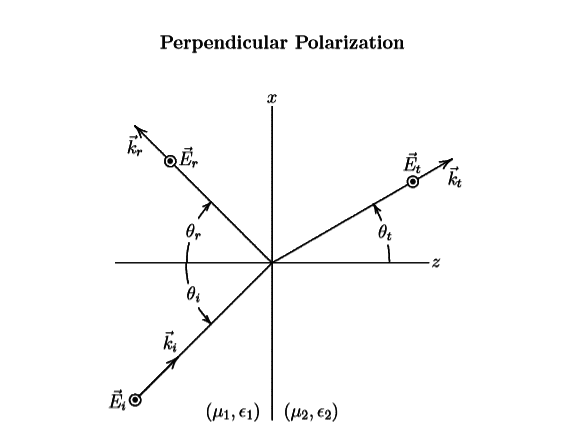
Hi, I have a plane-wave incident upon a planar interface that is perpendicularly polarized with an electric field directed out of the page in the y-hat direction, perpendicular to the x-z plane of incidence. An image of the incident plane:
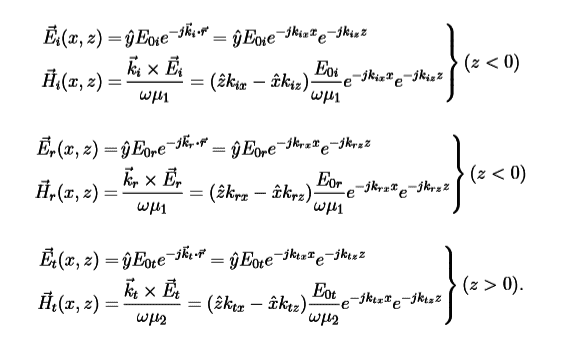
I'm also given the general expressions for the incident, reflected, and transmitted waves for perpendicular polarization:
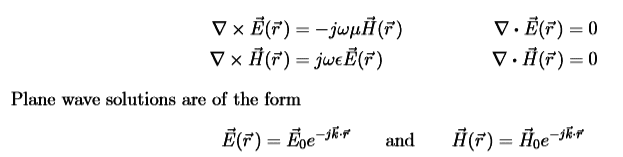
Some relevant eqns (just maxwell equations and solutions):
Alright, so what I need to do here is obtain the expressions of E for a parallel polarization, rather than perpendicular. The solution should come from duality, which I assume also comes from maxwell equations.
What I do know is that the solution is obtained from the perpendicular incidence of H. Do I simply use the above maxwell equation Del x H = jweE(r), and take the curl of each H(x,z) equation to obtain E for the parallel case?
I'm not looking for the solution, but if someone could just point me in the right direction here I'd appreciate it.
I'm also given the general expressions for the incident, reflected, and transmitted waves for perpendicular polarization:
Some relevant eqns (just maxwell equations and solutions):
Alright, so what I need to do here is obtain the expressions of E for a parallel polarization, rather than perpendicular. The solution should come from duality, which I assume also comes from maxwell equations.
What I do know is that the solution is obtained from the perpendicular incidence of H. Do I simply use the above maxwell equation Del x H = jweE(r), and take the curl of each H(x,z) equation to obtain E for the parallel case?
I'm not looking for the solution, but if someone could just point me in the right direction here I'd appreciate it.
