20W solar panel not charging 18Ah battery fast enough for nightly LED lights
- Thread starter Wolst73
- Start date
-
- Tags
- Project Solar Solar panel
Join the discussion
Registration is free. Start your own thread to ask a follow-up.
153 replies · 22K views
Engineering news on Phys.org
Wolst73
- 56
- 7
OmCheeto said:configuration: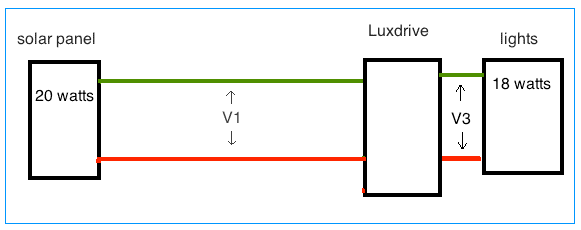
Ok, here we go. Bright sunny day. Measurements taken between 12:30 and 1pm. Panel pointed directly at sun.
V1: 4.42v
V3: 16.26v
Measured amps at green line(negative) between Lux and lights: 0.02amps
Repeated Jim's tests with both the 10a and 30a charge controller. Same results as before and negligible difference between the 2 controllers.
Interesting the 30a controller had the green light showing battery was good, whereas when I plugged it into the 10a it showed red still.
Hope that sheds some more light. (Ha, no pun intended)
Wolst73
- 56
- 7
Did last post with results go through? Any thoughts? Panel issue?
OmCheeto
Gold Member
- 2,536
- 3,663
Wolst73 said:Did last post with results go through? Any thoughts? Panel issue?
Had to go do social responsibilities yesterday.
Your readings look like operator error to me.
So this morning, I'm doing as close as I can to the same experiment, without a constant current driver.
In your defense, I hooked up my spaghetti wiring wrong the first time, and also came up with gibberish.
Things are looking better now.
I also got out an ancient analog multimeter I picked up at a garage sale for $1.00 this spring, and have refined and eliminated many of the myriad of unknowns.
My 33.6 meters of wire which runs to my panel, as I have to chase sunlight around my yard, measures 1.65 ohms, which means it's 22 gauge.
I also eliminated all of my 0.05 ohm test leads, replacing them with eentsy weentsy little clothes line clips.
Still waiting for the sun to come out...
Interesting that I'm getting as much power out of the panel, given the conditions.
Code:
V no load      V loaded    amps       watts
19.27           10.83      0.712      7.71096
18.72            6.44      0.421      2.71124
Wolst73
- 56
- 7
OmCheeto said:without a constant current drive
Does my driver replace resistor? Hook positive amp terminal to positive output of driver and -ve amp to -ve of panel?
OmCheeto
Gold Member
- 2,536
- 3,663
Wolst73 said:Does my driver replace resistor? Hook positive amp terminal to positive output of driver and -ve amp to -ve of panel?
What does "-ve" mean?
Wolst73
- 56
- 7
Negative. Don't know why I abbreviated that one but not positive.
Wolst73
- 56
- 7
OmCheeto said:Your readings look like operator error to me.
I'm sure you're right! All results look funny?
V1 reading was done by connecting solar panel to Lux drive and measuring voltage at that connection. V3 reading was done at connection of lux output to led lights (lights on but not bright) and measuring there.
Amp reading was done by disconnecting negative wire of lux drive output from led lights and connecting positive amp meter terminal to that wire and negative amp terminal to the negative wire of led lights.
I saw on your second picture u had the amp meter negative terminal connected to negative solar panel and positive amp meter terminal to the positive output of the resistor. Using that set up, should I have connected negative amp meter terminal to solar panel and positive amp meter terminal to positive output from Lux?
OmCheeto
Gold Member
- 2,536
- 3,663
Wolst73 said:I'm sure you're right! All results look funny?
V1 reading was done by connecting solar panel to Lux drive and measuring voltage at that connection. V3 reading was done at connection of lux output to led lights (lights on but not bright) and measuring there.
Amp reading was done by disconnecting negative wire of lux drive output from led lights and connecting positive amp meter terminal to that wire and negative amp terminal to the negative wire of led lights.
I saw on your second picture u had the amp meter negative terminal connected to negative solar panel and positive amp meter terminal to the positive output of the resistor. Using that set up, should I have connected negative amp meter terminal to solar panel and positive amp meter terminal to positive output from Lux?
Because these are such simple circuits, and you are using digital meters, the polarity of the meter leads is irrelevant. All that matters is that they be hooked into the correct place in the circuits.
Wolst73
- 56
- 7
OmCheeto said:Your readings look like operator error to me.
Repeated tests:
Where is the error of my ways?
Last edited:
Science Advisor
Gold Member
- 5,661
- 4,509
I found a site for worldwide weather and insolation information.
http://eosweb.larc.nasa.gov/sse
(The site doesn't work with very old browsers 'cause they use a more recent encryption protocol than was available in the past.)
On the left side of their page, click on Meterology and Solar Energy.From there you can select which data you want for your location. Remember that Longitude is "-" (negative) for the Western hemisphere. It looks like your cloudless days occur only 10% to 30% of the time depending on season. (I used 43 to 44 Lat. and -122 to -123 Long.)
http://eosweb.larc.nasa.gov/sse
(The site doesn't work with very old browsers 'cause they use a more recent encryption protocol than was available in the past.)
On the left side of their page, click on Meterology and Solar Energy.From there you can select which data you want for your location. Remember that Longitude is "-" (negative) for the Western hemisphere. It looks like your cloudless days occur only 10% to 30% of the time depending on season. (I used 43 to 44 Lat. and -122 to -123 Long.)
Science Advisor
Gold Member
- 5,661
- 4,509
Yup, definitely underpowered, it's the cause we're chasing.jim hardy said:Looks to me like panel does not send enough power to controller for it to make full output.
What do other folks see ?
Bad panel, not enough panel area, not enough Sun? I think all three! Maybe panel orientation and damaged battery by now.The second one can cover for the others, but at what cost? See post #98, then factor in cloud cover from post #131.
Wolst73
- 56
- 7
Tom.G said:Bottom line is if you want to carry thru from two days of rain you will need at least ten times your current panel area.
So given my cloudy rainy winters, solar power is not a practical option? 10x current panel area just to power lights?
Any way to test battery viability? Hook up to charger and see if it charges up fully??
Science Advisor
Gold Member
- 5,661
- 4,509
Yea. And then discharge it at a known rate and see if it can supply the expected runtime. I recommend you discharge not more than 50% or so. (saves batteries that way.)Wolst73 said:Any way to test battery viability? Hook up to charger and see if it charges up fully??
OmCheeto
Gold Member
- 2,536
- 3,663
Given the length of time the battery has been fully discharged, I would take it into an automotive battery shop and have them charge it for you.Wolst73 said:So given my cloudy rainy winters, solar power is not a practical option? 10x current panel area just to power lights?
Any way to test battery viability? Hook up to charger and see if it charges up fully??
They might also be able to do a test discharge.
Science Advisor
Gold Member
- 5,661
- 4,509
Automotive shops aren't likely to have a charger small enough, or the knowledge, to handle that small a battery, especially a sealed one.OmCheeto said:I would take it into an automotive battery shop and have them charge it for you.
If you have a battery charger, you could try hooking it to your Solar Charge Controller and charge the battery through that. Just pretend the charger is the Solar Panel. Probably should monitor the battery voltage and current to see if it's working.
OmCheeto
Gold Member
- 2,536
- 3,663
jim hardy said:Looks to me like panel does not send enough power to controller for it to make full output.
What do other folks see ?
I don't see the panel!

I stopped by http://aa.usno.navy.mil/data/docs/AltAz.php that gives the angle of the sun for a given location. (I used W 123° 30', N 48° 24')
At noon today, at the southern tip of Vancouver Island, the sun was 62.1° above the horizon.
That means a 20 watt panel, laying flat on the ground, should have been generating 17.7 watts, under optimal conditions.
Obviously, with the readings indicating 1/2 watt, this was not the case.
Wolst73 said:Where is the error of my ways?
Not making friends with a local electrician.

Last edited by a moderator:
Wolst73
- 56
- 7
Found out my neighbor had a panel gathering dust in his garage. No idea on specs. Hooked it up to multimeters and was reading 20V and 0.8A. Motomaster eliminator brand. Battery is now up to 12.23V.
Now the problem. Hooked it up in omcheetos configuration to see if readings were better. V1 was around 5V if I remember right. Was hooking up amp meter when the lights went out. Appears Lux drive is now dead. It was rated for 10-32 volts in so shouldn't have been that?? 0.8 Amps way less than battery putting out?? Shite again.
Now the problem. Hooked it up in omcheetos configuration to see if readings were better. V1 was around 5V if I remember right. Was hooking up amp meter when the lights went out. Appears Lux drive is now dead. It was rated for 10-32 volts in so shouldn't have been that?? 0.8 Amps way less than battery putting out?? Shite again.
Wolst73
- 56
- 7
Tom.G said:Bizarre! What a bummer.
Not exactly what I said but was very relieved it was the Lux drive and didn't blow the LED's. That would have been a major pain to replace them. I will order new driver. I am going away for 10 days so should be here when I get back.
Battery was up to 12.52v which I don't recall ever seeing with other panel so another finger pointing at faulty panel and in 1 day! (BTW, eBay seller is still asking for more pictures of data...sent again today).
I have unhooked everything tonight as I don't trust it being hooked up and nothing else going wrong when I'm not around.
Wolst73
- 56
- 7
Hi everyone. Thought I would give you an update. When I got back I reconnected both panels to charge controller. The ammeter had also arrived so hooked it up to measure panel output to controller. Borrowed panel showed about 0.5A in optimal light (makes no difference when I unhook my panel). Let battery charge for a few days. Light on charge controller started flashing which I believed to be fully charged or switching to trickle charge. Voltage was about 13.9. Reconnected lights that night and have been on every night since. Have them set for 2 hours. Battery is down about 1/2 volt in morning. Had a couple days in a row of cloud and battery didn't quite recover the 1/2 volt used each day but full sun since and battery is gaining.
Hopefully when replacement panel arrives we will get somewhere around the 1.5A total although I have my doubts about the quality of that panel.
Thanks again for everyone's suggestions and time. Much appreciated.
Hopefully when replacement panel arrives we will get somewhere around the 1.5A total although I have my doubts about the quality of that panel.
Thanks again for everyone's suggestions and time. Much appreciated.
Wolst73
- 56
- 7
Solar powered led lights are still working fine although the cloudy winter made them very hit and miss. Bought another panel to help out. 40w 12 volt panel. Have extra power as battery gets charged fully everyday. New summer project in mind. Bought a water fountain to go in flower bed. However the pump is a 120V ac pump. (0.082amp 60hz). Original plan was to connect one of the panels to a dc to ac inverter and power it that way using the panels output as an on/off switch. Want the fountain to run during the day. After some reading, some sites say it should work, some say it is not possible.
Other option I thought of would be to buy a dc submersible pump and replace. Can get one for about $25 from amazon. Would need something to regulate the power from panel and also serve as on/off. Am I wrong in thinking that charge controller only switches to load when output from panel drops?
Which option do you think will work using my current setup?
Other option I thought of would be to buy a dc submersible pump and replace. Can get one for about $25 from amazon. Would need something to regulate the power from panel and also serve as on/off. Am I wrong in thinking that charge controller only switches to load when output from panel drops?
Which option do you think will work using my current setup?
Science Advisor
Homework Helper
- 30,594
- 7,548
You need to do a proper budget of Ahrs in and Ahrs out under the worst light conditions you want it to work. Any pond pump that's worth while will need at least 1A (24/7 i.e. 24Ahr every day) which represents a massive increase in demand. It's down to panel output AND battery Ahr capacity.
That's effectively what happens but only as a consequence of what the system does. The controller looks at the volts on the battery and so the current supplied from the panel has to be based on that. It gives as much current as needed to keep the battery from overcharging (on a bright day, the panel is obvs supplying load and charge current) . It cuts off the load if the battery volts are dangerously low and passes anything it can to the battery.Wolst73 said:Am I wrong in thinking that charge controller only switches to load when output from panel drops?
Science Advisor
Homework Helper
Dearly Missed
- 9,864
- 4,896
Triplett 630 ? A buck ? You made out like a bandit. That classic was forty dollars in 1964, a day or two's wages . That picture of it belongs in @ZapperZ 's "Green with Envy" thread.OmCheeto said:I also got out an ancient analog multimeter I picked up at a garage sale for $1.00 this spring,
To this day it remain the most desirable analog multimeter because its center scale resistance of just 4.5 ohms gives resolution to sub-one-ohm. Compare to any other analog meter.
http://www.triplett.com/wp-content/uploads/2012/11/84-183f.pdf
old jim
OmCheeto
Gold Member
- 2,536
- 3,663
What a coincidence. That's what I used it for yesterday; measuring the resistance of a 1 Ω resistor, for another PF inspired "solar" experiment.jim hardy said:Triplett 630 ? A buck ? You made out like a bandit. That classic was forty dollars in 1964, a day or two's wages . That picture of it belongs in @ZapperZ 's "Green with Envy" thread.
To this day it remain the most desirable analog multimeter because its center scale resistance of just 4.5 ohms gives resolution to sub-one-ohm. Compare to any other analog meter.
I downloaded that the same day I bought the meter, which is somewhat odd, in that I was 150 miles from home. Wifi and laptops are the bomb.
Still haven't replaced the 30 volt battery.
Though I almost never measure resistances > 10,000 Ω, so probably never will.
Wolst73
- 56
- 7
Clarification: this is not for a pond. It is a mirror ball with water coming out the top and flowing down the sides. Pumps just enough to get the water out the top. Nothing major.
After this winters experience with the LED lights, solar power is not a viable option in Victoria for the winter. I had 2 panels hooked up and with all the clouds, rain and short days, the lights rarely came on. Thus, I don't expect anything to run on the worst light days (November to March). Will be a summer feature.
Current battery is the same 12V 18ah on page 1. Have the 40w panel stated above and also the one mentioned earlier in this thread. It actually blew over in the winter and cracked but is still working. Going to try to seal the glass to keep as much moisture out. Have an extra battery as well (12v 3ah). So could potentially make a separate system with its own panel.
So question is, use battery or panel connected to dc to ac inverter and use original pump (if this is even possible) or use battery connected to a replacement dc pump. Assuming you would need something to regulate amp? Also something that senses light to turn circuit on?
What would you electrical experts do??
After this winters experience with the LED lights, solar power is not a viable option in Victoria for the winter. I had 2 panels hooked up and with all the clouds, rain and short days, the lights rarely came on. Thus, I don't expect anything to run on the worst light days (November to March). Will be a summer feature.
Current battery is the same 12V 18ah on page 1. Have the 40w panel stated above and also the one mentioned earlier in this thread. It actually blew over in the winter and cracked but is still working. Going to try to seal the glass to keep as much moisture out. Have an extra battery as well (12v 3ah). So could potentially make a separate system with its own panel.
So question is, use battery or panel connected to dc to ac inverter and use original pump (if this is even possible) or use battery connected to a replacement dc pump. Assuming you would need something to regulate amp? Also something that senses light to turn circuit on?
What would you electrical experts do??
Science Advisor
Gold Member
- 5,661
- 4,509
Since your operating time and seasons are flexible, I would go with the simplest possible; a DC pump connected to a solar panel. If you need the water flow while a cloud passes by, add a battery and controller. Motors aren't real touchy about applied voltage, DC motors vary speed with applied voltage and AC motors vary speed with applied frequency. A small DC motor wouldn't have a problem with a 25% overvoltage; assuming the flow isn't restricted, it would just pump more water! And wear out a little sooner.Wolst73 said:What would you electrical experts do??
Wolst73
- 56
- 7
This is the original pump (WP-450)
http://jebaopump.com/products/wp-450-replacement-pump-rwp-450-submersible-fountain-pump
This is what I found that had similar flow rates
https://www.amazon.com/dp/B00C6XNB50/?tag=pfamazon01-20
http://jebaopump.com/products/wp-450-replacement-pump-rwp-450-submersible-fountain-pump
This is what I found that had similar flow rates
https://www.amazon.com/dp/B00C6XNB50/?tag=pfamazon01-20
Wolst73
- 56
- 7
Tom.G said:f you need the water flow while a cloud passes by, add a battery and controller.
That's a good idea. My controller has a few minute delay before it switches to load so hopefully cloud would have passed. Is there a controller without a delay?
how would you wire it so that pump is running directly off panel when there is enough sunlight and switch to battery when it's power output drops? (Jim's schematic pictures would be great!)