Properly producing TDR on PNA network analyzer N5224B

  • Thread starter yefj
  • Start date
17 replies · 3K views · last reply
yefj
Messages
165
Reaction score
2
Hello, my pna port1 is connected to a resonator.
the resonator is connected to pna threw a good line 30cm long.
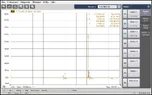
I made S11 of 10Mhz to 40Ghz and converted to time domain(probably pna doing ifft) as you can see in the photos.
the time resopnce is very bad.
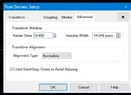
There is a menu I have to the time domain shownin the photo.
What setting could make my TDR better looking so I could see the reflections from the load of port 1 ?
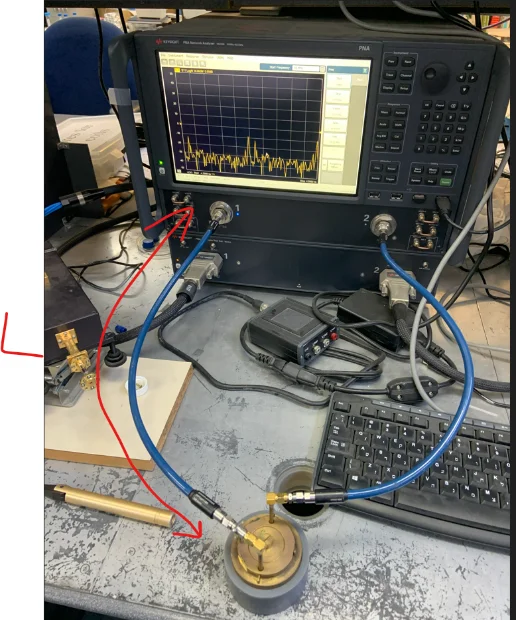
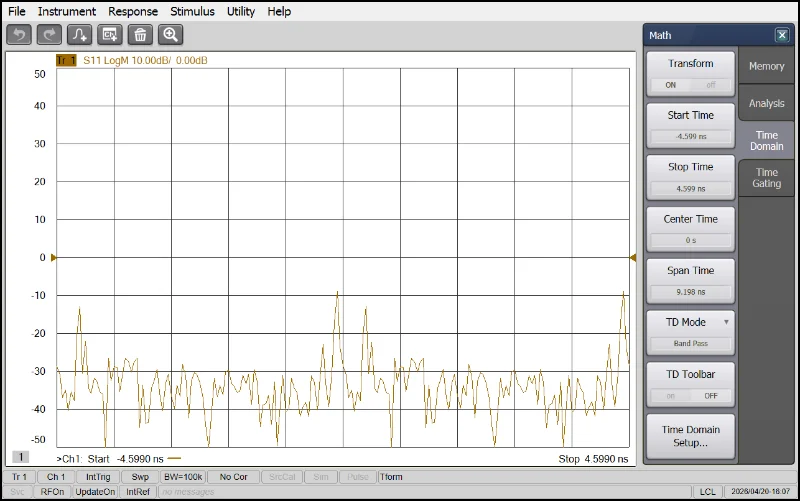
Photo of a PNA network analyzer displaying a noisy, jagged time-domain trace on its screen, with a blue coaxial cable running from port 1 to a brass resonator fixture on the bench.


Analyzer screen showing a time domain S11 trace in LogM, 10 dB per division, from -4.599 ns to 4.599 ns, with a noisy trace around -30 to -40 dB and two peaks near -10 dB at about -4 ns and +4 ns.
 
Last edited by a moderator:
If you are measuring S11, why are connecting another coax cable to the 2nd VNA port? For S11 you should only need one connection to the resonator. You can just terminate the output of the resonator in a 50 Ohm coax terminator.

What frequency is the resonator tuned to? Can you show S11 in the frequency domain for reference? How does that measurement change if you connect the resonator directly to Port 1 of the VNA with just a coax adapter instead of through a 30cm coax cable?

(Very nice instrument, BTW.) :smile:
 
yefj said:
What setting could make my TDR better looking so I could see the reflections from the load of port 1 ?
Since it is computing the time domain from the frequency domain, it might have 'automatic fixture removal' software running that will remove the connection cables from the frequency domain network analysis. That would remove the cables from your computed TDR.
 
Hello , lets take a simpler case, I have an open on the end of the cable so reflection is -1.
so the reflected signal cacels the original one after a round trip. T(2*L/V)
I expect the see a TDR ash shoqwn below.
but in reality ash you can see in the TDR I got its totally different.
also I attached the original S11.
Where did I go wrong?
Thanks.

Two formulas: Source Reflection Coefficient Γs = (Zs − Zo)/(Zs + Zo) and Load Reflection Coefficient Γld = (Zld − Zo)/(Zld + Zo).

Hand-drawn sketch of a step-and-pulse voltage waveform versus time, with a vertical axis labeled V source and a level marked Vp; a sharp step rises to Vp, then drops back down, with an annotation reading reflection came back.

Photo of a lab bench showing a network analyzer screen with a yellow trace, a blue coaxial cable running to a test fixture with brass connectors on a black mounting block, and a keyboard at right.

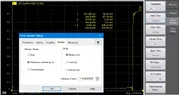
Screenshot of a Time Domain Setup dialog on a network analyzer, Transform tab selected with Transform On checked, Start -10.000000 nsec, Stop 10.000000 nsec, Center 0 fsec, Span 20.000000 nsec, Band Pass mode selected; yellow trace on the grid behind.

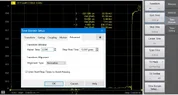
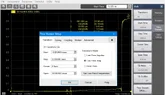
Screenshot of a Time Domain Setup dialog on a network analyzer, Advanced tab selected, showing Kaiser Beta 6.000, Impulse Width 48.873 psec, and Alignment Type Normalize; a yellow trace is visible behind the dialog.

Vector network analyzer screen showing an S11 LogM trace from 10 MHz to 40 GHz, 10 dB per division, with a handwritten label S11 above; the trace stays near 0 dB then dips sharply near 15 GHz, 25 GHz and 35 GHz.

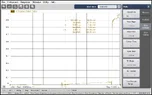
Screenshot of a network analyzer in time domain mode showing S11 LogM over -10 ns to 10 ns, with noisy peaks around 0 to 2 ns and a large spike near 8 ns on a -8 to -108 dB scale.
 
You are plotting with a dB Log vertical axis in time mode. Try plotting with a linear vertical scale like in a TDR, the noise floor grass should disappear.

In the time domain plot, the decaying oscillations at +0ns and at +4ns suggest a BP filter is corrupting the low-frequency DC signal, while hiding the high-frequency TDR step.

A TDR employs a fast rise DC pulse, while S-parameter analysis employs AC coupling. The filter should be turned off.

Is there any documentation on how to set up the PNA to do a TDR?
 
hello balun core_I have attached the tdr in linear scale few questions:
1.what is meaning of the y axes?
for example marker 2 of the photo we have is 4.22ns and yaxes 567mu
what is "mu"?
2. I saw in other manuals the keiser coeffient shownin the photos.What theoretically is the best way to get TDR as clear as possible?
Also the Help manual is attached.
Thanks.
 
Attachments
  • Screenshot of the Time Domain Setup dialog on a network analyzer, Advanced tab, showing Kaiser Beta 6.000, Impulse Width 44.940 psec, Alignment Type Normalize, and Limit Start/Stop Times to Avoid Aliasing checked.
    kaiser_beta_setup.webp
    18.3 KB · Views: 24
  • time_gating_setup.pdf
    time_gating_setup.pdf
    732.9 KB · Views: 28
  • Time-domain reflectometry trace on a vector network analyzer, S11 linear magnitude, Start -10.000 ns, Stop 10.000 ns, with Marker 2 at 4.224863 ns and a sharp reflection peak near 4.2 ns.
    tdr_linear.webp
    29.3 KB · Views: 28
Help manual, page 7, see the green plot examples.
Experiment with different transform modes.
It seems you were using an "Impulse Mode".
You need to use "Low-pass Step Mode" to see the transmission lines.

On the Keysight N5224B PNA Microwave Network Analyzer, mU stands for milli-Units, representing a linear magnitude value multiplied by 10-3. It is a unit often used in linear magnitude formats for S-parameters, where the values are small.
 
Hello Baluncore,few questions:
1.why making pulse rise time shorter make tdr better?
2.I have transformed into time domain step responce.Is it more logical now given that port 1 cable has nothing connected to it?
3.I have shown in the photos below the Y-axes settings and how the markers look at each settings
Where can I see the impedance value? is there a way I could see it?
Thanks.
 
Attachments
  • Screenshot of a VNA time domain step response trace (S11, Tr 1) with the Time Domain Setup dialog open on the Advanced tab, showing Kaiser Beta 2.000 and Step Rise Time 13.397 psec.
    new_pulse rise_time.webp
    29.1 KB · Views: 29
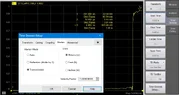
  • Screenshot of a VNA time domain trace (S11 LinM) with the Time Domain Setup dialog open on the Marker tab, Transmission marker mode and Meters units selected, and three marker readings listed on the trace.
    new_units_transmition.webp
    27.8 KB · Views: 25
  • Screenshot of a network analyzer Time Domain Setup dialog over a time-domain reflection trace, with Marker Mode set to Reflection (divide by 2) and Units set to Meters.
    new_units_reflection.webp
    28.7 KB · Views: 21
  • Screenshot of a VNA time domain setup dialog with a yellow step response trace behind it, showing a Low Pass Step transform on channel 1 from -5.025 ns to 5.025 ns, with the Time Domain side menu visible.
    new_time_setting_1.webp
    33.3 KB · Views: 18
  • Screenshot of a VNA time-domain reflection plot (Tr 1, S11) showing a step-like trace that rises sharply near 5 ns with three markers and reflection distance readings.
    new_time_domain_plot.webp
    30.6 KB · Views: 19
yefj said:
1.why making pulse rise time shorter make tdr better?
It improves the spatial resolution of the reflected features. The spatial resolution is on the order of the rise time. If you want to see ##Z_0## discontinuities that are, say, 1cm in extent, you will need a TDR pulse risetime which corresponds to that length in the medium.
 
yefj said:
1.why making pulse rise time shorter make tdr better?
https://en.wikipedia.org/wiki/Gibbs_phenomenon#Description
If the rise-time of the step is only 1ns then you can only see big or long discontinuities in the impedance of the line.
As the rise-time becomes shorter, the bandwidth becomes greater, and the linear resolution is improved.
yefj said:
2.I have transformed into time domain step responce.Is it more logical now given that port 1 cable has nothing connected to it?
Terminate the port 1 cable with a resistive mismatched.
yefj said:
Where can I see the impedance value? is there a way I could see it?
The voltage, maps to reflection coefficient, ρ (rho), then to impedance relative to Zo. The vertical axis range is from:
1.0V, with ρ = +1, infinite ohms.
0.5V, with ρ = 0, at Zo.
0.0V, with ρ = -1, at zero ohms.

Zline = Zo * (1+ρ) / (1-ρ)
 
Hello baluncore,few questions:
1.What is the math for 0.5V , with ρ = 0, at Zo.
2.in straight cable its easy velocity factor.
What about a PCB? How in PCB we find the velocity factor?
Thanks.
Text reading: in the usual case where the relative permeability, μr, is 1. In the most general case: followed by the equation VF = 1 / √(μr εr).
Equation: TDR Length = (c * v * T_d) / 2, with c and v in the numerator and T_d subscripted, divided by 2.


Screenshot of a VNA time-domain plot of S11 in linear magnitude, showing reflection peaks at 0 ns and near 4.86 ns with a marker table listing distances in mm.

Typed worked calculation of a cable length from a time delay: velocity factor 1, Td = 4.86 ns, L = c·v·Td/2 with c = 3×10^8 m/s, giving L = 0.729 m.
 
Last edited:
yefj said:
1.What is the math for 0.5V , with ρ = 0, at Zo.
ρ = 0; is a perfect impedance match.
Zline = Zo * (1+ρ) / (1-ρ)
Zline = 50 * ( 1 + 0 ) / ( 1 - 0) = 50 ohms.

yefj said:
2.in straight cable its easy velocity factor.
What about a PCB? How in PCB we find the velocity factor?
vf ≈ 1/√εr ; where εr is the relative permittivity of the PCB insulator material. That assumes the transmission lines on the PCB are on opposite sides of the PCB, so most of the field is in the dielectric, not the air.
 
Hello Baluncore, regarding your good advices:
1.you said that 0.5V is ρ = 0.so I assume you are doing voltage divider math.
Where the pulse amplitude is 1V source resistance is 50ohms and line impedance is 50 ohms.
2.How did you know that the input is 1V?
3.How did you know that the Y axes is voltage in my plot?

3.this very intresting so in general we can use vf ≈ 1/√εr . is there more cool tricks to find phase velocity in the lab?
I can read theoretical phase velocities . Is there more practical methods in the lab to exract precise phase velocity of the medium a signal is travelling in?
Thanks

https://eng.libretexts.org/Bookshel.../03:_Transmission_Lines/3.11:_Microstrip_Line
 
yefj said:
1.you said that 0.5V is ρ = 0. so I assume you are doing voltage divider math.
It is not that simple. It is ρ math, in reflection coefficient space.
Voltage varies from 0 to 1.
Reflection coefficient ρ, varies from = -1 to +1.
Impedance varies from zero to infinity.

yefj said:
2.How did you know that the input is 1V?
Because you wrote:
yefj said:
1.What is the math for 0.5V , with ρ = 0, at Zo.
2 * 0.5V = 1V.

yefj said:
3.How did you know that the Y axes is voltage in my plot?
The step is a voltage step, and the Units range from 0U to 1U on the plot.

Nearly all 'close-in' metal TDR is done with 1V steps, into 50 ohms. That is because the fastest steps are produced by Step Recovery Diodes. Slower steps, but with higher voltage, come from transistor avalanche breakdown.

Slow rise-time steps can be quickened by using a non-linear transmission line. NLTLs are fabricated on a chip, using a ladder of Schottky varactor diodes, linked by inductors. In effect, a voltage soliton wave is generated in the NLTL, which steepens one edge of a square wave, but slows the other.
Solitons are like shock waves, so the lines that shape them are sometimes called shocklines.

yefj said:
... is there more cool tricks to find phase velocity in the lab?
Yes. Make a known length dipole out of a transmission line. Find the resonant frequency, and so compute the wavelength in free space. You can then compute the vf, and so estimate Er for the insulation.

There is no end to the possibilities. Remember that: "A month in the laboratory can often save an hour in the library." — Frank Westheimer.
 
Hello Baluncore,two questions regarding your good advices.
1.How do you convert mathematickally voltage 0-1 into reflection coeeficient?
2.As shown in photos belowIn transmission mode we have 1.46m disance in reflection mode its 728mm,
why there is such a big difference in the length ?


Screenshot of a network analyzer time-domain trace with a Time Domain Setup dialog open on the Marker tab, showing Transmission selected and Meters units, with marker readings in ps and mm and m.

Screenshot of a network analyzer time-domain trace (S11, Tr 1) with a Time Domain Setup dialog open on the Marker tab, showing Reflection (divide by 2) selected and Meters units; markers read 301.500 ps, 22.56 mU, 728.90 mm and 4.863 ns.

link the phase
 
Attachments
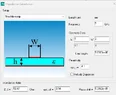
  • Screenshot of the Impedance Calculation dialog for a thin microstrip line with h = 1 mm, W = 2 mm, line length 5 mm, frequency 5 GHz, eps_r 4.1, giving Z_0 50.47 Ohm, eps_eff 3.14, phase shift 53.1620.
    1777143355240.webp
    25 KB · Views: 19
yefj said:
Hello Baluncore,
@yefj Just write @Baluncore and I will be notified that you have addressed me in the post.

yefj said:
1.How do you convert mathematickally voltage 0-1 into reflection coeeficient?
ρ = 2 * ( v / Vin ) - 1 ;
Where Vin is the incident pulse voltage, and v is the displayed voltage.

yefj said:
2.As shown in photos below In transmission mode we have 1.46m disance in reflection mode its 728mm,
why there is such a big difference in the length ?
It is simply for your convenience. The distance, to the discontinuity and back, is twice as long as the distance to the discontinuity.
728mm * 2 = 1456mm.

Reflection mode quotes the one-way distance from the start to the discontinuity, (the fault in the cable). Transmission mode quotes the two-way distance, from the start to the discontinuity, and back again to the start.

How do you get to play with a $100k Keysight Agilent N5224B ?
 
Hello ,few questions regarding your good presentation:
1.reflection coefficient is shown in the formula, If we know Zo then if we know reflection coefficient then we know the reflection impedance of the TDR.
How does the VNA know what is Zo (characteristic line impdance)
2.How Do I set in the VNA basic reflection coeffient as shown by rho in the formula?

3 .In the last photo in the end I have mU Y axes.If I understand correctly its voltage .
In order to convert this voltage into reflection coefficient then I need to use the following formula.
How do We know from the VNA that the pulse have 1V amplitude?

4.This is just a device we have in our university lab :-) I didt know its so expensive.
Thanks.


Equation rho = 2 * (v / Vin) - 1, with the caption: Where Vin is the incident pulse voltage, and v is the displayed voltage.

Typeset formula for transmission line reflection coefficient: rho equals (Z_term minus Z_0) divided by (Z_term plus Z_0), with definitions of Z_term as terminal impedance in ohms and Z_0 as characteristic impedance in ohms.

Two Keysight PNA menu screenshots titled Set Time Domain parameters 2 of 3: Math and Format softkey panels with callouts for Conversions, Analysis, Math, Lin Mag and Format 1.

Screenshot of a VNA time-domain plot titled S11 LinM, showing a reflection trace with y-axis from 0 to 1 and x-axis from -5.0250 ns to 5.0250 ns, with marker readouts including distance in mm.
 
yefj said:
How does the VNA know what is Zo (characteristic line impdance)
2.How Do I set in the VNA basic reflection coeffient as shown by rho in the formula?
RF instruments are generally manufactured to have an input impedance of 50 ohms, so they can be connected to other RF modules through standard 50 ohm cable.

yefj said:
3 .In the last photo in the end I have mU Y axes.If I understand correctly its voltage .
In order to convert this voltage into reflection coefficient then I need to use the following formula.
How do We know from the VNA that the pulse have 1V amplitude?
The output driver of a TDR or VNA, is usually a low impedance, approximately 2 volt signal, that is series terminated through a 50 ohm resistor to the instrument output terminal. The signal in the external 50 ohm coaxial cable will then be about 1 volt.

The fast output pulse of a TDR is whatever amplitude it has. We would once have attached a short length of 50 ohm coax cable to the terminal, then adjusted the vertical offset and gain of the viewing oscilloscope to place zero before the step at the bottom of the screen, with the first step to 50 ohms at the centre of the screen. The reflection from the open end of that coax, would then take the signal to the top of the screen. That is now adjusted automatically by self calibration of the TDR or VNA.