Solenoid Magnetic Field calculation

Click For Summary
SUMMARY

The calculation of the magnetic field in a solenoid is primarily based on Ampere's Law, represented as ∫circ H ⋅ ds = N * I, where only the current passing through the area of the rectangle is considered. The confusion arises from the assumption that both currents (into and out of the page) contribute equally, but only the current entering the page is included due to symmetry, as the vertical components cancel each other out. For more precise calculations, especially in finite-length solenoids, Biot-Savart's Law is recommended, as it accounts for the effects of the solenoid's winding.

PREREQUISITES
  • Understanding of Ampere's Law and its application in magnetic field calculations
  • Familiarity with Biot-Savart's Law for magnetic field analysis
  • Basic knowledge of solenoid structure and function
  • Concept of magnetic field symmetry and its implications
NEXT STEPS
  • Study the derivation and applications of Ampere's Law in various geometries
  • Explore Biot-Savart's Law in detail, focusing on its use for finite-length solenoids
  • Investigate the effects of solenoid winding on magnetic field strength
  • Review examples of magnetic field calculations in different configurations of solenoids
USEFUL FOR

Physics students, electrical engineers, and anyone involved in electromagnetic theory or applications related to solenoids and magnetic fields.

UMath1
Messages
361
Reaction score
9
I am confused about how the magnetic field of a solenoid is calculated in this image.
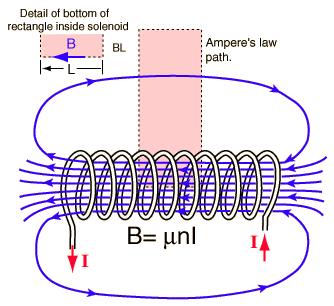
sol.gif

Why is only the current going into the page included in calculating the magnetic field? Shouldn't the field be twice the amount calculated because there is a magnetic field generated by the part of the turns the bottom with current going out of the page? And I don't understand why the vertical components of the path are taken to be zero. Although it is said that the field is perpendicular, the diagram shows that there is a portion of the field parallel to the vertical path.
 
Physics news on Phys.org
Yes. But it doesn't answer my question.
 
UMath1 said:
Why is only the current going into the page included in calculating the magnetic field? Shouldn't the field be twice the amount calculated because there is a magnetic field generated by the part of the turns the bottom with current going out of the page?
Ampere's law is used.
It says that only the current passing through the area of the rectangle is to be included in the calculation:

circ H ⋅ ds = N * I

UMath1 said:
And I don't understand why the vertical components of the path are taken to be zero.

They are not taken to be zero, but they cancel each other due to symmetrical reasons. The formula is only valid as for the center of the solenoid.

The upper side of the rectangle is assumed to be so far away, that it has no influence, so this horizontal component is taken to be zero.
You are the one to sketch the rectangle.
 
Yes I understand that. But if you use ampere's law that way, the circular winding of the wire seems to have no bearing on the field inside the wire. I thought that the field inside the solenoid is increased because of the winding if the wire.
 
UMath1 said:
But if you use ampere's law that way, the circular winding of the wire seems to have no bearing on the field inside the wire. I thought that the field inside the solenoid is increased because of the winding if the wire.
I'm not using Ampere's law that way, just using Ampere's law.

If you want a "bearing", you must use Biot-Savart's law. It doesn't need symmetry, infinite length of the solenoid, and so on.

Biot-Savart is accurate in case of finite length of the solenoid. Ampere is an approximation.
 

Similar threads

Replies
5
Views
2K
  • · Replies 5 ·
Replies
5
Views
1K
  • · Replies 2 ·
Replies
2
Views
2K
  • · Replies 5 ·
Replies
5
Views
3K
  • · Replies 3 ·
Replies
3
Views
1K
  • · Replies 5 ·
Replies
5
Views
1K
  • · Replies 42 ·
2
Replies
42
Views
3K
  • · Replies 8 ·
Replies
8
Views
2K
  • · Replies 3 ·
Replies
3
Views
2K
  • · Replies 5 ·
Replies
5
Views
2K