onkel_tuca
- 6
- 0
Hello fellow nerds,
I've come across a math problem, where I'd like to find the solution vector of a NxN square matrix. It is possible to find a solution for a given N, albeit numbers in the matrix become very large for any N>>1, and numbers in the solution vector become very small. So it's not easy to compute solutions. Anyhow I realized that the components of the solution vector seem to converge and I'm asking myself if it's possible to write down the solution for N->∞.
Here's the matrix:
\begin{equation}
\begin{pmatrix}
1&-2&[-2]^2&\dots&[-2]^{N-1}\\
1&-6&[-6]^2&\dots&[-6]^{N-1}\\
1&-12&[-12]^2&\dots&[-12]^{N-1}\\
\vdots&\vdots&\vdots&\ddots&\vdots\\
1&-N(N+1)&[-N(N+1)]^2&\dots&[-N(N+1)]^{N-1}
\end{pmatrix}
\begin{pmatrix}
a_1\\
a_3\\
a_5\\
\vdots\\
a_{2N-1}
\end{pmatrix}=
\begin{pmatrix}
1/3\\
1/5\\
1/7\\
\vdots\\
\frac 1 {2N+1}
\end{pmatrix}
\end{equation}
or:
\begin{eqnarray}
\sum_{k=1}^{N}a_{2k-1} \left[-l(l+1)\right]^{k-1}=\frac 1{2l+1}\;,
\end{eqnarray}
for all l≤N.
I'm looking for the vector a (the numbering of the index is indeed arbitrary). For instance for N=1, one finds a1=1/3. For N=2 one finds a1=2/5 and a3=1/30. And so on. I already found that a1→1/2 for N→∞. When I look at the numerical solutions, the other ai also seem to converge slowly, see the following plot:
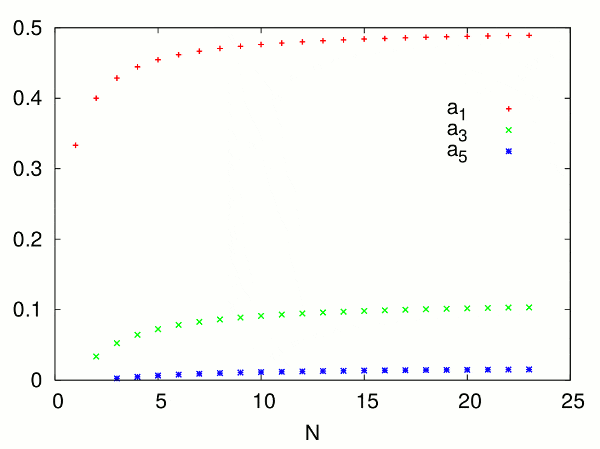
But I cannot think of a way to find these values without resorting to numerics.
Cheers, Max
I've come across a math problem, where I'd like to find the solution vector of a NxN square matrix. It is possible to find a solution for a given N, albeit numbers in the matrix become very large for any N>>1, and numbers in the solution vector become very small. So it's not easy to compute solutions. Anyhow I realized that the components of the solution vector seem to converge and I'm asking myself if it's possible to write down the solution for N->∞.
Here's the matrix:
\begin{equation}
\begin{pmatrix}
1&-2&[-2]^2&\dots&[-2]^{N-1}\\
1&-6&[-6]^2&\dots&[-6]^{N-1}\\
1&-12&[-12]^2&\dots&[-12]^{N-1}\\
\vdots&\vdots&\vdots&\ddots&\vdots\\
1&-N(N+1)&[-N(N+1)]^2&\dots&[-N(N+1)]^{N-1}
\end{pmatrix}
\begin{pmatrix}
a_1\\
a_3\\
a_5\\
\vdots\\
a_{2N-1}
\end{pmatrix}=
\begin{pmatrix}
1/3\\
1/5\\
1/7\\
\vdots\\
\frac 1 {2N+1}
\end{pmatrix}
\end{equation}
or:
\begin{eqnarray}
\sum_{k=1}^{N}a_{2k-1} \left[-l(l+1)\right]^{k-1}=\frac 1{2l+1}\;,
\end{eqnarray}
for all l≤N.
I'm looking for the vector a (the numbering of the index is indeed arbitrary). For instance for N=1, one finds a1=1/3. For N=2 one finds a1=2/5 and a3=1/30. And so on. I already found that a1→1/2 for N→∞. When I look at the numerical solutions, the other ai also seem to converge slowly, see the following plot:
But I cannot think of a way to find these values without resorting to numerics.
Cheers, Max
Last edited: