Solution To Photon Trajectory Equation

Click For Summary
SUMMARY

The discussion focuses on solving the photon trajectory equation using the Schwarzschild metric and null geodesics. The nonlinear ordinary differential equation (ODE) derived is of the form u'' + u = 3u^2, where u represents the trajectory. Participants explore perturbative expansions and the need for initial conditions to determine coefficients in the solution. The final solution incorporates parameters such as the impact parameter b, which is defined in the context of Schwarzschild spacetime.

PREREQUISITES
  • Understanding of differential equations, specifically nonlinear ODEs.
  • Familiarity with the Schwarzschild metric in general relativity.
  • Knowledge of perturbation theory and its application in physics.
  • Basic concepts of geodesics and their significance in spacetime.
NEXT STEPS
  • Study the application of perturbation theory in solving nonlinear differential equations.
  • Learn about the Schwarzschild metric and its implications for photon trajectories.
  • Explore numerical methods for solving complex ODEs, including software tools like Mathematica or MATLAB.
  • Investigate initial value problems in the context of general relativity and their physical interpretations.
USEFUL FOR

Physicists, mathematicians, and students in advanced studies of general relativity, particularly those interested in gravitational lensing and photon trajectories in curved spacetime.

LazyPhysicist1
Messages
7
Reaction score
0
TL;DR
I need help solving the nonlinear photon trajectory diffeq near a mass as derived by the Schwarzschild metric.
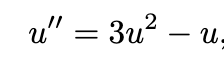
Using the null geodesic and the Schwarzschild metric, this differential equation for photon trajectory near a mass can be derived, where u is r_s /2r:

View attachment 349924

Though this nonlinear ode is fairly easy to approximate (which I already have), I'm looking for an analytic solution or an approximate analytic solution. No online calculators work, except Wolfram (for which I don't have pro), which gives me an unusably complicated solution; https://www.wolframalpha.com/input?i=y''+=+3y^2-y

Is there a way I can better solve this differential equation/approximate an analytical solution? Thanks.
 

Attachments

  • Screenshot 2024-08-15 at 09.55.10.png
    Screenshot 2024-08-15 at 09.55.10.png
    1.4 KB · Views: 63
Physics news on Phys.org
Without the gravitational term, the equation of motion is ##u'' + u = 0## i.e. ##u \sim \sin{\phi}##, which is to say that the trajectory is a straight line (specifically ##u = \tfrac{1}{b} \sin{\phi}## if the impact parameter is ##b##).

Putting in the gravitational term so that ##u'' + u = 3u^2## (with ##M=1##), you take a perturbative expansion around the previous straight line solution with expansion parameter ##1/b##. So to linear order,

##u = \frac{1}{b} \sin{\phi} + \frac{1}{b} \epsilon := u_0 + \frac{1}{b} \epsilon##

which you can plug back in (and use ##u_0'' + u_0 = 0##) to get

##\epsilon'' + \epsilon = \frac{3}{b} \frac{1-\cos{2\phi}}{2}##

This is now a classic second order ODE for ##\epsilon(\phi)## that you can solve by finding a homogeneous and particular solution. I'll leave you to try and work out the intermediate and remaining steps.
 
  • Like
Likes   Reactions: LazyPhysicist1
ergospherical said:
Without the gravitational term, the equation of motion is ##u'' + u = 0## i.e. ##u \sim \sin{\phi}##, which is to say that the trajectory is a straight line (specifically ##u = \tfrac{1}{b} \sin{\phi}## if the impact parameter is ##b##).

Putting in the gravitational term so that ##u'' + u = 3u^2## (with ##M=1##), you take a perturbative expansion around the previous straight line solution with expansion parameter ##1/b##. So to linear order,

##u = \frac{1}{b} \sin{\phi} + \frac{1}{b} \epsilon := u_0 + \frac{1}{b} \epsilon##

which you can plug back in (and use ##u_0'' + u_0 = 0##) to get

##\epsilon'' + \epsilon = \frac{3}{b} \frac{1-\cos{2\phi}}{2}##

This is now a classic second order ODE for ##\epsilon(\phi)## that you can solve by finding a homogeneous and particular solution. I'll leave you to try and work out the intermediate and remaining steps.
Thank you! I get ##\epsilon = \frac{\cos{2\phi}+3}{2b} + c(\sin{\phi} + \cos{\phi})## thus giving me a solution of

##u(\phi) = \frac{(\frac{\cos{\phi}+3}{2b} + c(\sin{\phi} + \cos{\phi}) + \sin{\phi})}{b}##, where ##b=\frac{r^2 \sin ^2 \theta}{1-\frac{2 M}{r}} \frac{d \phi}{d t}##

How do I know what c is? Also, how did you get ##u = \tfrac{1}{b} \sin{\phi}## from ##u = c \sin{\phi}##?
 
LazyPhysicist1 said:
Also, how did you get ##u = \tfrac{1}{b} \sin{\phi}## from ##u = c \sin{\phi}##?

The zero order straight line solution is ##u = \tfrac{1}{b} \sin{\phi}## because geometrically ##u = 1/r##, so that's equivalent to ##b = r\sin{\phi}## (draw a sketch).

LazyPhysicist1 said:
I get ##\epsilon = \frac{\cos{2\phi}+3}{2b} + c(\sin{\phi} + \cos{\phi})##

Almost, but the homogeneous solution can be any linear combination of sin and cos, so they need separate coefficients. It's useful to write these in the form ##C/b## and ##D/b## so that we can explicitly keep track of the perturbative order.

##\epsilon = \frac{1}{2b} (\cos{2\phi} + 3) + \frac{C}{b} \cos{\phi} + \frac{D}{b}\sin{\phi}##

and

##u = \frac{1}{b} \sin{\phi} + \frac{1}{2b^2} (\cos{2\phi} + 3) + \frac{C}{b^2} \cos{\phi} + \frac{D}{b^2}\sin{\phi}##

Choosing ##C## and ##D## amounts to specifying the orientation of the orbit. If you want the photon to fall in from the left (##x \rightarrow -\infty##), then you want ##y \rightarrow 0## as ##\phi \rightarrow \pi## and ##r \rightarrow \infty##. In this case you find ##C = 2##, for example.
 
  • Like
Likes   Reactions: LazyPhysicist1
ergospherical said:
The zero order straight line solution is ##u = \tfrac{1}{b} \sin{\phi}## because geometrically ##u = 1/r##, so that's equivalent to ##b = r\sin{\phi}## (draw a sketch).


Almost, but the homogeneous solution can be any linear combination of sin and cos, so they need separate coefficients. It's useful to write these in the form ##C/b## and ##D/b## so that we can explicitly keep track of the perturbative order.

##\epsilon = \frac{1}{2b} (\cos{2\phi} + 3) + \frac{C}{b} \cos{\phi} + \frac{D}{b}\sin{\phi}##

and

##u = \frac{1}{b} \sin{\phi} + \frac{1}{2b^2} (\cos{2\phi} + 3) + \frac{C}{b^2} \cos{\phi} + \frac{D}{b^2}\sin{\phi}##

Choosing ##C## and ##D## amounts to specifying the orientation of the orbit. If you want the photon to fall in from the left (##x \rightarrow -\infty##), then you want ##y \rightarrow 0## as ##\phi \rightarrow \pi## and ##r \rightarrow \infty##. In this case you find ##C = 2##, for example.
Got it! Thanks a lot!
 
ergospherical said:
The zero order straight line solution is ##u = \tfrac{1}{b} \sin{\phi}## because geometrically ##u = 1/r##, so that's equivalent to ##b = r\sin{\phi}## (draw a sketch).


Almost, but the homogeneous solution can be any linear combination of sin and cos, so they need separate coefficients. It's useful to write these in the form ##C/b## and ##D/b## so that we can explicitly keep track of the perturbative order.

##\epsilon = \frac{1}{2b} (\cos{2\phi} + 3) + \frac{C}{b} \cos{\phi} + \frac{D}{b}\sin{\phi}##

and

##u = \frac{1}{b} \sin{\phi} + \frac{1}{2b^2} (\cos{2\phi} + 3) + \frac{C}{b^2} \cos{\phi} + \frac{D}{b^2}\sin{\phi}##

Choosing ##C## and ##D## amounts to specifying the orientation of the orbit. If you want the photon to fall in from the left (##x \rightarrow -\infty##), then you want ##y \rightarrow 0## as ##\phi \rightarrow \pi## and ##r \rightarrow \infty##. In this case you find ##C = 2##, for example.
How do I solve for D?
 
Another initial condition, e.g. fix the initial gradient of the light ray trajectory. In truth you don't need to do this if all you want is the first order deflection, because ##(D/b^2)\sin{\theta}## is one order smaller than the first term ##(1/b)\sin{\theta}## whatever ##O(1)## constant you pick for ##D##.
 
Could you be a little more specific as to how I would determine D given initial photon direction angle a/initial gradient of light ray? I already incorporated angle a into the impact parameter.
 
You need to fix your trajectory to whatever initial conditions you want, i.e. specify a point (or a limit, e.g. infinity from the left) and a derivative along the trajectory at this point e.g. ##dy/dx## (e.g. to zero).
 
  • Like
Likes   Reactions: LazyPhysicist1
  • #10
Got it, I solved for the coefficents. One last thing; do I take b as the impact parameter rsin(theta) from the nongravitational case, or ##b=\frac{r^2 \sin ^2 \theta}{1-\frac{2 M}{r}} \frac{d \phi}{d t}##, which is the impact parameter in schwarzachild spacetime. Also, I take it to be the parameter for the initial condition right? Not the parameter for each point.
 
  • #11
ergospherical said:
You need to fix your trajectory to whatever initial conditions you want, i.e. specify a point (or a limit, e.g. infinity from the left) and a derivative along the trajectory at this point e.g. ##dy/dx## (e.g. to zero).
LazyPhysicist1 said:
Got it, I solved for the coefficents. One last thing; do I take b as the impact parameter rsin(theta) from the nongravitational case, or ##b=\frac{r^2 \sin ^2 \theta}{1-\frac{2 M}{r}} \frac{d \phi}{d t}##, which is the impact parameter in schwarzachild spacetime. Also, I take it to be the parameter for the initial condition right? Not the parameter for each point.
 

Similar threads

  • · Replies 11 ·
Replies
11
Views
2K
  • · Replies 20 ·
Replies
20
Views
2K
  • · Replies 1 ·
Replies
1
Views
1K
  • · Replies 5 ·
Replies
5
Views
1K
  • · Replies 1 ·
Replies
1
Views
1K
  • · Replies 186 ·
7
Replies
186
Views
12K
  • · Replies 14 ·
Replies
14
Views
2K
Replies
9
Views
2K
  • · Replies 52 ·
2
Replies
52
Views
8K
  • · Replies 1 ·
Replies
1
Views
2K