Discussion Overview
The discussion revolves around the feasibility and implications of sharing Covid-19 spit tests among groups, such as families or departments, as a potential solution to conserve testing resources. Participants explore theoretical models, practical challenges, and the effectiveness of such an approach in real-world scenarios.
Discussion Character
- Exploratory
- Technical explanation
- Debate/contested
- Mathematical reasoning
Main Points Raised
- One participant questions whether sharing a Covid-19 spit test is possible and seeks insights on its potential effectiveness.
- Another participant suggests that theoretically, the number of required tests could be reduced from N tests to log2 N tests for N people, but highlights practical issues such as dilution and increased error rates.
- Concerns are raised about the practicality of shared testing, particularly regarding the time it takes to identify positive cases and the potential for false negatives.
- Several participants emphasize that combining samples could lead to a dilution effect, requiring tests to be more sensitive and potentially increasing the likelihood of false results.
- Some participants argue that while the mathematical approach is valid, it may not be practical due to the complexities of sample collection and testing protocols.
- A participant mentions that similar methods have been implemented in Germany, but questions remain about their effectiveness and whether newer methods have been tested.
- Another participant proposes a method of splitting positive groups into sub-groups for further testing, suggesting that this could help manage the number of tests needed.
Areas of Agreement / Disagreement
Participants express a range of views, with some supporting the theoretical basis for shared testing while others highlight significant practical challenges. No consensus is reached on the viability of the proposed method.
Contextual Notes
Limitations include assumptions about sample sensitivity, the complexity of testing protocols, and the potential for increased error rates when combining samples. The discussion does not resolve these issues.
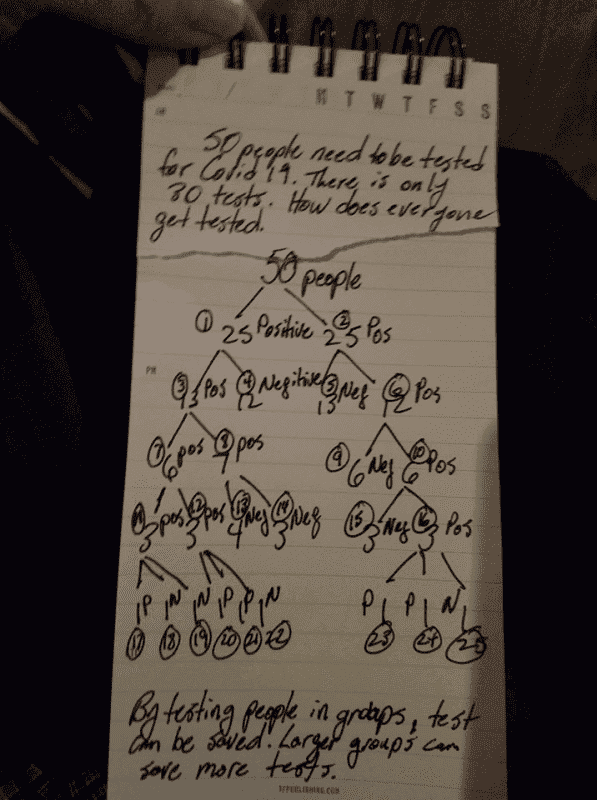 implemented to save tests.