Solve Acceleration of 2.0 kg Block in Newton's 3rd Law Problem

  • Thread starter Thread starter pingpong240
  • Start date Start date
  • Tags Tags
    Law
Click For Summary

Homework Help Overview

The problem involves a 2.0 kg block being pulled by a tension force while interacting with another block and experiencing friction. The context is rooted in Newton's laws of motion, particularly focusing on the effects of forces and friction on acceleration.

Discussion Character

  • Mixed

Approaches and Questions Raised

  • Participants discuss the setup of Newton's second law for both blocks, questioning the roles of tension and friction. There are attempts to clarify the direction of forces and the impact of friction on the acceleration of the blocks.

Discussion Status

Some participants have provided insights into the force diagrams and equations, while others express confusion about the assumptions made regarding tension and the direction of forces. There is ongoing exploration of the relationships between the blocks' accelerations.

Contextual Notes

Participants note potential misunderstandings regarding the setup of forces and the effects of friction, as well as the implications of the tension force in the system. There is a lack of consensus on the correct interpretation of the forces involved.

pingpong240
Messages
27
Reaction score
0
The lower block in Figure P8.28 is pulled on by a rope with a tension force of F = 28 N. The coefficient of kinetic friction between the lower block and the surface is 0.40. The coefficient of kinetic friction between the lower block and the upper block is also 0.40. What is the acceleration of the 2.0 kg block?
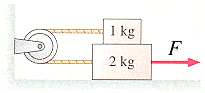
p8-28alt.gif
Relevant Equations
f_k = uN
Newton's 2nd and 3rd Laws

What I Did
Well I made two systems, one with the block on the bottom (block 1) and one with the block on the top (block 2). Now one thing that seemed confusing to me was that block 1 was being pulled with a force of 28 N, but in the picture the force is depicted going away from the wall. I'm not too sure where block 2 comes into play, other than enacting a frictional force on block 1. So this is how I have Newton's 2nd law set up:

Force_1x = friction(2 on 1) + friction (floor on 1) - 28 N
= .4 (1) + .4(2) - 28 N
Force_1y = 0
Force_2x = 28 N - friction(1 on 2)
= 28 N - .4(2)
Force_2y = 0

But this gets me a somewhat high acceleration, that is not right.
As you can see, I'm doing something seriously wrong here. Please help me with this problem!
 

Attachments

  • p8-28alt.gif
    p8-28alt.gif
    4.8 KB · Views: 436
Physics news on Phys.org
Force_1x = friction(2 on 1) + friction (floor on 1) - 28 N = .4 (1) + .4(2) - 28 N

The total frictional force is 1*0.40 + 3*0.40.

Both blocks are resting on the floor.
 
OK so that gives me a force of -26.4 N in the x direction. I divided by the mass of the bottom block, 2 kg, to get an acceleration of -13.2 m/s^2. I tried dividing by the total mass to get -8.8 m/s^2, which didn't work either. Is there some way that I set up Newton's second law wrong other than that? Also, did I make the right assumption with the direction of the tension, is it a negative tension because it is being pulled left? Or is it a positive force that is directed right as in the picture? I appreciate all of your help.
 
Last edited:
Can anyone offer their insight?
 
you are forgetting about the tension caused by the rope in your force diagram. Heres what I came up with

[tex]\sum F_2 = m_2 a_2 = F_a - F_{f2g} -F_{f21} -T[/tex]
[tex]\sum F_1 = m_1 a_1 = F_{f1} - T[/tex]
 
hints: a1=-a2, the only unknown variable is T...
 
i've got one more stab at this question...so i have to make sure that i get it right...
so what is F_a, is that the tension force? I'm not sure i understand. also, when you say the force of 2 on 1, you mean block 2 on 1 right? and the lower block is moving to the left, correct? I'm quite confused, i thought the tension force was 28 N...
 
Last edited:
Fa=28N
F2g= frictional force between 2 and ground (floor).
F12= frictional force between 1 and 2.
 
so when you say a_2, you say that is the acceleration of the block on the floor? I'm working it out right now...
 
  • #10
OK here's what I did. For the record I am not at all confident in my answer :(...yet the accelerations seem to agree well...
Following the format above, I did this:
28 - 7.84 - 3.92 - T = 2* a_2
7.84 - T = 1* a_1
I messed around with the equations to get T=10.64 N a_2 = 2.8 m/s^2 and a_1 = -2.8 m/s^2

So I suppose this answers the question with -2.8 m/s^2...
So nervous to put it in and see if it's right, does it seem logical?
 
Last edited:
  • #11
Since the question was "What is the acceleration of the 2.0 kg block?": the answer should be 2.8 m/s^2(if your calculations are correct). for a2=-a1...
 
Last edited:
  • #12
Yeah it's 2.8 m/s^2. Thank you for all of your help, I really appreciate everyone's help! The clarifications helped out greatly Ahmed. I understand how to do these types of problems now. Someday maybe I'll help all of you out ;) ...after I actually learn how to do all of these things that is...
 
Last edited:

Similar threads

Replies
13
Views
4K
  • · Replies 6 ·
Replies
6
Views
2K
Replies
6
Views
1K
Replies
16
Views
3K
Replies
17
Views
4K
Replies
2
Views
2K
Replies
23
Views
3K
Replies
15
Views
3K
Replies
7
Views
2K
  • · Replies 9 ·
Replies
9
Views
3K