Solve Gauss' Law for Electric Field - Help Here!

Click For Summary

Homework Help Overview

The problem involves applying Gauss' Law to determine the electric field generated by a charged conducting rod and a coaxial conducting cylindrical shell. The original poster presents a scenario with specific dimensions and charges, seeking to find the electric field at various radial distances from the system.

Discussion Character

  • Exploratory, Conceptual clarification, Mathematical reasoning

Approaches and Questions Raised

  • The original poster attempts to identify the appropriate form of Gauss' Law to apply, expressing uncertainty about manipulating the integral involved. Some participants suggest considering the geometry of the problem and using symmetry to simplify the calculations.

Discussion Status

Participants are actively engaging with the problem, offering hints and guidance on how to approach the calculations. There is a focus on understanding the implications of the conducting nature of the materials and how to apply Gauss' Law effectively. Multiple interpretations of the setup are being explored, particularly regarding the electric field's behavior inside and outside the conducting shell.

Contextual Notes

Some participants express frustration with the instructional methods experienced in class, which may be affecting their understanding of the topic. There is also a mention of the need to consider the charge distribution on the surfaces of the conductors.

Saladsamurai
Messages
3,009
Reaction score
7
! AHH Gauss' Law!

Homework Statement


Figure 23-27 is a section of a conducting rod of radius R1 = 1.30 mm and length L = 11.00 m inside a thick-walled coaxial conducting cylindrical shell of radius R2 = 10.0R1 and the (same) length L. The net charge on the rod is Q1 = +3.40 × 10^-12 C; that on the shell is Q2 = −2.00Q1.

a) What is the magnitude and (b) direction (radially inward or outward) of the electric field at a radial distance r=2R2?

What are (c) E and (d) direction at r=5R1?

What is the charge on the (e) interior and (f) exterior surface of the shell?
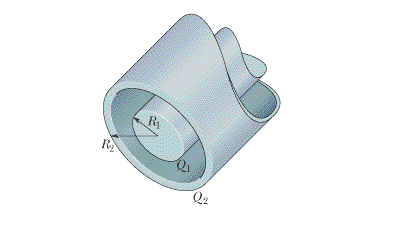
Picture1-4.png


Homework Equations


I'm going to be honest, I slept through most of this class this week (it's like being in @!#$ing morgue!) so I am having some trouble here. ANY help is greatly appreciated


I am sure I need some form of Gauss' Law (since that is the name of the chapter).

I am just not sure which form? can someone help me out here?

I know that \phi=\frac{q_{enc}}{\epsilon_o}

There are many formulae, but this one seems promising since I know the q_enc.

I also know that by the definition of a flux

\epsilon_o\int\vec{E}\cdot d\vec{A}=q_{enc}


I am just a little jammed from here. How can I manipulate that integral? Or better still, what can I use instead of the integral so that I can write it as E=...SOMETHING ?
 
Physics news on Phys.org
Anybody got a hint?
 
Saladsamurai said:
Anybody got a hint?

think what mean \intE\dotndA... try to find the good coordinates... look the pictutr... and solve your integral...

ciao
 
Think of the cylinders as lines of charges
 
erm. outside is conducting so I don't believe it has any electrical field on the inside, please correct me if I'm wrong..but uh, just do the flux = E(2pi*r*l), and then use gauss', treating it as a line of charge (lambda*l)/epsilonknot
do a bit of algebra, treating the center of the inner cylinder as a line of charge with a cylindrical gaussian surface around it and you have E = (lambda/(2*pi*epsilonknot*r))
this should get you started at least.
 
Feldoh said:
Think of the cylinders as lines of charges

I know this holds the key to solving this, but for some reason I cannot see it. Man, I wish mt professor gave us some reason to stay awake in class. Do you know how obnoxious it is to listen to a teacher just read straight from the text for an hour and a half! I am sure we all get crappy teachers at some point, but man, this sucks!
 
You're asked for the magnitude and direction of the electric field at 2R2, and 5R1, in other words, you want the electric field for a point outside of the outer shell. You can obtain a function for the electric field outside of the outer shell by using Gauss' Law, and appealing to symmetry. Think of a gaussian cylinder that encloses the conducting materials, such that the end caps of the cylinder do not intercept any electric field. In other words, the flux through the endcaps of the gaussian cylinder is zero simply because the d\vec{A} pointing outward from each endcap is perpendicular to \vec{E} (E dotted with A is zero). Now all you have to worry about is the electric flux through the sidewall of the cylinder. We have:

E(r)A_{sidewall} = \frac{Q_{ENCLOSED}}{\epsilon_0}

This will be the electric field for a point at a radial distance "r" such that "r" > R2. We already know the enclosed charge, now all we need is the area of the sidewall and we're in business. The area will be A = 2 \pi r L . Now all you have to do is solve for E(r) above and plug in the values that you know. Of course, if you find that the electric field yields a negative value, you know it will point inward, and if it yields a positive value, it will point outward.
 
hotcommodity said:
You're asked for the magnitude and direction of the electric field at 2R2, and 5R1, in other words, you want the electric field for a point outside of the outer shell. You can obtain a function for the electric field outside of the outer shell by using Gauss' Law, and appealing to symmetry. Think of a gaussian cylinder that encloses the conducting materials, such that the end caps of the cylinder do not intercept any electric field. In other words, the flux through the endcaps of the gaussian cylinder is zero simply because the d\vec{A} pointing outward from each endcap is perpendicular to \vec{E} (E dotted with A is zero). Now all you have to worry about is the electric flux through the sidewall of the cylinder. We have:

E(r)A_{sidewall} = \frac{Q_{ENCLOSED}}{\epsilon_0}

This will be the electric field for a point at a radial distance "r" such that "r" > R2. We already know the enclosed charge, now all we need is the area of the sidewall and we're in business. The area will be A = 2 \pi r L . Now all you have to do is solve for E(r) above and plug in the values that you know. Of course, if you find that the electric field yields a negative value, you know it will point inward, and if it yields a positive value, it will point outward.

Yeah that's essentially about what I was talking^^
 

Similar threads

  • · Replies 26 ·
Replies
26
Views
3K
Replies
10
Views
4K
  • · Replies 6 ·
Replies
6
Views
2K
  • · Replies 1 ·
Replies
1
Views
2K
Replies
23
Views
5K
Replies
6
Views
2K
Replies
10
Views
4K
  • · Replies 7 ·
Replies
7
Views
1K
Replies
5
Views
2K
  • · Replies 1 ·
Replies
1
Views
2K