Solve Mixed Questions: 1-7 | Find the Answer

  • Thread starter Thread starter blaziken's_charizard
  • Start date Start date
  • Tags Tags
    Mixed
Click For Summary

Homework Help Overview

The discussion revolves around various physics problems, including topics such as energy transfer, forces acting on objects, center of gravity, thermal expansion, and kinetic energy. Participants are exploring multiple-choice questions related to these concepts.

Discussion Character

  • Mixed

Approaches and Questions Raised

  • Participants express their reasoning for selecting answers to multiple-choice questions, often citing their understanding of relevant physics principles. Some participants question the validity of certain options and seek clarification on concepts like energy transfer and the behavior of forces.

Discussion Status

The discussion includes various perspectives on the questions posed, with some participants agreeing on certain answers while others express uncertainty or seek further confirmation. There is an ongoing exploration of the underlying principles related to the questions, particularly regarding energy and forces.

Contextual Notes

Participants are working within the constraints of multiple-choice questions, which may limit the depth of exploration into the concepts. Some questions involve assumptions about physical behavior that are being examined and debated.

blaziken's_charizard
Messages
33
Reaction score
0
1. The speed of a body of mass, m, moving horizontally, increases from u to v over a distance, d, under the influence of a constant resultant force, F, in the direction of motion. The energy transferred to the body is:

1. Fd
2. m/2*(v^2 - u^2)
3. 1/2*(mv)^2

The options are: 1 only, 2 only, 1 & 2 only or 1 & 3 only.

I'd say 1 & 3 only seeing as I recognize they are equations dealing with energy and I don't know of the equation in 2.2. A steel balling is falling with constant velocity through oil. The gravitational force acting on the ball is:
a) zero
b) reduced by the upward forces
c) less than it would be in air
d) exactly equal to the sum of the upward forces

I chose D because the other don't make sense to my knowledge.3.
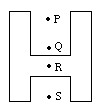
14ugcxj.gif


The figure above shows a lamina of uniform thickness. Its centre of gravity is most likely to be at:
a) P
b) Q
c) R
d) S

Dunno why also... Q just seems right.4. In which of the following situations is the strong force associated with the contraction of a previously heated object made use of?

1) Joining sections of a railway line
2) Fitting metal rims onto wheels
3) Rivets
4) Clinical Thermometer

I'd say 1, 2, 3 and 4. Though I'm a bit skeptical about 4.5. There are four containers: A B C & D. They contain water of masses m, 2m, 3m and 4m at temperatures 20 °C, 40 °C, 60 °C and 80 °C respectively.

Which of the above must lose the most energy to cool down to 10 °C? I'd say D because it has the highest mass and would undergo the greatest temp. change and hence the value of E would be high from the equation: E=mc(t2-t1)

In which of the cases above is the average kinetic energy of the molecules the greatest?
I again say D.6. Which of the following would cause the hot air above a fire to rise?
1. Increase in speed of the air molecules
2. Expansion of the air
3. Decrease in the density of the air

I'd say all three because increase in speed = expansion = lower density = rise


7. Which of the following components may be found in both d.c. motors and a.c. generators?
1) soft iron armature
2) brushes
3) slip rings

I say 2 only
I hope I am correct. If I am not please feel free to correct me. Thank you guys :)
 
Physics news on Phys.org
blaziken's_charizard said:
1. The speed of a body of mass, m, moving horizontally, increases from u to v over a distance, d, under the influence of a constant resultant force, F, in the direction of motion. The energy transferred to the body is:

1. Fd
2. m/2*(v^2 - u^2)
3. 1/2*(mv)^2

The options are: 1 only, 2 only, 1 & 2 only or 1 & 3 only.

I'd say 1 & 3 only seeing as I recognize they are equations dealing with energy and I don't know of the equation in 2.
Write down two expressions, one for the energy that the mass has before the acceleration and the energy the mass has after the acceleration.
blaziken's_charizard said:
2. A steel balling is falling with constant velocity through oil. The gravitational force acting on the ball is:
a) zero
b) reduced by the upward forces
c) less than it would be in air
d) exactly equal to the sum of the upward forces

I chose D because the other don't make sense to my knowledge.
Correct :smile:
blaziken's_charizard said:
3.
14ugcxj.gif


The figure above shows a lamina of uniform thickness. Its centre of gravity is most likely to be at:
a) P
b) Q
c) R
d) S

Dunno why also... Q just seems right.
I would agree with you :smile:
blaziken's_charizard said:
4. In which of the following situations is the strong force associated with the contraction of a previously heated object made use of?

1) Joining sections of a railway line
2) Fitting metal rims onto wheels
3) Rivets
4) Clinical Thermometer

I'd say 1, 2, 3 and 4. Though I'm a bit skeptical about 4.
I would agree with you on all of them except (1). Why do you think gaps are left between sections of rail (these gaps are especially visible in winter).
blaziken's_charizard said:
5. There are four containers: A B C & D. They contain water of masses m, 2m, 3m and 4m at temperatures 20 °C, 40 °C, 60 °C and 80 °C respectively.

Which of the above must lose the most energy to cool down to 10 °C? I'd say D because it has the highest mass and would undergo the greatest temp. change and hence the value of E would be high from the equation: E=mc(t2-t1)
Correct :smile:
blaziken's_charizard said:
In which of the cases above is the average kinetic energy of the molecules the greatest?
I again say D.
Correct :smile:. As an aside if all the cups were at 10oC, what would be your answer then?
blaziken's_charizard said:
6. Which of the following would cause the hot air above a fire to rise?
1. Increase in speed of the air molecules
2. Expansion of the air
3. Decrease in the density of the air

I'd say all three because increase in speed = expansion = lower density = rise
Indeed, but which one is the root cause?
 
Hootenanny said:
Write down two expressions, one for the energy that the mass has before the acceleration and the energy the mass has after the acceleration.

Correct :smile:

I would agree with you :smile:

I would agree with you on all of them except (1). Why do you think gaps are left between sections of rail (these gaps are especially visible in winter).

Correct :smile:

Correct :smile:. As an aside if all the cups were at 10oC, what would be your answer then?

Indeed, but which one is the root cause?

If they were all at 10oC then the answer would still be D [the one with the most mass?]

The root cause is the decrease density; the more dense air displaces the less dense air resulting the more dense air 'sinking' and the less dense air 'rising.

The gaps are there because when the trains move over the rail sections their temperature increases- with this comes thermal expansion. The gap therefore facilitates this expansion. These questions are multiple choice and for this specific question:

4. In which of the following situations is the strong force associated with the contraction of a previously heated object made use of?

1) Joining sections of a railway line
2) Fitting metal rims onto wheels
3) Rivets
4) Clinical Thermometer

The options are:
a) 2 & 3 only
b) 2 & 4 only
c) 1, 2 & 3 only
d) All of the above (1, 2, 3 & 4)The one with the energy:

First expression:

Kinetic energy = 1/2*(mu)^2

Second expression:

Kinetic energy = 1/2*(mv)^2

Therefore energy transferred:

1/2*(mv)^2 - 1/2*(mu)^2

By factorizing:

1/2m(v^2 - u^2)

1. Fd
2. m/2*(v^2 - u^2)
3. 1/2*(mv)^2

The options are: 1 only, 2 only, 1 & 2 only or 1 & 3 only.

So I guess it's 2 only?Also, can anyone confirm this:7. Which of the following components may be found in both d.c. motors and a.c. generators?
1) soft iron armature
2) brushes
3) slip rings

I say 2 only
 
Last edited:
blaziken's_charizard said:
If they were all at 10oC then the answer would still be D [the one with the most mass?]
Correct, although the average kinetic energy per molecule will remain unchanged, D has the greatest mass and therefore the greatest energy :smile:
blaziken's_charizard said:
The root cause is the decrease density; the more dense air displaces the less dense air resulting the more dense air 'sinking' and the less dense air 'rising.
Ahh, but what causes the density to decrease?
blaziken's_charizard said:
The gaps are there because when the trains move over the rail sections their temperature increases- with this comes thermal expansion. The gap therefore facilitates this expansion. These questions are multiple choice and for this specific question:

4. In which of the following situations is the strong force associated with the contraction of a previously heated object made use of?

1) Joining sections of a railway line
2) Fitting metal rims onto wheels
3) Rivets
4) Clinical Thermometer

The options are:
a) 2 & 3 only
b) 2 & 4 only
c) 1, 2 & 3 only
d) All of the above (1, 2, 3 & 4)
Okay, I'm not sure whether thermal contraction is useful in railway lines but if I had to chose an option it would be (d).
blaziken's_charizard said:
The one with the energy:

First expression:

Kinetic energy = 1/2*(mu)^2

Second expression:

Kinetic energy = 1/2*(mv)^2

Therefore energy transferred:

1/2*(mv)^2 - 1/2*(mu)^2

By factorizing:

1/2m(v^2 - u^2)

1. Fd
2. m/2*(v^2 - u^2)
3. 1/2*(mv)^2

The options are: 1 only, 2 only, 1 & 2 only or 1 & 3 only.

So I guess it's 2 only?
Sound good to me :approve:
blaziken's_charizard said:
7. Which of the following components may be found in both d.c. motors and a.c. generators?
1) soft iron armature
2) brushes
3) slip rings

I say 2 only
Not my area of expertise, if it's still unanswered tomorrow I shall raise it in the Homework Helper's forum.
 
Hootenanny said:
Correct, although the average kinetic energy per molecule will remain unchanged, D has the greatest mass and therefore the greatest energy :smile:

Ahh, but what causes the density to decrease?

Okay, I'm not sure whether thermal contraction is useful in railway lines but if I had to chose an option it would be (d).

Sound good to me :approve:

Not my area of expertise, if it's still unanswered tomorrow I shall raise it in the Homework Helper's forum.


An increase in temperature of the air causes density to decrease in that the molecules move faster thus taking up more space [mass] per unit volume.

And thanks a lot for your help :) !
 
blaziken's_charizard said:
An increase in temperature of the air causes density to decrease in that the molecules move faster thus taking up more space [mass] per unit volume.
Correct, so it's the molecular speed that's important.
blaziken's_charizard said:
And thanks a lot for your help :) !
No worries, it's a pleasure. :smile:
 

Similar threads

Replies
3
Views
1K
  • · Replies 3 ·
Replies
3
Views
545
  • · Replies 8 ·
Replies
8
Views
1K
Replies
4
Views
3K
  • · Replies 11 ·
Replies
11
Views
2K
Replies
13
Views
2K
  • · Replies 2 ·
Replies
2
Views
2K
  • · Replies 12 ·
Replies
12
Views
3K
  • · Replies 38 ·
2
Replies
38
Views
4K