Solve Mystery Equation - Get Insight into Relevance & Contents of Brackets

  • Context: Undergrad 
  • Thread starter Thread starter emrock
  • Start date Start date
  • Tags Tags
    Mystery
Click For Summary

Discussion Overview

The discussion revolves around an equation that participants are trying to contextualize, particularly focusing on the contents of the brackets within it. The conversation explores potential applications, interpretations, and the nature of the equation itself, touching on concepts from physics and mathematics.

Discussion Character

  • Exploratory
  • Debate/contested
  • Technical explanation
  • Mathematical reasoning

Main Points Raised

  • Some participants suggest that the equation may relate to mathematical problems, particularly involving derivatives, with a focus on the third derivative with respect to ##r##.
  • One participant proposes that ##\phi_E## could represent the scalar potential of the electric field, linking it to the electric field equation in electrostatics.
  • Several participants emphasize that the expression in question is not a complete equation, as it lacks a right-hand side, leading to various interpretations of its meaning.
  • One participant speculates that assuming the right-hand side is zero could lead to interpretations related to wave equations in the context of electric fields.
  • Another participant raises concerns about the necessity of formulating equations in terms of covariant objects for vector fields, questioning the clarity of the right-hand side.
  • Discussion includes references to the d'Alembertian operator and its relation to the Laplacian, with some participants seeking clarification on covariant versus contravariant notation.
  • One participant notes the lack of engagement from the original poster, suggesting that the inquiry may not be actively pursued.

Areas of Agreement / Disagreement

Participants express differing views on the nature of the equation and its components, with no consensus reached regarding its interpretation or the implications of the right-hand side. The discussion remains unresolved with multiple competing interpretations.

Contextual Notes

Participants highlight the ambiguity surrounding the right-hand side of the equation and the need for clarity in formulating equations involving vector fields. There are also references to specific mathematical notations that may not be universally understood among participants.

Who May Find This Useful

This discussion may be of interest to those exploring mathematical physics, particularly in the context of electric fields, wave equations, and the nuances of mathematical notation in physics.
emrock
Messages
2
Reaction score
0
TL;DR
Looking for context around an equation
I am hoping that people here might be able to provide insight into
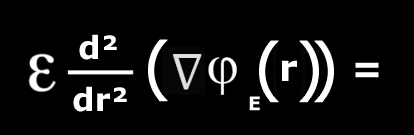
what context/s this equation might be relevant, particularly the contents of the brackets.

I am aware it is a strange request, related to puzzle solving,
but perhaps someone can help guide me in an interesting direction.

calc1.png
 
Physics news on Phys.org
emrock said:
Summary:: Looking for context around an equation ...

So give us all some context ... where did you see this ?
 
Usually in equations that arise from problems in physics we have derivatives up to second, but here a third derivative w.r.t to ##r## will appear because the operator of gradient contains the first derivative w.r.t ##r##.
So this equation is most likely from a mathematical problem.

However it could be that ##\phi_E## is the scalar potential of the electric field (commonly known as voltage) and the electric field is then ##\vec{E}=\nabla\phi_E## (this last equation holds only in the electrostatic case ) , so this equation takes the second derivative ##\frac{d^2}{dr^2}##(w.r.t ##r##) of the electric field ##\vec{E}## inside some dielectric material. The greek letter epsilon ##\epsilon## that appears next to it could be the electric permittivity of the material.
 
Last edited:
  • Like
Likes   Reactions: Adesh
This is not an equation. An equation has something on both sides of the equals sign.
 
  • Like
Likes   Reactions: sophiecentaur
Vanadium 50 said:
This is not an equation. An equation has something on both sides of the equals sign.
Strictly speaking you are right, it is not an equation, it is the LHS of an equation.
 
Vanadium 50 said:
This is not an equation. An equation has something on both sides of the equals sign.
That is exactly the mystery. If the right hand side of the equation were known, the mystery would cease to exist. :oldsmile:
 
What if one assumes the right hand side is zero?
 
  • Like
Likes   Reactions: Adesh
Could it be the spatial component of a wave equation in terms of an electric field? Ignoring the epsilon (permittivity I guess) if you solve Maxwell’s equations you can get a wave equation which (for the one dimensional case) is the second derivative with respect to space of the E field minus the second derivative with respect to time of the E field. The time component is multiplied the reciprocal the square of the wave speed when the spatial component has a coefficient of unity. This is equal to zero in the case of empty space with no charges present. I’ve never seen it solved for the D field as opposed to the E field but the epsilon in this case looks like it would make it so. This of course would make it not in empty space since it’s not epsilon naught. So if I had to put some thing on the right hand side of that equation it would be one over the square of the speed of light times the second time derivative of a displacement current. This may need a constant added to it if it is not an empty space due to possible charges present.
 
The problem is that the right-hand side of the equation is not clearly defined. Any equation making sense for vector fields must be formulated in terms of covariant objects, i.e., for spatial derivatives it must somehow be built with ##\vec{\nabla}##.
 
  • Like
Likes   Reactions: omega_minus
  • #10
emrock said:
I am hoping that people here might be able to provide insight into
what context/s this equation might be relevant,
Designing a nerdy t-shirt?
 
  • #11
vanhees71 said:
The problem is that the right-hand side of the equation is not clearly defined. Any equation making sense for vector fields must be formulated in terms of covariant objects, i.e., for spatial derivatives it must somehow be built with ##\vec{\nabla}##.
Thanks for the information @vanhees71. In EE we don’t discuss Maxwell’s equations in tensor notation (unfortunately) so I’ve not been formally educated on the meaning of “covariant”. Our notation of the spatial derivative part is “del squared” and is taken as the 2nd partial derivative of each vector component along an axis in Cartesian coordinates. (Occasionally we’d see a d’Alembertian for the whole wave equation). Could you help me understand what the difference is here? It sounds like something I’d like to know more about.
 
  • #13
It may be worth pointing out that this was a drive-by posting. The OP hasn't been here since he asked his question.
 
  • Like
Likes   Reactions: omega_minus and jim mcnamara
  • #14
Thanks @jedishrfu for the info. The d’Alembertian part I’m familiar with, I only mentioned it because that’s as “fancy” as we got in my grad school. But the tensor links are helpful to review for me since in orthogonal coordinates covariant and contravariant are the same. But I’m always left confused by how one knows what to assign a given vector quantity. For example why did @vanhees71 say “covariant” objects and not contravariant ones? Are E fields always covariant? Thanks.
 

Similar threads

Replies
5
Views
4K
  • · Replies 5 ·
Replies
5
Views
1K
  • · Replies 11 ·
Replies
11
Views
4K
  • · Replies 1 ·
Replies
1
Views
3K
  • · Replies 3 ·
Replies
3
Views
2K
  • · Replies 5 ·
Replies
5
Views
2K
Replies
5
Views
3K
  • · Replies 179 ·
6
Replies
179
Views
28K
  • · Replies 9 ·
Replies
9
Views
3K
  • · Replies 2 ·
Replies
2
Views
2K