Solve the probability distribution and expectation problem

2 replies · 2K views · last reply
chwala
Gold Member
Messages
2,854
Reaction score
436
Homework Statement
See attached
Relevant Equations
understanding of probability distribution concept...
This is the problem;
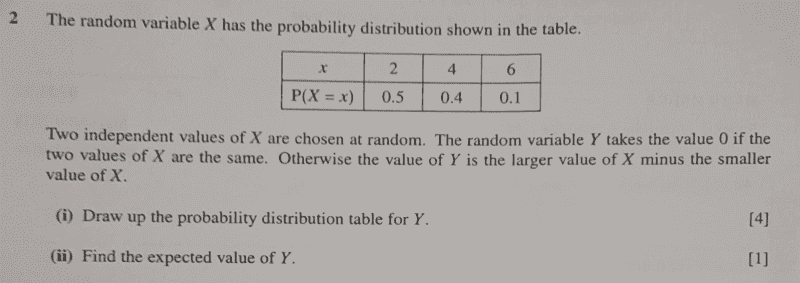
Exam question: probability table for discrete random variable X with values 2, 4, 6 and probabilities 0.5, 0.4, 0.1, followed by parts (i) and (ii) about the distribution of Y.


Find my working to solution below;
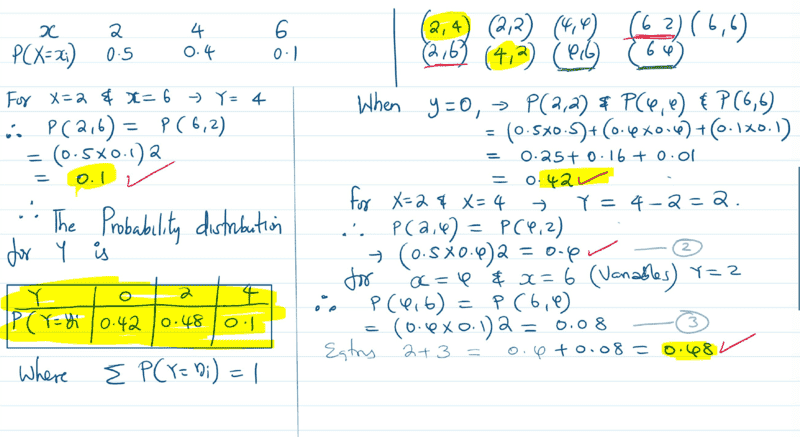
Handwritten working finding the probability distribution of Y = X1 + X2 from a table of X with P(X=2)=0.5, P(X=4)=0.4, P(X=6)=0.1; the resulting table gives P(Y=0)=0.42, P(Y=2)=0.48, P(Y=4)=0.1.

Handwritten working for expectation E(X) = sum of x P(X=x_i) = (0 x 0.02) + (2 x 0.08) + (4 x 0.1) = 0 + 0.96 + 0.4 = 1.36, with a tick and the word Bingo in red.
find mark scheme solution below;

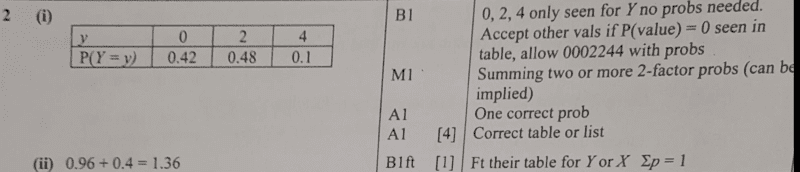
Probability table with Y values 0, 2 and 4 in the top row and P(Y = y) values 0.42, 0.48 and 0.1 beneath them, with mark scheme notes and marks B1, M1, A1, A1 and B1ft alongside.


I seek any other approach ( shorter way of doing it) will be appreciated...
 
chwala said:
Homework Statement:: See attached
Relevant Equations:: understanding of probability distribution concept...

shorter way of doing it
It would have been quicker to have found the probability of Y=2 by subtracting the other two probabilities from 1. I don't see any other shortcuts.
 
haruspex said:
It would have been quicker to have found the probability of Y=2 by subtracting the other two probabilities from 1. I don't see any other shortcuts.
That's true, but it could pose problem to a student who may have made a mistake on say finding wrong values of ##Y=0 ##& ##Y=4##, ...if you get what I mean... this error would consequently affect the value of ##Y=2##.
Finding the values of ##Y## indepedently and then checking whether their total sum is ##1## is more concrete...
 
Last edited: