Solve Uncertainty in "An Introduction to Error Analysis" by John R Taylor

  • Thread starter Thread starter NicolaiTheDane
  • Start date Start date
  • Tags Tags
    Uncertainty
Click For Summary
The discussion revolves around an example from "An Introduction to Error Analysis" by John R. Taylor, specifically regarding the calculation of uncertainty in the formula for gravitational acceleration, g. The main concern is the application of the error propagation rules, particularly the confusion surrounding the factor of 2 in the calculations. It is clarified that the factor of 2 cancels out when considering the definitions provided in the book, and that the errors should be treated as uncorrelated rather than correlated. Additionally, there is a correction regarding the notation for error, emphasizing the proper representation of delta as part of the variable. The conversation concludes with an acknowledgment of the oversight in the initial understanding.
NicolaiTheDane
Messages
100
Reaction score
10
This isn't a homework question, but instead a question about an example in a book I'm reading, in prep for next semester. As such using the posting template is a bit of a miss. Hope that can be forgiven.

1. Homework Statement


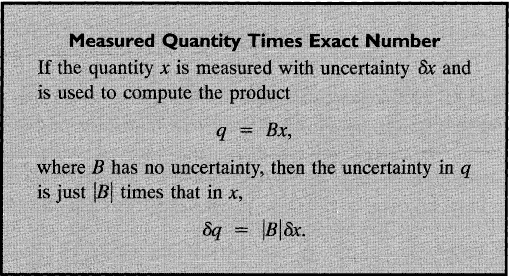
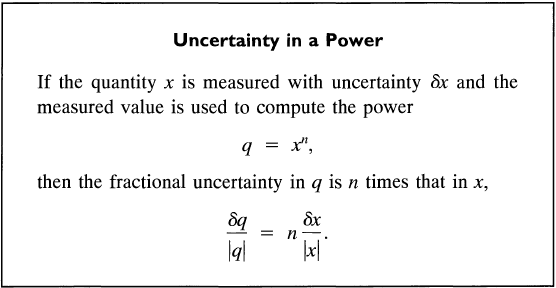
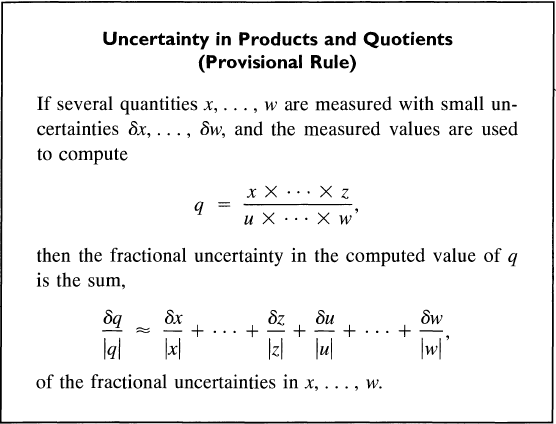
I'm reading "An Introduction to Error Analysis" by John R Taylor during my spring vacation as brush up for my next semester. I encountered an example that doesn't make sense to me though. It goes through teaching 3 rules as follows:
upload_2018-8-17_14-8-6.png
(3.8)
upload_2018-8-17_14-8-16.png
(3.9)
upload_2018-8-17_14-8-35.png
(3.10)

Now the example it gives is as follows (leaving out units for ease):

##t = 1.6\pm0.1##

##h = 46.2\pm0.3##

Now it calculates ##g = \frac{2*h}{t^2}## and more importantly its uncertainty as follows:

$$\frac{\delta g}{g}=\frac{\delta h}{h}+2*\frac{\delta t}{t} = 0.007+2*0.063 = 0.133$$

as justifed by 3.8 and 3.10. However here is my problem; What about 3.9?

The Attempt at a Solution


As far as I can see, the example completely forgets about the factor 2. With 3.9 in mind, ##x = \frac{h}{t^2}## shouldn't it be:

$$\frac{\delta g}{g}=2*\left(\frac{\delta h}{h}+2*\frac{\delta t}{t}\right)$$

What am I missing?
 

Attachments

  • upload_2018-8-17_14-8-6.png
    upload_2018-8-17_14-8-6.png
    12.6 KB · Views: 566
  • upload_2018-8-17_14-8-16.png
    upload_2018-8-17_14-8-16.png
    45.7 KB · Views: 396
  • upload_2018-8-17_14-8-35.png
    upload_2018-8-17_14-8-35.png
    7.3 KB · Views: 480
Physics news on Phys.org
Honestly, you should not be using 3.8 because it essentially makes the assumption that all the errors are correlated (which may be conservative, but usually not the case). If the errors are uncorrelated, it would be more appropriate to add the relative errors in quadrature.

However, given 3.8-10: No, there should not be a factor of 2. What is given in 3.9 is ##\delta q##, not ##\delta q/q##. The factor of 2 from ##\delta q## cancels the factor of 2 from ##q##.

Edit: To expand on that, 3.9 states ##\delta q = |B| \delta x## and by definition ##|q| = |B| |x|## and therefore
$$
\frac{\delta q}{|q|} = \frac{|B|\delta x}{|B| |x|} = \frac{\delta x}{|x|}.
$$

Also, do not write ##\delta * x##, it is ##\delta x## which is the error in ##x##. The ##\delta## and the ##x## are part of the same symbol representing the error in ##x##.
 
  • Like
Likes NicolaiTheDane
Orodruin said:
Honestly, you should not be using 3.8 because it essentially makes the assumption that all the errors are correlated (which may be conservative, but usually not the case). If the errors are uncorrelated, it would be more appropriate to add the relative errors in quadrature.

However, given 3.8-10: No, there should not be a factor of 2. What is given in 3.9 is ##\delta q##, not ##\delta q/q##. The factor of 2 from ##\delta q## cancels the factor of 2 from ##q##.

Edit: To expand on that, 3.9 states ##\delta q = |B| \delta x## and by definition ##|q| = |B| |x|## and therefore
$$
\frac{\delta q}{|q|} = \frac{|B|\delta x}{|B| |x|} = \frac{\delta x}{|x|}.
$$

Also, do not write ##\delta * x##, it is ##\delta x## which is the error in ##x##. The ##\delta## and the ##x## are part of the same symbol representing the error in ##x##.

Of course! Embarrassing oversight on my part. Thanks a bunch!
 
The book claims the answer is that all the magnitudes are the same because "the gravitational force on the penguin is the same". I'm having trouble understanding this. I thought the buoyant force was equal to the weight of the fluid displaced. Weight depends on mass which depends on density. Therefore, due to the differing densities the buoyant force will be different in each case? Is this incorrect?

Similar threads

  • · Replies 6 ·
Replies
6
Views
2K
Replies
6
Views
2K
  • · Replies 15 ·
Replies
15
Views
4K
  • · Replies 3 ·
Replies
3
Views
2K
  • · Replies 19 ·
Replies
19
Views
3K
  • · Replies 4 ·
Replies
4
Views
9K
  • · Replies 1 ·
Replies
1
Views
2K
Replies
2
Views
2K
  • · Replies 9 ·
Replies
9
Views
2K
  • · Replies 2 ·
Replies
2
Views
2K