Solving a Damped Movement w/ Mass Spring System: Find K, Acceleration

  • Thread starter Thread starter alnpoke
  • Start date Start date
  • Tags Tags
    Movement
Click For Summary
SUMMARY

The discussion focuses on solving a damped movement problem in a mass-spring system, specifically determining the damping coefficient and acceleration after a specified time. Given parameters include a spring constant (k) of 180 lb/ft and a mass of 2.9 kg, with a 7% ratio of variation between natural and damped oscillation. The relevant equation for the motion is x = A e^(-(b/2m)t) cos(ω't), where 'b' represents the damping coefficient. The acceleration can be calculated after 3.3 seconds of oscillation.

PREREQUISITES
  • Understanding of damped harmonic motion
  • Familiarity with the mass-spring system dynamics
  • Knowledge of the equation for damped oscillation
  • Basic calculus for solving differential equations
NEXT STEPS
  • Calculate the damping coefficient using the provided parameters
  • Determine the acceleration of the mass-spring system at t = 3.3 seconds
  • Explore the effects of varying the spring constant on damped motion
  • Study the relationship between damping ratio and oscillation frequency
USEFUL FOR

Students and professionals in physics, mechanical engineering, and applied mathematics who are working on problems related to oscillatory motion and damping in mechanical systems.

alnpoke
Messages
1
Reaction score
1
New poster has been reminded to show the Relevant Equations and their work on the solution
Homework Statement
damping coeficient
Relevant Equations
x=Ae^(-(b/2m)t) cos⁡〖ω^' 〗 t⁡
hello everyone could you help me with this exercise please muffled movement

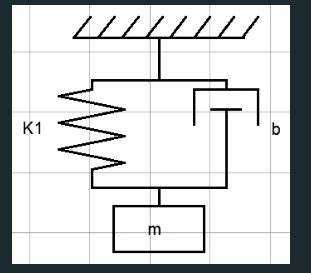
The mass spring system shown is at rest, to which an external element tensions it 1.9 (cm) (positive section of our study) and releases it, it begins to oscillate describing a damped movement. Considering that k = 180 (lb / ft), and that the mass has a value of 2.9 (kg), determine the damping coefficient if the ratio of variation between natural and damped oscillation is 7% and find the acceleration of the body after 3.3 (s) after starting the movement

1591990325633.png
1591990389542.png
 
  • Like
Likes   Reactions: Delta2
Physics news on Phys.org
alnpoke said:
Homework Statement:: damping coeficient
Relevant Equations:: x=Ae^(-(b/2m)t) cos⁡〖ω^' 〗 t⁡

hello everyone could you help me with this exercise please muffled movement

The mass spring system shown is at rest, to which an external element tensions it 1.9 (cm) (positive section of our study) and releases it, it begins to oscillate describing a damped movement. Considering that k = 180 (lb / ft), and that the mass has a value of 2.9 (kg), determine the damping coefficient if the ratio of variation between natural and damped oscillation is 7% and find the acceleration of the body after 3.3 (s) after starting the movement

View attachment 264544View attachment 264545
Per forum rules you must show an attempt. You should also be able to state some standard equation for damped harmonic motion.
 

Similar threads

Replies
17
Views
3K
  • · Replies 14 ·
Replies
14
Views
2K
Replies
1
Views
1K
Replies
17
Views
2K
  • · Replies 3 ·
Replies
3
Views
2K
Replies
4
Views
3K
Replies
1
Views
3K
  • · Replies 2 ·
Replies
2
Views
8K
Replies
6
Views
4K
Replies
8
Views
2K