Solving a Group Isomorphism Problem: Can You Help?

  • Thread starter Thread starter seaglespn
  • Start date Start date
  • Tags Tags
    Group Isomorphism
Click For Summary

Homework Help Overview

The discussion revolves around demonstrating that two groups are isomorphic, specifically focusing on a group defined by cubic roots of unity and the group Z3. Participants are exploring the properties and elements of these groups to establish a function that satisfies the isomorphism criteria.

Discussion Character

  • Exploratory, Conceptual clarification, Assumption checking

Approaches and Questions Raised

  • Participants are attempting to identify the elements of the group G and Z3, questioning how to construct an appropriate isomorphism. There are discussions about the identities of the groups and the implications of mapping elements between them. Some participants are also exploring the mathematical definitions and properties of the groups involved.

Discussion Status

Several participants have provided insights into the elements of the groups and the nature of isomorphisms. There is an ongoing exploration of how to represent the elements mathematically and verify the isomorphism conditions. While some guidance has been offered, there is no explicit consensus on the final approach or solution.

Contextual Notes

Participants have noted challenges with LaTeX formatting and the need for clarity in defining the elements of the groups. The discussion includes references to specific mathematical properties and operations relevant to the groups being analyzed.

seaglespn
Messages
26
Reaction score
0
A Group Problem :)

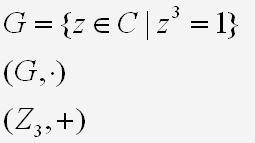
So.. I have to demonstrate that those following two groups are isomorfic , that there is an isomorphism between those 2 groups :
attachment.php?attachmentid=7363&stc=1&d=1153178125.jpg


Now I know that in such a way that an isomorphism might be , there must also be defined a function in G with values in Z3, and is soooo weird... :frown: So pls help :smile:

PS: How do I write LaTex ? I have TeXaide and I tried to copy paste the translation in all possible ways into the code tags, but doesn't works .
 

Attachments

  • 1st eQ.JPG
    1st eQ.JPG
    4 KB · Views: 465
Last edited:
Physics news on Phys.org
First, what are the elements of G? What are the elements of R3? Of course, an isomorphism must take the identity of one group to the identity of the other so there are not very many choices! (And the choices are irrelevant- there may be more than one isomorphism.)
 
The G is a set and is defined in my attachment(made from complex elements with the cube equal with 1) ,and Z3 ... I don't know exactly how to explain it mathematicaly but in school we learn it just as Z3.
Particular case for Zn which has n elements , from 0 to n-1, and is a group, so if you add 1 to 4 from Z5 you don't get 5, but 0.
I hope I explained well , that thing... One thing more, pls someone who understood the term I was talking about, write it here? :D THX( NOT a native englishman :) ).
 
So Z3 is the closed additive group of 0-2.

The elements of the z^3 set, under multiplication (call them a-c, where a is 1 and we go counterclockwise around the circle):

a*a=a a*b=b a*c=c b*b=c b*c=a c*c=b

Looking at Z3, calling 0-2 A-C, you can get the exact same formulae, making them equivalent.
 
G is a set of complex numbers, but what are these complex numbers, and how many are there? (hint: one of them is 1). Now, you have to construct an isomorphism between this set and Z3. That is, for each element g in G, associate to it a unique element f(g) in Z3, and verify that for all g,h in G, f(g*h)=f(g)+f(h), where the multiplication g*h is done in G and f(g)+f(h) is done in Z3. Note that this means, for example, the identity of G must map to the identiy of Z3.
 
Oh, guys thanks a lot, that enlighted me :).
So I only have to find element of G, construct a function with the property of f:G->Z3 and f(g*h)=f(g)+f(h)...
Elements of G are the cubic roots of the unity, and I kinda blocked here, there is 1 and there must be other 2 complex ones... help?!
 
Ok, I've kinda find out another root but I'm not sure about this one (doesn't sounds so good :) ) :
i^(4/3)

Damn, LaTex still doesn't works for me :((, any help here too ?! .
Thx.
 
Last edited:
seaglespn said:
Ok, I've kinda find out another root but I'm not sure about this one (doesn't sounds so good :) ) :
i^(4/3)

The easy way to use the cubic roots is to not calculate them. For any z^n=1, the roots can be graphed on the unit circle in the complex plane. For n=3, there are going to be 3 even spaced points on the unit circle, with one of them at z=1. If n=5, there would be 5 evenly spaced points, with one of them at z=1. When you start multiplying them together, it's the same as adding them in a counterclockwise fashion (so call the other four roots z1-z4, with z1 the first point counterclockwise from 1). Then z1*z3=z4. You can call 1 z0 for simplicity's sake

This is most easily verifiable for z^4=1
 
Remember my original question? What are the elements of G and Z3? There are only three elements of each and I wanted you to actually list them. If you can list the elements of the group (at least in principle for an infinite group) it makes finding an isomorphism much easier.

The "principal third root of unity", commonly represented by [itex]\omega_3[/itex], is [itex]\frac{-1+ i\sqrt{3}}{2}[/itex]. Another root is just [itex]\omega_3^2[/itex] and, of course, [itex]\omega_3^3= 1[/itex] is the third. [itex]i^\frac{4}{3}[/itex] doesn't have anything to do with your original problem.
1 is, of course, the identity. [itex]\omega *\omega= \omega^2[/itex], [itex]\omega *\omega^2= \omega^3= 1[/itex] and [itex]\omega^2 *\omega^2= (\omega^3)*(\omega)= \omega[/itex]. Those, together with the fact that multiplication of complex numbers is commutative gives the operation table for the group. It might be good practice to actually write out the table.

Z3 also has 3 elements. We can take them to be 0, 1, 2. Of course, 0 is the identity. 1+ 1= 2, 1+ 2= 3= 0 (mod 3), and 2+ 2= 4= 1 (mod 3). Again, the group operation is commutative.

Since 1 is the group identity in G and 0 is the group identity in Z3, any isomorphism must map 1 to 0: f(1)= 0. It seems kind of obvious to take f([itex]\omega[/itex])= 1 and f([itex]\omega^2[/itex])= 2. That that is an isomorphism follows from the fact that multiplying powers of the same base is just adding the exponents.
 
Last edited by a moderator:
  • #10
@HallsofIvy : Thanks a lot! Now I can get the things started :).
 
Last edited:
  • #11
Thanks again to all of you, I just finished the problem, and another one (same type), and I totally understood the tehnique, thx!
 
  • #12
Actually, it's easy to prove that any two groups with 3 elements are isomorphic (same is true of 1 or 2 element groups but not 4 or more elements). Call the elements of one a,b,c (with a the identity), the other x,y,z (with z the indentity). Any isomorphism must map the identity to identity: a to x. Then there are two choices, b to y and c to z or b to z and c to y. You can show that they are both isomorphisms!
 

Similar threads

  • · Replies 1 ·
Replies
1
Views
1K
  • · Replies 26 ·
Replies
26
Views
2K
Replies
7
Views
3K
  • · Replies 1 ·
Replies
1
Views
2K
  • · Replies 9 ·
Replies
9
Views
2K
  • · Replies 18 ·
Replies
18
Views
5K
  • · Replies 1 ·
Replies
1
Views
2K
  • · Replies 5 ·
Replies
5
Views
4K
Replies
3
Views
2K
Replies
1
Views
3K