Solving a Complex Problem: Can You Help?

  • Context: Undergrad 
  • Thread starter Thread starter sfphysics
  • Start date Start date
  • Tags Tags
    Complex
Click For Summary
SUMMARY

The discussion centers on solving a physics problem involving the spherical interface formula, specifically (n1/p) + (n2/q) = ((n2-n2)/R). A user calculated q to be 15 cm but could not reconcile this with the expected answer of 23 cm. Another participant suggested that the flat end of the rod must be considered in the calculations, indicating that the problem requires a more comprehensive approach to account for all geometrical factors involved.

PREREQUISITES
  • Understanding of spherical interface formulas in optics
  • Familiarity with the concepts of refraction and indices of refraction
  • Basic knowledge of geometry related to rods and flat surfaces
  • Ability to manipulate algebraic equations
NEXT STEPS
  • Research the derivation and applications of the spherical interface formula in optics
  • Study the effects of flat surfaces on light refraction
  • Explore problem-solving techniques for complex physics problems
  • Review examples of similar physics problems involving rods and interfaces
USEFUL FOR

Students studying physics, educators teaching optics, and anyone interested in solving complex refraction problems.

sfphysics
Messages
1
Reaction score
0
Does anyone know how to solve this problem? I tried using the spherical interface formula (n1/p)+(n2/q)=((n2-n2)/R) and I get q=15cm which I cannot seem to relate to the answer provided (23cm). Anyone know the correct way to approach this problem?
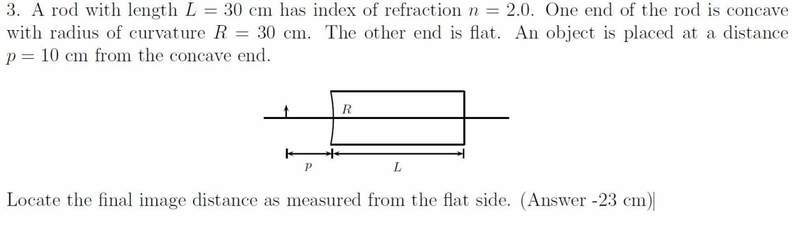
attachment.php?attachmentid=58375&stc=1&d=1367371157.jpg


Thanks.
 

Attachments

  • physicsproblem429a.jpg
    physicsproblem429a.jpg
    14.9 KB · Views: 566
Science news on Phys.org
You probably need to account for the flat end of the rod as well.
 
sfphysics said:
Does anyone know how to solve this problem? I tried using the spherical interface formula (n1/p)+(n2/q)=((n2-n2)/R) and I get q=15cm which I cannot seem to relate to the answer provided (23cm). Anyone know the correct way to approach this problem?
[ IMG]https://www.physicsforums.com/attachment.php?attachmentid=58375&stc=1&d=1367371157[/PLAIN]

Thanks.
Is this a Homework problem?
 

Similar threads

  • · Replies 7 ·
Replies
7
Views
2K
  • · Replies 4 ·
Replies
4
Views
2K
  • · Replies 6 ·
Replies
6
Views
1K
  • · Replies 2 ·
Replies
2
Views
3K
Replies
2
Views
1K
  • · Replies 2 ·
Replies
2
Views
3K
  • · Replies 3 ·
Replies
3
Views
2K
Replies
6
Views
2K
  • · Replies 11 ·
Replies
11
Views
2K
  • · Replies 3 ·
Replies
3
Views
2K