Discussion Overview
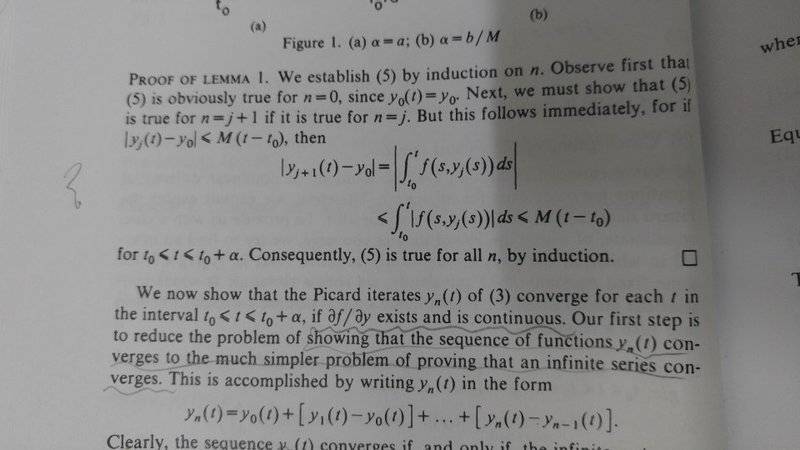
The discussion revolves around understanding the application of mathematical induction to solve a recurrence relation, specifically in the context of Picard iterates and their properties. Participants explore the definitions and implications of certain equations, particularly focusing on the conditions under which the induction hypothesis holds true.
Discussion Character
- Technical explanation
- Conceptual clarification
- Debate/contested
Main Points Raised
- Some participants express confusion about how induction is applied, particularly in deriving the formula for when n=j+1 from n=j.
- There is a discussion about the definition of ##y_n(t)## and its relation to Picard iterates, with some participants confirming their understanding of equation (5) as ##|y_n(t)-y_0| \leq M(t-t_0)##.
- One participant notes that the use of the induction hypothesis is crucial for establishing that ##|f(s,y_j(s))| \leq M##, but questions whether this follows directly from the induction step.
- Another participant emphasizes that the rectangle R, defined by constants a and b, is essential for ensuring that the function f remains bounded by M.
- There is a concern about the clarity of the book's explanation, with some participants feeling that additional context would have been helpful.
Areas of Agreement / Disagreement
Participants generally agree on the definitions and the role of the induction hypothesis but express differing views on the clarity of the explanation provided in the book. Some participants feel confident in their understanding, while others continue to seek clarification.
Contextual Notes
Participants highlight that the conditions under which the induction hypothesis holds depend on the definitions of the constants a and b, which are not fixed and may vary. This introduces uncertainty regarding the applicability of the results derived from the induction process.