Solving a Symbolic Logic Problem: A V D and ~(B ^ C) = D

  • Thread starter Thread starter Ejayrazz
  • Start date Start date
  • Tags Tags
    Logic
Click For Summary
SUMMARY

The discussion revolves around solving a symbolic logic problem involving the propositions A v D, (~B ^ ~C) = D, and B => ~(C => A). The user is attempting to derive A through disjunction elimination but is struggling with the second sub-derivation. Key insights include recognizing that assuming B leads to a contradiction, specifically B => C ^ ~A, which ultimately results in B => ~B. This contradiction indicates that the assumptions made may need reevaluation to correctly apply disjunction elimination.

PREREQUISITES
  • Understanding of symbolic logic notation and terminology
  • Familiarity with propositional logic rules, including disjunction elimination
  • Knowledge of logical equivalences and implications
  • Experience with constructing logical proofs
NEXT STEPS
  • Study the principles of disjunction elimination in symbolic logic
  • Learn about logical equivalences, particularly in propositional logic
  • Explore techniques for identifying contradictions in logical proofs
  • Practice constructing proofs using tools like truth tables and natural deduction
USEFUL FOR

Philosophy students, logic enthusiasts, and anyone interested in mastering symbolic logic and proof construction techniques.

Ejayrazz
Messages
1
Reaction score
0
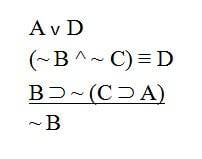
Perchance someone here has some background in Philosophy, specifically symbolic logic? For the life of me I can't figure out the following:

A v D
(~B ^ ~C) = D
B => ~(C=> A)
~B

What I have so far is this:

1| A v D ......P
2| (~B ^ ~C) = D ....P
3| B => ~(C =>A) ...P
4| |B ......A
5| | |C .......A
r| | |?
s| | |?
t| | |?
u| | |?
v| | |A ........1, ?-?, ?-?, vE
w| | C=>A ......5-v, =>I
x| | B => ~(C =>A) ...2, R
y| | ~(C =>A) .....w, x, =>E
z| ~B ......4, w, y, ~I

What I can't figure out is how to get the disjunction elimination for A in the second sub-derivation. Anyone have a clue?
Logicproblem1.jpg
 
Physics news on Phys.org
I'm not sure about what you're doing as I have limited experience with this kind of thing, but as far as I can tell, if you assume B you get a contradiction:

B => C ^ ~A (equivalent to proposition 3)
~A => ~B ^ ~C (props 1 and 2)
So, you get B => C ^ ~C (or B => ~B...either way).

Or is that way off?
 

Similar threads

  • · Replies 2 ·
Replies
2
Views
2K
  • · Replies 14 ·
Replies
14
Views
2K
  • · Replies 9 ·
Replies
9
Views
2K
Replies
3
Views
2K
  • · Replies 3 ·
Replies
3
Views
2K
  • · Replies 18 ·
Replies
18
Views
3K
  • · Replies 2 ·
Replies
2
Views
2K
Replies
1
Views
1K
Replies
3
Views
2K
  • · Replies 4 ·
Replies
4
Views
3K