Solving an ODE-45 from Euler-Lagrange Diff. Eqn.

  • Thread starter Thread starter Axecutioner
  • Start date Start date
  • Tags Tags
    Euler-lagrange
Click For Summary

Homework Help Overview

The discussion revolves around deriving the equations of motion for a double pendulum using Euler-Lagrange differential equations. Participants are exploring the complexities involved in the motion of the system, including considerations of energy and inertia.

Discussion Character

  • Exploratory, Conceptual clarification, Mathematical reasoning, Problem interpretation

Approaches and Questions Raised

  • Participants discuss the need to consider rotational energy and moment of inertia in their equations. There are suggestions to define generalized coordinates and to find kinetic and potential energy. Some participants express uncertainty about obtaining analytical solutions and mention attempts at numerical solutions using software.

Discussion Status

The discussion is ongoing, with participants sharing their attempts and insights. Some guidance has been offered regarding the formulation of the problem, but there is no clear consensus on a solution approach. Multiple interpretations of the equations and their implications are being explored.

Contextual Notes

Participants note constraints such as the avoidance of small angle approximations due to the nature of the forces involved in their specific project. There is also mention of challenges faced when attempting numerical solutions in software like Maple.

Axecutioner
Messages
31
Reaction score
0
I need to find the equation of motion of a double pendulum, as shown here:
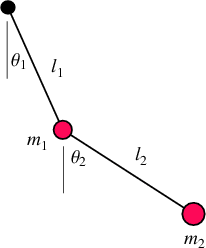
dimg270.gif


I've gotten as far as the two euler-lagrange differential equations, simplified to this:

K1\ddot{θ}1 + K2\ddot{θ}2cos(θ1 - θ2) + K3\dot{θ}22sin(θ1 - θ2) + K4sin(θ1) = 0
K5\ddot{θ}2 + K6\ddot{θ}1cos(θ1 - θ2) + K7\dot{θ}12sin(θ1 - θ2) + K8sin(θ2) = 0

Assuming initial conditions \ddot{θ}1o, \dot{θ}1o, θ1o, \ddot{θ}2o, \dot{θ}2o, θ2o

What would these equations of motion be?
θ1(t) =
θ2(t) =

I was told it could be done in MATLAB but I don't have the software or know how to use it yet so any help would be appreciated. Step-by-step solution would be even better. Thanks in advance.
 
Physics news on Phys.org
Have you considered the rotational energy aswell? You have to have a moment of inertia dependent term.
The procedure for solving this type of problems is as follows:
1. Define your generalized coordinates for each of the masses: e.g. (x1,y1) = (l1sin(theta(t),l1cos(theta(t)) ...
2. Find the velocity and simplify it. Remember the chain rule for differentiation.
3. Find the Potential energy V and kinetic T(T = 1/2m_1v_1^2+1/2m_2v_2^2+1/2I_1 \omega_1^2+1/2I_2\omega_2^2) where omega = dtheta/dt
and the lagrangian is L = T-V
4. Write down your dynamical equations, 2 masses gives 2 equations. and there you go.
\dfrac{\partial L}{\partial \theta_1} - \dfrac{d}{dt}\dfrac{\partial L}{\partial \dot{\theta_1}}=0
Summary: Be strict defining coordinate system. Remember the chain rule and product rule for differentiation. Concentrate it is hard algebra.
The equations of motion comes from solving this differential equation system. Sometimes it is assumed that sin(theta) = theta for theta<<1 and that simplifys a lot.
But in general this problem is chaotic in nature, and you would probably solve nummericaly in matlab.
 
Last edited:
Here's what I've done so far, before I posted the OP:

http://i.imgur.com/c1Sdb.jpg

Some of the K values are the same but just keep each one different, since this entire double pendulum case is a simplification of part of a project I'm working on.

And Rotational Kinetic energy and Kinetic energy are the same for a point mass ( 1/2mv^2 = 1/2mL^2w^2 = 1/2Iw^2) so adding both would be wrong.

And I do not want to use the small angle approximation because the actual pendulum in my project is being torqued with an angle dependent force, and the angles involved cover a wide range.
 
Iv'e tried solving the system in maple nummerically without luck. I don't think i am able to get an analytical solution, sorry. And I've never seen a analytical solution.
 

Similar threads

Replies
8
Views
2K
  • · Replies 1 ·
Replies
1
Views
1K
  • · Replies 2 ·
Replies
2
Views
3K
  • · Replies 15 ·
Replies
15
Views
2K
  • · Replies 5 ·
Replies
5
Views
2K
Replies
6
Views
2K
  • · Replies 2 ·
Replies
2
Views
4K
  • · Replies 2 ·
Replies
2
Views
4K
  • · Replies 4 ·
Replies
4
Views
3K
  • · Replies 14 ·
Replies
14
Views
3K