Solving Chi-Square Problem: z-table or t-table?

  • Thread starter Thread starter Precursor
  • Start date Start date
Click For Summary
The discussion centers on the appropriate use of the z-table versus the t-table for calculating chi-square values in statistical analysis. Participants emphasize that the z-table should be used, as it corresponds to the normal distribution relevant for the chi-square test. There is a debate about adding categories with zero observed frequencies, with some arguing against arbitrary additions that could skew results. The calculations yield varying chi-square values, highlighting the impact of category selection on the test statistic and p-value. Ultimately, the conversation underscores the importance of adhering to statistical principles to avoid misleading conclusions.
Precursor
Messages
219
Reaction score
0
Homework Statement

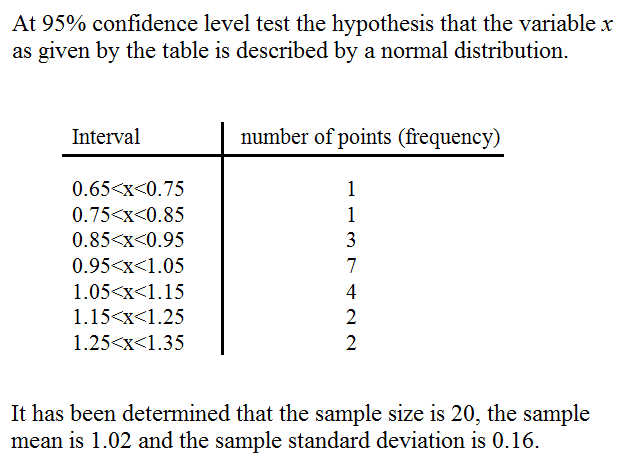
rthk4w.png


The attempt at a solution

I started by finding the expected frequencies corresponding to the intervals. I used the z-table for this. I got a chi-square value of 3.47.

The answer, however, should be 1.98.

Should I have used the z-table as mentioned earlier, or should I use the t-table? If so, how would I use the t-table?
 
Physics news on Phys.org
Precursor said:
Homework Statement

rthk4w.png


The attempt at a solution

I started by finding the expected frequencies corresponding to the intervals. I used the z-table for this. I got a chi-square value of 3.47.

The answer, however, should be 1.98.

Should I have used the z-table as mentioned earlier, or should I use the t-table? If so, how would I use the t-table?

I got a chi-square value of 2.568.

You should NOT use the t-table, because the t-distribution applies to a completely different problem (estimating the mean)

RGV
 
Yes, you should use the z-table, since that represents the normal distribution that you want to test against.

One of the preconditions for Pearson's chi-squared test is that the events must have a total probability of 1.
So we need to add 2 categories (x<0.65 and x>1.35) with observed frequency 0 for a total of 9 categories.
@RGV: Is it possible you missed that?

Using that I get a chi-square value of 3.17.
@Precursor: How did you get 3.47?

With 9-3=6 degrees of freedom that gives a p-value of 0.79.
Since a p-value of 0.05 is required, we can not reject the normal-distribution-hypothesis.
 
I like Serena said:
Yes, you should use the z-table, since that represents the normal distribution that you want to test against.

One of the preconditions for Pearson's chi-squared test is that the events must have a total probability of 1.
So we need to add 2 categories (x<0.65 and x>1.35) with observed frequency 0 for a total of 9 categories.
@RGV: Is it possible you missed that?

Using that I get a chi-square value of 3.17.
@Precursor: How did you get 3.47?

With 9-3=6 degrees of freedom that gives a p-value of 0.79.
Since a p-value of 0.05 is required, we can not reject the normal-distribution-hypothesis.

Yes, the first time I did it I forget that; but I did it again (before you posted) with first category (-infinity,0.75) and final category (1.25,infinity) and got Chi^2 = 1.91255.

Your suggestion to take two new categories (< 0.65) and (>1.35) is NOT recommended: it is too arbitrary and is adding fictitious categories. For example, I could add a bunch of new categories, say (-infinity,0.05),(0.05,0.15),(0.15,0.25),(0.25,0.35),... , all with observed frequencies = 0 but non-zero theoretical frequencies. This would increase the value of Ch^2 and increase the number of degrees of freedom. The alternative, to expand the first one (0.65,0.75) into (-infinity,0.75) is more justifiable (and is essentially what the link you provide does near the bottom).

RGV
 
Ray Vickson said:
Yes, the first time I did it I forget that; but I did it again (before you posted) with first category (-infinity,0.75) and final category (1.25,infinity) and got Chi^2 = 1.91255.

Your suggestion to take two new categories (< 0.65) and (>1.35) is NOT recommended: it is too arbitrary and is adding fictitious categories. For example, I could add a bunch of new categories, say (-infinity,0.05),(0.05,0.15),(0.15,0.25),(0.25,0.35),... , all with observed frequencies = 0 but non-zero theoretical frequencies. This would increase the value of Ch^2 and increase the number of degrees of freedom. The alternative, to expand the first one (0.65,0.75) into (-infinity,0.75) is more justifiable (and is essentially what the link you provide does near the bottom).

RGV

Nice! :smile:
We're almost there (1.98).
I also draw the conclusion that calculating the chi-square test statistic gives you some freedom of choices that have quite some impact on the test statistic (although the resulting p-values are pretty close).
Adding a lot of fictitious categories does worsen the p-value significantly though.

I do wonder, aren't we throwing out some information here, since extending the category (0.65, 0.75) removes the information of the lower bound?
 
Question: A clock's minute hand has length 4 and its hour hand has length 3. What is the distance between the tips at the moment when it is increasing most rapidly?(Putnam Exam Question) Answer: Making assumption that both the hands moves at constant angular velocities, the answer is ## \sqrt{7} .## But don't you think this assumption is somewhat doubtful and wrong?

Similar threads

  • · Replies 4 ·
Replies
4
Views
2K
  • · Replies 2 ·
Replies
2
Views
2K
  • · Replies 2 ·
Replies
2
Views
2K
  • · Replies 3 ·
Replies
3
Views
1K
  • · Replies 4 ·
Replies
4
Views
2K
  • · Replies 1 ·
Replies
1
Views
2K
  • · Replies 8 ·
Replies
8
Views
2K
  • · Replies 14 ·
Replies
14
Views
2K
Replies
4
Views
2K
  • · Replies 2 ·
Replies
2
Views
2K