Solving Distance Traveled Using Formulas vs. Graphs

Click For Summary

Homework Help Overview

The discussion revolves around calculating the distance traveled by a body during specific time intervals, comparing results obtained from formulas for uniformly accelerated motion and graphical methods. The subject area includes kinematics and the interpretation of distance versus displacement.

Discussion Character

  • Mixed

Approaches and Questions Raised

  • Participants explore the differences in results when calculating distance using the formula for accelerating bodies versus graphical methods. Questions arise about the origin of specific formulas and potential typographical errors in textbooks. There is also a discussion on the distinction between distance and displacement, as well as average speed versus average velocity.

Discussion Status

Some participants have offered clarifications regarding the formulas and concepts involved, while others are questioning their calculations and assumptions. The conversation reflects a productive exploration of the topic, with multiple interpretations being considered.

Contextual Notes

Participants note discrepancies between their calculations and textbook solutions, leading to discussions about the definitions of distance and displacement, as well as the implications of using different methods for calculation.

Callmelucky
Messages
144
Reaction score
30
Homework Statement
calculate the distance traveled by a body given the graph
Relevant Equations
##d=V_0\times t + \frac{1}{2}\times at^{2}##, ##d=\frac{vt}{2}##
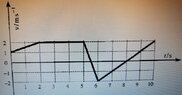
So basically I wonder why the distance traveled by a body in the 5th second gives different results when calculated by the formula for accelerating body(##d=V_0\times t + \frac{1}{2}\times at^{2}##) and when calculated using a graph(formula for the surface of the triangle).

Here is the graph of the problem(pic below).
When I calculate distance traveled using ##d=\frac{vt}{2}## I get ##d=\frac{\Delta v\Delta t}{2}=\frac{4\times 1}{2}=2m##, and when I do the same using ##d=V_0\times t + \frac{1}{2}\times at^{2}## I get ##d=V_0\times t+\frac{1}{2}\times at^{2} = 2 + (-2)=0## because ##a=\frac{\Delta v}{\Delta t}= -4##.

If someone can please tell me where I am wrong, thank you.
 

Attachments

  • WhatsApp Image 2023-03-17 at 19.04.43.jpeg
    WhatsApp Image 2023-03-17 at 19.04.43.jpeg
    47.2 KB · Views: 120
Physics news on Phys.org
Where does the d=vt/2 expression come from ?
 
BvU said:
Where does the d=vt/2 expression come from ?
my textbook, it's just marked as s instead of d
 

Attachments

  • WhatsApp Image 2023-03-17 at 19.18.44.jpeg
    WhatsApp Image 2023-03-17 at 19.18.44.jpeg
    14.6 KB · Views: 126
Callmelucky said:
my textbook, it's just marked as s instead of d
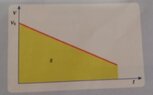
There must be a typo. The area of the shaded portion (a trapezoid) is
##d = \dfrac{(v_0+v)t}{2} ##

and this formula will give consistent results with the other.

-Dan
 
  • Like
Likes   Reactions: Callmelucky
topsquark said:
There must be a typo. The area of the shaded portion (a trapezoid) is
##d = \dfrac{(v_0+v)t}{2} ##

and this formula will give consistent results with the other.

-Dan
Does that then mean that the body didn't cross any distance for that one second?
One more question, I have calculated that the average speed in the first 6 seconds is 3/2 m/s but the solution in the textbook is 10/6 m/s. I used the same formula for distance traveled by accelerating the body for the first 2 seconds which is ##d=V_0\times t + \frac{1}{2}\times at^{2} = 1\times 2+\frac{1}{2}\times 0.5\times 4= 3m##, after that, distance traveled from 2nd to 5th second is 6m(v*t=2*3=6m) and distance from 5th to 6th second is 0m. So that is 9m/6sec= 3/2 m/s but the solution in the textbook is 10/9 m/s, can you please explain how?
Thank you
 
Callmelucky said:
One more question, I have calculated that the average speed in the first 6 seconds is 3/2 m/s but the solution in the textbook is 10/6 m/s. I used the same formula for distance traveled by accelerating the body for the first 2 seconds which is ##d=V_0\times t + \frac{1}{2}\times at^{2} = 1\times 2+\frac{1}{2}\times 0.5\times 4= 3m##, after that, distance traveled from 2nd to 5th second is 6m(v*t=2*3=6m) and distance from 5th to 6th second is 0m. So that is 9m/6sec= 3/2 m/s but the solution in the textbook is 10/9 m/s, can you please explain how?
Thank you
The distance traveled from from the 5th to the 6th second is not zero. The displacement is zero. The distance traveled is the sum of the "go" trip (5.0-5.5 s) and the "return" trip (5.5-6.0 s.) Average speed is what the odometer records over the entire trip divided by the duration of the trip.
 
  • Like
Likes   Reactions: topsquark
To add to the above, you need to discriminate distance from displacement and speed from velocity.
In a V/T graph, areas below the time axis count as positive if you want distance travelled and average speed, but negative if you want displacement and average velocity.
 
  • Like
Likes   Reactions: SammyS and topsquark

Similar threads

  • · Replies 9 ·
Replies
9
Views
764
  • · Replies 25 ·
Replies
25
Views
2K
Replies
13
Views
2K
Replies
8
Views
849
  • · Replies 60 ·
3
Replies
60
Views
4K
Replies
23
Views
2K
  • · Replies 3 ·
Replies
3
Views
1K
  • · Replies 6 ·
Replies
6
Views
2K
  • · Replies 1 ·
Replies
1
Views
2K
  • · Replies 11 ·
Replies
11
Views
3K