Solving Equilibrium w/ Plank & Forces | Physics Problem

  • Thread starter Thread starter ago01
  • Start date Start date
Click For Summary

Homework Help Overview

The discussion revolves around a physics problem involving static equilibrium of a plank and forces acting on it, particularly focusing on the interactions between a person and the plank as well as the gravitational forces involved. Participants are analyzing the forces and torques at play, including normal forces and the center of mass of the system.

Discussion Character

  • Exploratory, Conceptual clarification, Assumption checking

Approaches and Questions Raised

  • Participants explore the setup of forces and torques, questioning the existence of certain normal forces and the treatment of the system's mass. There is discussion about the importance of the center of mass and how it affects the equilibrium conditions. Some participants suggest reconsidering the definitions of the system and the implications of treating the board and person separately versus as a combined system.

Discussion Status

The discussion is ongoing with various interpretations being explored. Some participants have provided insights into the behavior of the center of mass and the implications for torque, while others are questioning the assumptions made about the forces involved. There is no explicit consensus yet, but productive lines of reasoning are being developed.

Contextual Notes

Participants note the complexity of defining the system, particularly in relation to the distribution of mass and the effects of different pivot points. There is also mention of the need to consider the system in three dimensions, although the primary focus has been on vertical and horizontal forces.

ago01
Messages
46
Reaction score
8
Homework Statement
A heavy, 6m long uniform plank has a mass of 30 kg. It is positioned so that 4m is supported on the deck of a ship and 2m sticks out over the water. It is held in place only by its own weight. You have a mass of 70kg and walk the plank past the edge of the ship.
Relevant Equations
Torque, Forces in Y, Forces in X. Static equilibrium.
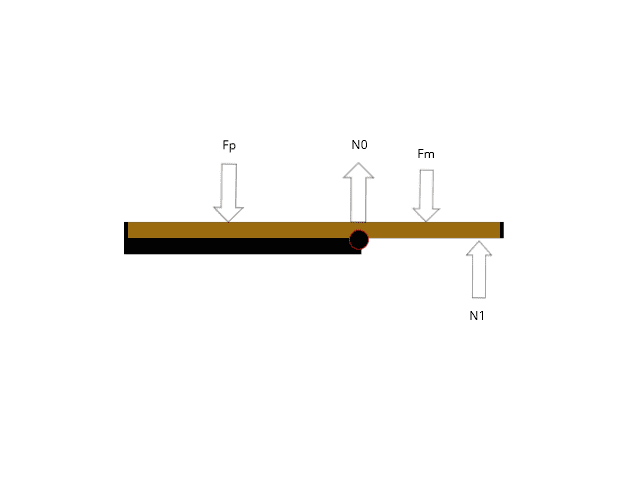
I first created the following diagram (after watching some videos, I had initially combined masses and this is wrong).
1637866748497.png


##F_p## Is the gravitational force of the board on the boat.
##N_0## Is the corresponding normal force the board experiences from the boat.
##F_m## Is the force of me at the point I step over the pivot.
##N_1## Is the normal force I experience from the plank after the pivot.

##m_p = 30 kg##
##m_m = 70 kg##

The pivot point is the red outlined black dot. The point exactly where the plank begins to overhang.

If this is in static equilibrium then at any point after the pivot that doesn't cause the plank to rotate I must be experiencing some normal force from the plank as well.

So, using the static equilibrium equations:

##\sum{F_x} = 0##

##\sum{F_y} = N_0 + N_1 - m_pg - m_mg = 0##

##\sum{T} = 0##

Call the left end of the plank ##A## and where I am standing ##B##:

##T_{A} = -4m_pg##
##T_{B} = -rm_mg##
##T_{N_0} = 0## (since it is at the lever arm)
##T_{N_1} = rN_1## (since this torque counters my torque in equilibrium).

So ##\sum{T} = -4m_pg - rm_mg + rN_1 = 0##

I understand that in order for the board to rotate it must be the case that ##N_1## = 0. But if that's the case, solving for ##N_0## using the sum of the y-forces does not help me solve for ##r## since in this case ##T_{N_1} = 0## and so:

##-4m_pg = rm_mg##

## r = -1.71m##

Which is obviously wrong. I'm sure I'm staring right at the answer and missing a critical piece of insight to solve this.
 
Physics news on Phys.org
N1 does not exist as the normal force you experience from the plank after the pivot.

N0 Is the corresponding normal reaction force the board experiences from the boat at the pivot point when tipping over is imminent.

For creating a good FBD, you should not consider the internal forces of the system, like the action-reaction forces among your feet and board.

Please, see
https://en.wikipedia.org/wiki/Free_body_diagram

https://www.physicsforums.com/threads/18-free-body-diagrams-statics.679262/

As the board is uniform in shape and thickness, you can consider the 30 kg as concentrated in its middle point, 3 m from each end.
 
Last edited:
Lnewqban said:
N1 does not exist as the normal force you experience from the plank after the pivot.

N0 Is the corresponding normal reaction force the board experiences from the boat at the pivot point when tipping over is imminent.

For creating a good FBD, you should not consider the internal forces of the system, like the action-reaction forces among your feet and board.

Please, see
https://en.wikipedia.org/wiki/Free_body_diagram

https://www.physicsforums.com/threads/18-free-body-diagrams-statics.679262/

As the board is uniform in shape and thickness, you can consider the 30 kg as concentrated in its middle point, 3 m from each end.

I finally figured it out but I'm left a little confused at why we don't consider the weight of the board and person together. To solve it I needed to consider the center of mass and it's behavior (which is where the gravitational force of the board rests). I would think that this mass would be ##M_m + M_p## but I was wrong.

Defining the system is a little confusing here, mostly because you are looking at the board + person but treating them separately.
 
If you consider the plank-man as a solid system, then you first must find the center of mass of each body, in order to find the combined center of mass of the plank-man system.

Please, see:
https://efcms.engr.utk.edu/ef151-2019-08/sys.php?f=bolt/bolt-main&c=class-4-1&p=area

If that combined system’s center of mass is located left of the pivot, it induces a CCW moment: the system will remain still because it does not have freedom of rotation in that direction.
If that combined system’s center of mass is located right of the pivot, it induces a CW moment: the system will rotate and fall because it has freedom of rotation in that direction.
 
It seems to me that if the system is static, (the man walking the plank freezes and the sword hasn't yet prodded him), and we pretend that the plank has the same density as the man has (probably really the man is somewhat denser) we say thanks to Euclid and find the centroid, and then when the sword prods, and the system becomes dynamic (the prodded man starts walking), we says thanks to Newton and Leibniz (and other luminaries) and start figuring derivatives (fluxions), but I think that @Lnewqban is right about the pivot point.
 
ago01 said:
I finally figured it out but I'm left a little confused at why we don't consider the weight of the board and person together. To solve it I needed to consider the center of mass and it's behavior (which is where the gravitational force of the board rests). I would think that this mass would be ##M_m + M_p## but I was wrong.

Defining the system is a little confusing here, mostly because you are looking at the board + person but treating them separately.
As @Lnewqban notes, you cannot simply add the masses because their mass centres are at different horizontal positions, so have different torque arms about the pivot.
Indeed, it is generally unhelpful to find the common mass centre of a composite system. Most such problems are more easily solved considering the masses separately. This is particularly so for moment of inertia questions.
 
  • Like
Likes   Reactions: Lnewqban
haruspex said:
As @Lnewqban notes, you cannot simply add the masses because their mass centres are at different horizontal positions, so have different torque arms about the pivot.
Indeed, it is generally unhelpful to find the common mass centre of a composite system. Most such problems are more easily solved considering the masses separately. This is particularly so for moment of inertia questions.
Is the walking the plank problem being considered in 3 spatial dimensions here? I was looking at downward (gravity) and forward (along the plank). I disregarded sidelong.
 
Last edited:
  • Skeptical
Likes   Reactions: berkeman

Similar threads

  • · Replies 7 ·
Replies
7
Views
2K
Replies
6
Views
3K
Replies
1
Views
1K
Replies
43
Views
2K
  • · Replies 7 ·
Replies
7
Views
2K
  • · Replies 13 ·
Replies
13
Views
2K
Replies
14
Views
2K
  • · Replies 4 ·
Replies
4
Views
3K
  • · Replies 9 ·
Replies
9
Views
4K
Replies
4
Views
2K