Solving for tan γ: Understanding the Relationship between d/l and h/l"

  • Thread starter Thread starter Expat09
  • Start date Start date
  • Tags Tags
    Block
Click For Summary
SUMMARY

The discussion clarifies the reasoning behind expressing tan γ in terms of dimensionless ratios d/l and h/l instead of using the variables d and h directly. The author emphasizes that all terms in the problem are dimensionless, including θ (in radians) and constants α and β, which scale h and l. By normalizing d and h with a common length l, the problem maintains consistency in units, enhancing clarity and mathematical rigor.

PREREQUISITES
  • Understanding of trigonometric functions, specifically tangent.
  • Familiarity with dimensionless quantities in physics and mathematics.
  • Basic knowledge of scaling constants in mathematical expressions.
  • Ability to interpret and manipulate ratios in mathematical contexts.
NEXT STEPS
  • Research the concept of dimensionless numbers in physics and engineering.
  • Study the properties and applications of trigonometric functions in various contexts.
  • Explore the significance of normalization in mathematical modeling.
  • Learn about the use of scaling factors in dimensional analysis.
USEFUL FOR

Students and professionals in mathematics, physics, and engineering who seek to deepen their understanding of dimensionless quantities and their applications in problem-solving.

Expat09
Messages
1
Reaction score
0
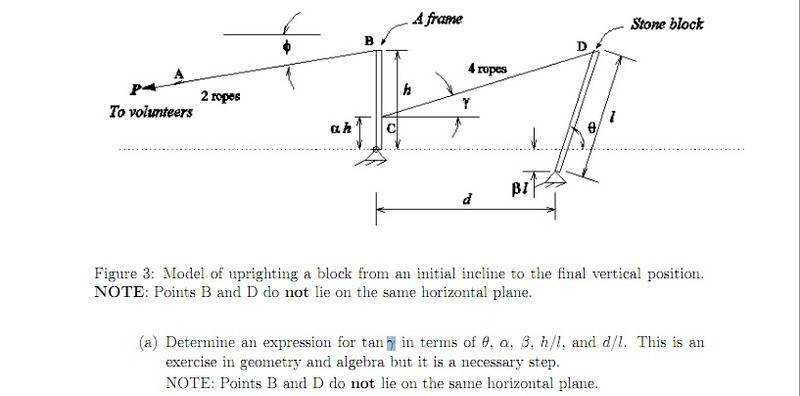
This is more a question about how the problem is written, rather than a question about how to do the problem
vmUrc.jpg


Why do they ask for tan γ in terms of d/l and h/l, rather than d and h? Is there some relation that I'm just not seeing? I'm pretty sure I know how to do the problem in terms of d and h, but the d/l and h/l terms are throwing me off
 
Physics news on Phys.org
Welcome to PF, Expat09.

If you look at all the rest of the terms, all of them are dimensionless. By this I mean, they have no units.

[itex]\theta[/itex] is in radians, which are dimensionless
[itex]\alpha[/itex] and [itex]\beta[/itex] are just constants to scale h and l.

Therefore, to make h and d dimensionless, the author chose a common length, l, to make it so there are no units for d/l and h/l.

Does this help at all?
 

Similar threads

Replies
14
Views
2K
Replies
10
Views
3K
  • · Replies 1 ·
Replies
1
Views
1K
Replies
1
Views
1K
  • · Replies 6 ·
Replies
6
Views
2K
  • · Replies 20 ·
Replies
20
Views
3K
  • · Replies 3 ·
Replies
3
Views
2K
  • · Replies 4 ·
Replies
4
Views
8K
  • · Replies 10 ·
Replies
10
Views
2K
  • · Replies 12 ·
Replies
12
Views
2K