Solving for Voltage Across Capacitor

  • Context: Engineering 
  • Thread starter Thread starter pka
  • Start date Start date
  • Tags Tags
    Capacitor Voltage
Click For Summary

Discussion Overview

The discussion revolves around solving for the voltage across a capacitor in a circuit containing multiple resistors, capacitors, and an inductor. Participants explore various techniques for analyzing the circuit, including Kirchhoff's laws, nodal analysis, and mesh analysis, while expressing confusion about the correct application of these methods.

Discussion Character

  • Exploratory
  • Technical explanation
  • Homework-related
  • Mathematical reasoning

Main Points Raised

  • One participant expresses difficulty in finding the voltage across the capacitor and questions the application of the voltage divider rule in a circuit with both series and parallel components.
  • Another participant suggests that nodal analysis is a more appropriate method for this circuit, emphasizing that voltage division requires elements to be in series.
  • A later reply critiques the use of mesh analysis and encourages writing a KCL equation directly related to the capacitor voltage.
  • Participants discuss the importance of understanding complex numbers in AC circuit analysis, noting that the principles are similar to DC circuit analysis.
  • One participant shares their equations and results, seeking feedback on their approach and expressing uncertainty about their calculations.
  • Another participant reassures that current can be found using voltage and impedance, regardless of the complexity of the numbers involved.

Areas of Agreement / Disagreement

There is no consensus on the best approach to solve the problem, with participants advocating for different methods such as nodal analysis and mesh analysis. Some express confusion over the application of voltage division, while others assert its limitations in this context.

Contextual Notes

Participants mention various mathematical steps and assumptions without resolving all uncertainties, particularly regarding the application of different analysis techniques and the handling of complex numbers.

Who May Find This Useful

This discussion may be useful for students or individuals seeking to understand circuit analysis techniques, particularly in the context of AC circuits involving capacitors and inductors.

pka
Messages
11
Reaction score
0
Hello there! I'm new to this forum and not quite sure if this question has been asked before. I've posted a link to the picture of the circuit I am trying to solve for. The circuit is rather simple but I cannot get it. =/ I need to find the voltage across the capacitor. I need to figure out the correct technique in order to do this because I have tried a few different ways and they do not give me the correct answer. I'm more concerned with how to do problems like these (multiple resistors, capacitors and inductors) because I seem to be doing something wrong and...I'm becoming more confused. This is what I've done:

I've tried Kirchoff's circuit laws and this is what I've come up with:
Vs = VR1 + VC1 and VC1 = VL + VR2 + VR3

I solved for the impedance in the inductor (ZL) and for the impedance in the capacitor (ZC). I get ZC = -j and ZL = j10.

I figured that I could use the voltage divider rule to solve for the voltage across the first resistor (VR1) which would then be:

VR1 = Vs*[ (ZR1) / (ZR1 + ZL + ZC + ZR2 + ZR3) ]
This gives me 16.3 - j2.44

Solving for the voltage across the capacitor I get VC1 = Vs - VR1.
This then gives me 83.7 + j2.44

This isn't the correct answer and I'm pretty sure not the correct way to approach this problem, lol. I don't think I've done the voltage divider rule correctly. In fact, I'm a little confused as to using the voltage divider rule. Can I still use it even though this circuit is made up of series and parallel components?

I have not tried doing a mesh current analysis just yet, but that to me seems to confuse me and take me in a circle just as much as the voltage analysis does.

Any help anyone can offer would be greatly appreciated! And many thanks in advance.Circuit:
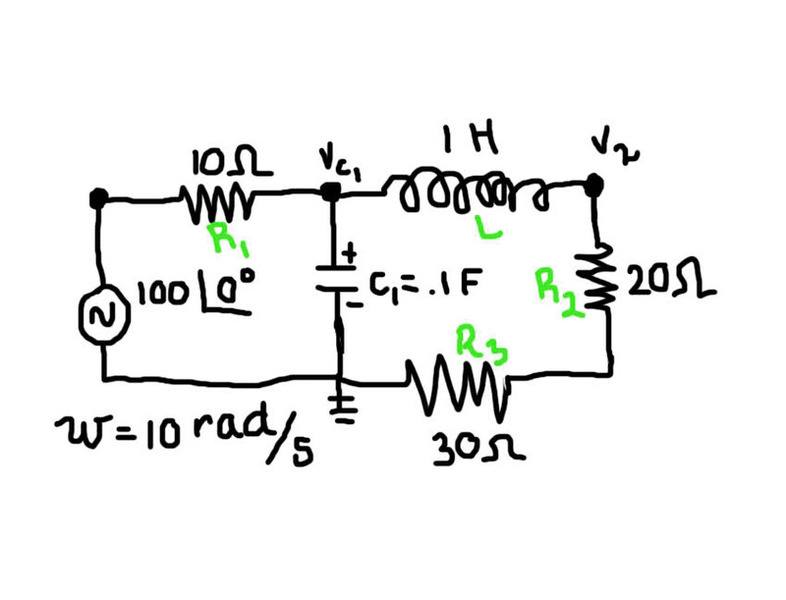
2078ca9.jpg
 
Last edited:
Physics news on Phys.org
ZL+ZR2+ZR3 are in parellel with ZC.

Welcome to PF. Normally if this is homework help, it should be posted Homework & Coursework Questions section.
 
This looks like a perfect candidate for nodal analysis. One essential node, so one equation w/ one variable.

Voltage division doesn't act the way you think it does. All elements have to be in series. You would need to do voltage divider for R1 and Zeq of [Zc || (ZL + R2 + R3)].

Typically, though, it's not the best idea to transform an element whose voltage or current you're trying to figure out. Your best course of action is to use nodal analysis on Vc, as this gets you the answer you're looking for in about 2 minutes.
 
Last edited:
Hey! Thank you for moving the thread where appropriate (whoever did it). I just wanted to respond and say thanks for the help but I still seem to not be getting the correct answer which is supposed to be (in polar notation, A|_ (theta) where A is the amplitude and theta is the phase shift) 10.01 |_(-83.2 degrees) Volts.

I have tried several different things...I don't know if my complex math skills are what is causing the problem but I have tried a mesh/voltage analysis. I designated the first loop to be called Ia (the part of the circuit where the voltage source is) and Ib (the part of the circuit where the inductor is).

My equations are as follows:

Vsource = VR1 + VC1
Vsource = Ia*ZR1 + (Ia - Ib)*ZC1

VC1 = VL + VR2 + VR3
(Ia - Ib)*ZC = Ib*ZL + Ib*ZL + Ib*ZR2 + Ib*ZR3

Solving for Ia I get from the second equation I get:
Ia = Ib* ( ZL + ZR2 + ZR3 + ZC) / ZC

When I substitute that into the first equation and solve for Ib, my final equation is this:
Ib = Vsource / [ ( (ZL + ZR2 + ZR3 + ZC)(ZR1 + ZC) / ZC ) - ZC ]

So far, is this correct or are my equations off somewhere?

The value I get for Ib is -40 + j141. The value I get for Ia is -34.5 + j3.4.

With Ia and Ib I can calculate VC1 (I think, lol) from:
VC1 = (Iz - Ib)*ZC.

Plugging in the values for all knowns I get VC1 to be -2.74 - j34.3

But...this is also not what I am supposed to be getting. Can critique my work and tell me what it is I am doing wrong?

Many thanks again for any help anyone can offer!
 
Why do you want to do this with mesh or voltage divider?

There's one essential node here and it just so happens to be the node with the exact voltage that you're looking for. Just write out a KCL equation and be done with it.

\frac{V_c_1-100}{10}+\frac{V_c_1}{-j}+\frac{V_c_1}{50+j10}=0

You should probably go back and bone up on your basic DC circuit analysis skills. This circuit should SCREAM nodal analysis to you.

edit: I wasn't trying to be rude above. But you should get used to the fact that AC circuit analysis works exactly like DC, except that you're using complex numbers. Just use what you learned in DC circuits and this stuff becomes quite easy.
 
Last edited:
You are good. Thank you so much for helping me with this problem. What was confusing me was the right hand side of the circuit. I wasn't sure if I could turn the series part into an equivalent impedance and then solve for the current across the capacitor. Also, I get confused with solving problems like these. But thank you for the help! I know what I am doing now and I'm going to practice more of these problems.

I was wondering though, if I wanted to find the current across one of the other resistors (R2 or R3) or even the inductor, could I or would I have to then use mesh?
 
Last edited:
You could use mesh to verify your answer if you like, but it's not needed to get the current. You can simply divide V_c1 by the impedance to get the current through the inductor, r_2 or r_3 (it's all the same current). The sooner you just forget that you're working with complex numbers the better. You find current the exact same way as you did in DC, you divide the voltage by the impedance (resistance) it's going through. So V_c1/(50+J10) is the current on the right. And the current on the left is (V_c1-100)/10.
 

Similar threads

  • · Replies 4 ·
Replies
4
Views
2K
  • · Replies 4 ·
Replies
4
Views
2K
  • · Replies 15 ·
Replies
15
Views
7K
Replies
15
Views
3K
  • · Replies 19 ·
Replies
19
Views
5K
Replies
2
Views
1K
  • · Replies 3 ·
Replies
3
Views
2K
  • · Replies 4 ·
Replies
4
Views
7K
  • · Replies 10 ·
Replies
10
Views
3K
  • · Replies 2 ·
Replies
2
Views
2K