Solving Giant Swing Horizontal Cable Tension

Click For Summary
SUMMARY

The discussion focuses on calculating the tension in the horizontal cable of a Giant Swing apparatus, where the seat swings at 33.0 revolutions per minute (rev/min) with a combined weight of 1164 N (295 N for the chair and 869 N for the person). The key equations used include centripetal force (Fc = mv²/r) and the relationship between period, circumference, and velocity. The user initially struggled with converting rev/min to meters per second (m/s) and correctly applying the principles of free body diagrams (FBD) to balance forces. The solution emphasizes treating the person and chair as a single object to simplify calculations.

PREREQUISITES
  • Understanding of centripetal force and its calculation (Fc = mv²/r)
  • Knowledge of free body diagrams (FBD) and force balance
  • Ability to convert angular velocity from revolutions per minute to linear velocity in meters per second
  • Familiarity with trigonometric functions in physics (sine, cosine)
NEXT STEPS
  • Learn how to convert angular velocity from rev/min to m/s accurately
  • Study the principles of centripetal acceleration and its applications in circular motion
  • Explore advanced free body diagram techniques for complex systems
  • Investigate the effects of different angles on tension in cables in similar physics problems
USEFUL FOR

Physics students, educators, and engineers interested in mechanics, particularly those studying circular motion and tension in cables.

jasonchiang97
Messages
72
Reaction score
2
1. Homework Statement
In one of the versions of the "Giant Swing", the seat is connected to two cables, one of which is horizontal (Figure 1) . The seat swings in a horizontal circle at a rate of 33.0 rev/min .

If the seat weighs 295 N and a 869-N person is sitting in it, find the tension in the horizontal cable.
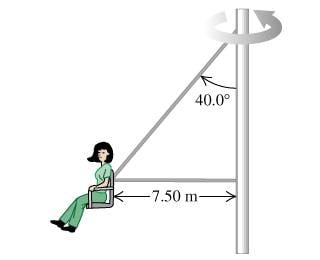
YF-05-58.jpg

Homework Equations


Fc=mv2/r
Period=circumference/velocity so 2πR/v

The Attempt at a Solution


I drew two FBD(free body diagrams). One for the person and one for the chair
For the person : TsinΘ-W-Fn=0
T=(W+Fn)/sinΘ
Fn = Weight of the chair

For the chair: Th+TcosΘ=mv2/r
Th = mv2/r - TcosΘ
mv2/r - [(Wc + Wp)/sinΘ]*cosΘ

To get the velocity, we use period = circumference /velocity
33 rev/min * 1min/60 sec = 0.55 rev/sec
0.55 = 2π(7.5)/v
v=85.68m/s
m= (Wp + Wc)/9.8
So (Wp+Wc/9.8)(81.68)2/7.5 - (295+869)/tan40

Basically I end up getting a huge number and I'm fairly certain that it's wrong but can't see why
 
Physics news on Phys.org
jasonchiang97 said:

I drew two FBD(free body diagrams). One for the person and one for the chair
I haven't checked your work in detail (sorry) but you should be able to treat the person and chair as a single object. The vertical component of the tension in the slanted cable must balance the weight of the person+chair, and the horizontal components of the two tensions must provide the centripetal acceleration.
 
Nathanael said:
I haven't checked your work in detail (sorry) but you should be able to treat the person and chair as a single object. The vertical component of the tension in the slanted cable must balance the weight of the person+chair, and the horizontal components of the two tensions must provide the centripetal acceleration.

yea that's basically what I did. I guess my main problem is I don't know how to convert rev/min to m/s so I just took the rev/min and divided it by 60 to get rev/sec which gives 0.55rev/sec

I then took 2π(7.5)/0.55 to get velocity. Wondering if that step is correct
 
##2\pi\frac{\text{radians}}{\text{revolution}}\cdot 7.5\frac{\text{meters}}{\text{radian}}\cdot\frac{1}{0.55\frac{\text{revolutions}}{\text{second}}}##

Check the units in the above equation. If it is not meters/second then try to fix it so it is.
 

Similar threads

  • · Replies 9 ·
Replies
9
Views
4K
  • · Replies 26 ·
Replies
26
Views
4K
Replies
2
Views
2K
  • · Replies 16 ·
Replies
16
Views
24K
  • · Replies 9 ·
Replies
9
Views
35K