Solving Laplace Equations using this boundary conditions?

Click For Summary
The discussion centers on solving the Laplace equation Uxx + Uyy = 0 with specified boundary conditions. The user successfully applied separation of variables and derived a solution for k = 0, yielding U(x,y) = y/b + 1. However, confusion arises when dealing with the case where k < 0, particularly with the boundary conditions and the Fourier series coefficients. A suggestion is made to redefine k as -c^2 and use sine and cosine functions appropriately to address the boundary conditions. The user is advised that the cosine expansion of 1 on the interval [0,a] leads to the vanishing of other coefficients, which is crucial for finding a valid solution.
astrodeva
Messages
1
Reaction score
0
The equation is Uxx + Uyy = 0
And domain of solution is 0 < x < a, 0 < y < b
Boundary conditions:
Ux(0,y) = Ux(a,y) = 0
U(x,0) = 1
U(x,b) = 2

What I've done is that I did separation of variables:
U(x,y)=X(x)Y(y)

Plugging into the equation gives:
X''Y + XY'' = 0

Rearranging:
X''/X = -Y''/Y = k

For case k > 0, I saw that it gives no non-trivial solutions.
For case k = 0, I solved it and found U(x,y) = y/b + 1

For case k < 0, I'm slightly lost.
X'' + kX = 0
Y'' - kX = 0
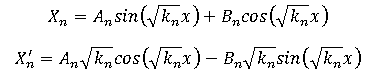
upload_2016-4-9_12-32-57.png


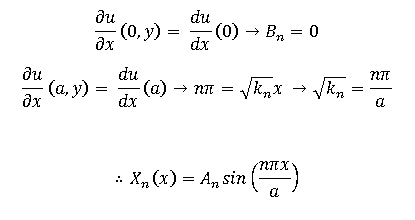
Using the X boundary conditions:
upload_2016-4-9_12-33-41.png


upload_2016-4-9_12-34-11.png

Using the Y boundary condition:
upload_2016-4-9_12-34-47.png

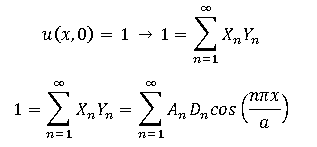
Using Fourier Series to find the coefficient:
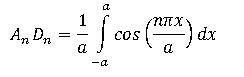
upload_2016-4-9_12-34-59.png


But the integral just gives Dn = 0, and this doesn't satisfy u(x,0) = 1.

Can someone explain where I went wrong?

Thanks!
 

Attachments

  • upload_2016-4-9_12-34-29.png
    upload_2016-4-9_12-34-29.png
    1.4 KB · Views: 307
  • upload_2016-4-9_12-34-45.png
    upload_2016-4-9_12-34-45.png
    1 KB · Views: 482
Physics news on Phys.org
Your working is confusing.

If you start with X&#039;&#039; = kX and want k &lt; 0, you should then be writing \sin(\sqrt{|k|}x) and so forth, or defining k = -c^2 where c \geq 0.

You want to be using cosines, which in fact you end up doing, but only after expressly stating that X_n = A_n\sin(n\pi x/a).

Now the cosine expansion of 1 on [0,a] is \cos(0x). Thus you have correctly determined that all the other coefficients vanish.
 
Question: A clock's minute hand has length 4 and its hour hand has length 3. What is the distance between the tips at the moment when it is increasing most rapidly?(Putnam Exam Question) Answer: Making assumption that both the hands moves at constant angular velocities, the answer is ## \sqrt{7} .## But don't you think this assumption is somewhat doubtful and wrong?

Similar threads

  • · Replies 11 ·
Replies
11
Views
3K
  • · Replies 5 ·
Replies
5
Views
3K
  • · Replies 1 ·
Replies
1
Views
1K
Replies
4
Views
2K
  • · Replies 5 ·
Replies
5
Views
1K
Replies
6
Views
2K
Replies
7
Views
2K
Replies
3
Views
2K
  • · Replies 1 ·
Replies
1
Views
2K