Graduate Solving Laplace's equation in polar coordinates for specific boundary conditions

Click For Summary
SUMMARY

This discussion focuses on solving Laplace's equation in polar coordinates to determine the magnetic scalar potential inside and outside a ferromagnetic wire under specific boundary conditions. The user, Stefan, seeks clarity on deriving solutions based on Gerber's "Applied Magnetism" (1994), particularly regarding the use of a linear combination of cylindrical harmonics. Key steps include obtaining the Fourier series for the boundary conditions and solving simultaneous equations for coefficients related to the magnetic potentials.

PREREQUISITES
  • Understanding of Laplace's equation in polar coordinates
  • Familiarity with magnetic scalar potential concepts
  • Knowledge of Fourier series and their application in boundary value problems
  • Experience with second-order linear ordinary differential equations (ODEs)
NEXT STEPS
  • Study the derivation of Fourier series for boundary conditions in electromagnetic problems
  • Learn about cylindrical harmonics and their role in solving Laplace's equation
  • Explore methods for solving simultaneous equations in the context of boundary value problems
  • Review applications of magnetic scalar potential in different geometries
USEFUL FOR

Graduate students in physics or engineering, researchers working on electromagnetic theory, and anyone interested in advanced mathematical methods for solving boundary value problems in physics.

Stefan H
Messages
3
Reaction score
0
TL;DR
Solving Laplace's equation for magnetic potentials inside and outside a ferromagnetic wire with specific boundary conditions. Help needed in understanding how to obtain the solution.
Hello everybody,

Currently I am doing my master's thesis and I've encountered a physics problem which is very difficult for me to solve. The problem I have is finding equations for the magnetic scalar potential inside and outside a ferromagnetic wire for specific boundary conditions.

Explanation of the problem:
A ferromagnetic wire is located in an external magnetic field. This means there is a magnetic potential inside and outside of the wire. I want to find specific solutions on the surface of the wire (r=a).
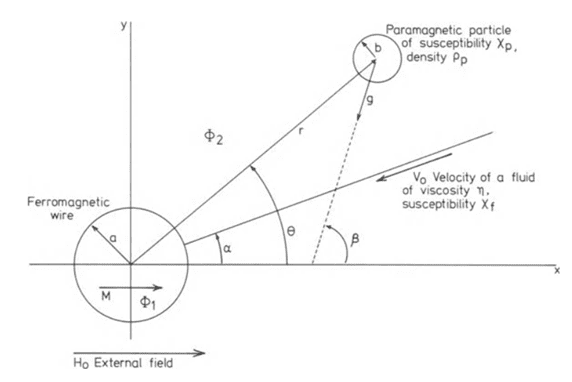
Geometry of the problem.png


My solution approach was to first solve Laplace's equation for polar coordinates for both magnetic potentials:
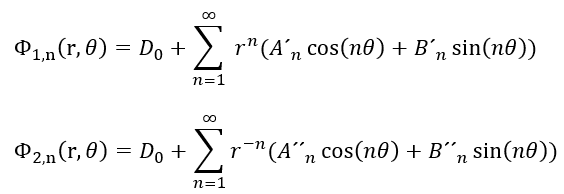
1640186034281.png


Now I want to find an expression for both potentials on the surface of the wire to obtain this solution (According to Gerber: "Applied Magnetism", 1994):
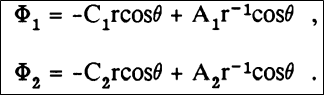
Solution of Laplace's equation.png


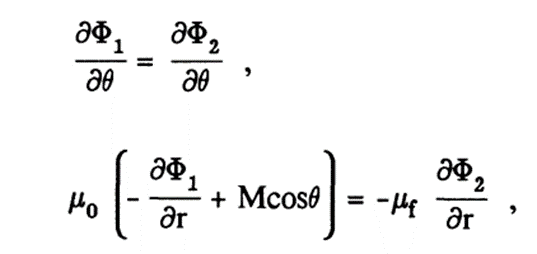
with the given boundary conditions:

1640186289463.png


The next goal would be to determine the constants C1, A1, C2 and A2. However, I really don't get how Gerber came to this type of solution. He only mentioned to use Laplace's equation and the boundary conditions with quote: "linear combination of cylindrical harmonics" to get his solution.

My overall goal is to understand his approach for this kind of problem, so I can apply it to a different geometry. It would be very nice if anybody here could help me out :)

Thanks in advance and happy Holidays,
Stefan
 
Last edited:
Physics news on Phys.org
Stefan H said:
Summary:: Solving Laplace's equation for magnetic potentials inside and outside a ferromagnetic wire with specific boundary conditions. Help needed in understanding how to obtain the solution.

Hello everybody,

Currently I am doing my master's thesis and I've encountered a physics problem which is very difficult for me to solve. The problem I have is finding equations for the magnetic scalar potential inside and outside a ferromagnetic wire for specific boundary conditions.

Explanation of the problem:
A ferromagnetic wire is located in an external magnetic field. This means there is a magnetic potential inside and outside of the wire. I want to find specific solutions on the surface of the wire (r=a).
View attachment 294600

My solution approach was to first solve Laplace's equation for polar coordinates for both magnetic potentials:View attachment 294601

Now I want to find an expression for both potentials on the surface of the wire to obtain this solution (According to Gerber: "Applied Magnetism", 1994):

View attachment 294602

with the given boundary conditions:

View attachment 294603

The next goal would be to determine the constants C1, A1, C2 and A2. However, I really don't get how Gerber came to this type of solution. He only mentioned to use Laplace's equation and the boundary conditions with quote: "linear combination of cylindrical harmonics" to get his solution.

My overall goal is to understand his approach for this kind of problem, so I can apply it to a different geometry. It would be very nice if anybody here could help me out :)

Thanks in advance and happy Holidays,
Stefan

The method is to obtain the Fourier series for \partial \Phi/\partial r on the boundary, and determine the coefficients of r^{\pm n}\cos(n\theta) and r^{\pm n}\sin(n\theta accordingly. In this case that is straightforward: the Fourier series for \mu_0M\cos\theta is \mu_0M\cos\theta. Thus from the boundary conditions you get the following simultaneous equations for n \geq 1: <br /> \begin{split}<br /> A_n&#039; - A_n&#039;&#039; &amp;= 0\\<br /> B_n&#039; - B_n&#039;&#039; &amp;= 0\\<br /> \mu_0A_n&#039; + \mu_fA_n&#039;&#039; &amp;= \begin{cases}<br /> \mu_0M, &amp; n = 1 \\ 0 &amp; n &gt; 1,<br /> \end{cases} \\<br /> \mu_0B_n&#039; + \mu_fB_n&#039;&#039; &amp;= 0<br /> \end{split} These have the unique solution A_n&#039; = A_n&#039;&#039; = 0 for n &gt;1 while A_1&#039; = A_1&#039;&#039; is non-zero, with B_n&#039; = B_n&#039;&#039; = 0 for all n.

Once you become sufficiently familiar with second-order linear ODEs, it will be intuitively obvious that only the r^{\pm1}\cos\theta terms were required here.
 
Thank you so much for your answer!

However I still have some questions left:
  1. Why is it necessary to obtain the Fourier series? The way I would proceed on this problem is to form the derivative depending on theta and r separately and put it in the boundary conditions. However, this would just lead to more equations which I don't know how to simplify.
  2. Maybe I put it wrong, but A´n, A´´n, B´n and B´´n are just coefficients. They don't mean the derivative of something. Is the answer still true then?
  3. I sadly don't really understand why the Fourier series of
    1640200589240.png
    is required, how it is obtained and how the following simultaneous equations are obtained. If you could elaborate on that, it would be very helpful.
 
pasmith said:
The method is to obtain the Fourier series for \partial \Phi/\partial r on the boundary, and determine the coefficients of r^{\pm n}\cos(n\theta) and r^{\pm n}\sin(n\theta accordingly. In this case that is straightforward: the Fourier series for \mu_0M\cos\theta is \mu_0M\cos\theta. Thus from the boundary conditions you get the following simultaneous equations for n \geq 1: <br /> \begin{split}<br /> A_n&#039; - A_n&#039;&#039; &amp;= 0\\<br /> B_n&#039; - B_n&#039;&#039; &amp;= 0\\<br /> \mu_0A_n&#039; + \mu_fA_n&#039;&#039; &amp;= \begin{cases}<br /> \mu_0M, &amp; n = 1 \\ 0 &amp; n &gt; 1,<br /> \end{cases} \\<br /> \mu_0B_n&#039; + \mu_fB_n&#039;&#039; &amp;= 0<br /> \end{split} These have the unique solution A_n&#039; = A_n&#039;&#039; = 0 for n &gt;1 while A_1&#039; = A_1&#039;&#039; is non-zero, with B_n&#039; = B_n&#039;&#039; = 0 for all n.

Once you become sufficiently familiar with second-order linear ODEs, it will be intuitively obvious that only the r^{\pm1}\cos\theta terms were required here.
Sorry that I am posting that again, but maybe you didn't see my answer since I did not reply directly to you.

Thank you so much for your answer!

However I still have some questions left:
  1. Why is it necessary to obtain the Fourier series? The way I would proceed on this problem is to form the derivative depending on theta and r separately and put it in the boundary conditions. However, this would just lead to more equations which I don't know how to simplify.
  2. Maybe I put it wrong, but A´n, A´´n, B´n and B´´n are just coefficients. They don't mean the derivative of something. Is the answer still true then?
  3. I sadly don't really understand why the Fourier series of
    1640200589240-png.png

    is required, how it is obtained and how the following simultaneous equations are obtained. If you could elaborate on that, it would be very helpful.
 

Similar threads

  • · Replies 22 ·
Replies
22
Views
4K
  • · Replies 8 ·
Replies
8
Views
4K
  • · Replies 2 ·
Replies
2
Views
2K
  • · Replies 6 ·
Replies
6
Views
2K
  • · Replies 2 ·
Replies
2
Views
2K
  • · Replies 4 ·
Replies
4
Views
2K
  • · Replies 5 ·
Replies
5
Views
1K
  • · Replies 1 ·
Replies
1
Views
1K
  • · Replies 5 ·
Replies
5
Views
3K