Solving Line Integral Limits: Negative Result?

Click For Summary
SUMMARY

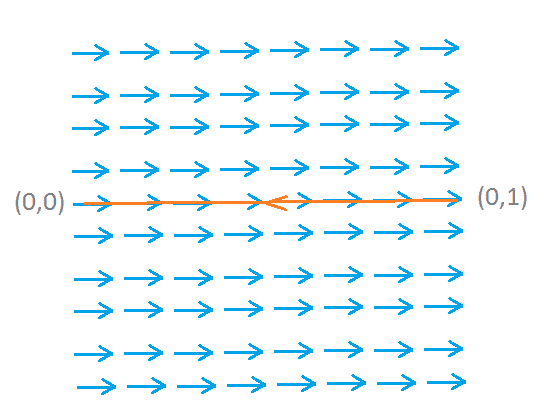
The discussion centers on the evaluation of a line integral in a vector field defined by f(x)=\hat{x} along a path directed from right to left. The user initially sets up the integral with limits from 1 to 0, resulting in a positive value of 1, which contradicts the expected negative outcome. The confusion arises from the double counting of the negative sign in the differential element ds, where the user incorrectly incorporates the negative sign of dx while also reversing the limits of integration. The correct interpretation clarifies that the integral should yield a negative result due to the direction of the path.

PREREQUISITES
  • Understanding of line integrals in vector calculus
  • Familiarity with vector fields and their representation
  • Knowledge of differential elements in integration
  • Proficiency in evaluating integrals with variable limits
NEXT STEPS
  • Review the concept of line integrals in vector fields
  • Study the properties of differential elements in integration
  • Learn about the implications of path direction on integral evaluation
  • Explore examples of line integrals with varying limits and orientations
USEFUL FOR

Students and professionals in mathematics, physics, and engineering who are working with vector calculus, particularly those focusing on line integrals and their applications in various fields.

OmegaKV
Messages
22
Reaction score
1
I want to the line integral in the following picture:
P220f03.png


The field is the blue arrows that go left to right, and the path is the orange line that is going from right to left.

Just by looking at the picture, it is clear that the result will be negative, but when I set up the integration this is what I get:

I'm letting the field be:

f(x)=\hat{x}

and since the path is pointing left, ds will be:

ds=dx*(-\hat{x})=-dx\hat{x}

and the path goes from x=1 to x=0, so the integration limits are from 1 to 0.

so the line integral is:

\int^b_a f \cdot ds=\int^0_1 (\hat{x} \cdot (-dx\hat{x})) = \int^0_1 (-dx) = 1

Why am I getting a positive number?
 
Physics news on Phys.org
You are double counting the negative sign of dx by both inserting it explicitly and letting the integration go from 1 to 0.
 
  • Like
Likes   Reactions: OmegaKV

Similar threads

  • · Replies 11 ·
Replies
11
Views
2K
  • · Replies 3 ·
Replies
3
Views
2K
  • · Replies 12 ·
Replies
12
Views
3K
  • · Replies 4 ·
Replies
4
Views
3K
  • · Replies 6 ·
Replies
6
Views
2K
  • · Replies 3 ·
Replies
3
Views
2K
  • · Replies 1 ·
Replies
1
Views
2K
  • · Replies 3 ·
Replies
3
Views
3K
  • · Replies 8 ·
Replies
8
Views
4K