Solving ODEs Using Laplace: Two Challenging Problems

  • Thread starter Thread starter sandpants
  • Start date Start date
  • Tags Tags
    Laplace Odes
Click For Summary
The discussion focuses on solving two ordinary differential equations (ODEs) using the Laplace transform method. The first problem involves the equation x'' + 3x' + 2x = e^(-t) with initial conditions x(0) = 0 and dx/dt = 0, where participants identify errors in partial fraction decomposition leading to incorrect initial values. The second problem, x'' - 2x' + 10x = e^(2t) with initial conditions x(0) = 0 and dx/dt = 1, presents challenges due to complex roots in the characteristic equation, complicating the inverse Laplace transform. Participants express frustration with the Laplace method, suggesting that direct methods like undetermined coefficients may be more straightforward. The conversation highlights the importance of careful calculation and verification in solving ODEs.
sandpants
Messages
21
Reaction score
0
I have the following 2 problems to solve using Laplace.

1) x'' + 3x' +2x=e^(-t); with x=dx/dt=0 when t = 0
2) x'' - 2x' +10x=e^(2t); with x=0 and dx/dt=1 when t=0
Where x' is dx/dt and x'' is the second derivative against time.

My attempts:

1)Using laplace I get

s2X(s)-x(0)-x'(0)+3sX(s)-x(0)+2X(s)=1/(s+1)

with x(0)=0, x'(0)=0 then

X(s)=1 over (s+1)(s2+3s+2) which is 1/[(s+1)(s+1)(s+2)] or 1/[(s+1)2(s+2)]
Using partial fraction
1/[(s+1)2(s+2)]=A/(s+1)+B/(s+1)2+C/(s+2).

I'll avoid doing the calcs; I may have made a mistake here, but I checked multiple times and didnt find and error.

A=10/12, B=-1/6 and C=-1 so that, after doing inverse laplace

x(t)=5/6e-t-1/6t*e-t-e-2t
But here's the issue. With this, x(0)=/=0. It's -1/6. and dx(0)/dt=1. I can't figure out where I went wrong.

2)The laplace transform is
s2 X(s)-x(0)-x'(0)-2sX(s)-x(0)+10X(s)=1/(s-2)
with x'(0)=1 this rearranges to

X(s)(s2-2s+10)=1/(s-2)+1=(s-1)/(s-2)
X(s)=(s-1)/[(s-2)(s2-2s+10)]

This is where I helplessly run around in circles. The quadratic roots are complex, and whilst they discomfort me only slightly, the issue is that I cannot rearrange this into a suitable form where the inverse laplace can be done.
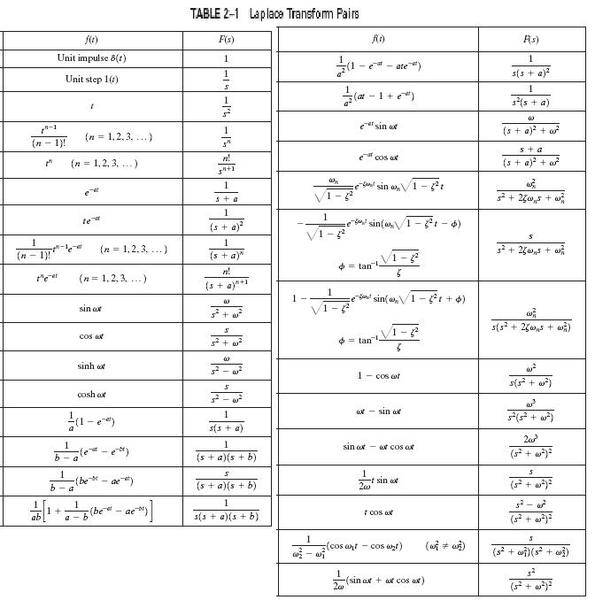
Laplace+Transform+Pairs.JPG

Taken from http://www.therationaltheorist.org/2009/11/fourier-analysis-and-odes.html
 
Physics news on Phys.org
sandpants said:
I have the following 2 problems to solve using Laplace.

1) x'' + 3x' +2x=e^(-t); with x=dx/dt=0 when t = 0
2) x'' - 2x' +10x=e^(2t); with x=0 and dx/dt=1 when t=0
Where x' is dx/dt and x'' is the second derivative against time.

My attempts:

1)Using laplace I get

s2X(s)-x(0)-x'(0)+3sX(s)-x(0)+2X(s)=1/(s+1)

with x(0)=0, x'(0)=0 then

X(s)=1 over (s+1)(s2+3s+2) which is 1/[(s+1)(s+1)(s+2)] or 1/[(s+1)2(s+2)]
Using partial fraction
1/[(s+1)2(s+2)]=A/(s+1)+B/(s+1)2+C/(s+2).

I'll avoid doing the calcs; I may have made a mistake here, but I checked multiple times and didnt find and error.

A=10/12, B=-1/6 and C=-1 so that, after doing inverse laplace

x(t)=5/6e-t-1/6t*e-t-e-2t
But here's the issue. With this, x(0)=/=0. It's -1/6. and dx(0)/dt=1. I can't figure out where I went wrong.
There's nothing that jumps out at me on how you set things up, but your answer is incorrect.

Using a different method, I got x(t) = (1/3)e-2t - (1/3)e-t - (1/3)te-t.

First place I'd check is the partial fractions decomposition. Can you verify that
$$ \frac{10/12}{s + 1} + \frac{-1/6}{(s + 1)^2} + \frac{-1}{s + 2} = \frac{1}{(s + 1)^2(s + 2)} ?$$


sandpants said:
2)The laplace transform is
s2 X(s)-x(0)-x'(0)-2sX(s)-x(0)+10X(s)=1/(s-2)
with x'(0)=1 this rearranges to

X(s)(s2-2s+10)=1/(s-2)+1=(s-1)/(s-2)
X(s)=(s-1)/[(s-2)(s2-2s+10)]

This is where I helplessly run around in circles. The quadratic roots are complex, and whilst they discomfort me only slightly, the issue is that I cannot rearrange this into a suitable form where the inverse laplace can be done.

Laplace+Transform+Pairs.JPG

Taken from http://www.therationaltheorist.org/2009/11/fourier-analysis-and-odes.html
 
I think I've noticed where I've made the mistake: left hand side of the partial fractions.

s+1=A(s+1)^2(s+2)+B(s+1)(s+2)+C(s+1)^3, not 1=A(s+1)^2(s+2)+B(s+1)(s+2)+C(s+1)^3 for which I calculated.

EDIT:

A=-1
B=1
C=1
Is what at I get now.
x(t)=e^(-2t)+te^(-t)-e^(-t) which is equal to 0 on t=0, and the derivative is 0 as well.
However this answer is different from the above.
 
Last edited:
sandpants said:
I think I've noticed where I've made the mistake: left hand side of the partial fractions.

s+1=A(s+1)^2(s+2)+B(s+1)(s+2)+C(s+1)^3, not 1=A(s+1)^2(s+2)+B(s+1)(s+2)+C(s+1)^3 for which I calculated.

EDIT:

A=-1
B=1
C=1
Is what at I get now.
x(t)=e^(-2t)+te^(-t)-e^(-t) which is equal to 0 on t=0, and the derivative is 0 as well.
However this answer is different from the above.
I agree with your new answer. I checked my previous answer, but apparently not well enough, as it was incorrect.

I'll take a look at your other question in a bit.
 
For the second problem, look at the eatcos(ωt) and eatsin(ωt) entries in your table. The expression s2 - 2s + 10 can be written as s2 - 2s + 1 + 9, and factored as (s - 1)2 + 32

Your solution will involve some linear combination of three functions: etsin(3t), etcos(3t), and e2t.
 
  • Like
Likes 1 person
Many thanks.
 
Can I do my usual rant about how I dislike the whole "Laplace Transform" method? Of course, it is much easier to do both of these 'directly'. The "characteristic" equation for x''+ 3x'+ 2= 0 is r^+ 3r+ 2= (r+ 2)(r+ 1)= 0. which has solutions -2 and -1 so the general solution is x= Ce^{-2t}+ De^{-t}. Then find a particular solution to the entire equation by "undetermined coefficients"- try x= Ate^{-t}.

The second equation has characteristic equation r^2+ 2r-10= (r+ 5)(r- 2)= 0. And you can try x= Ate^{2t} for a specific solution to the equation.
 
HallsofIvy said:
Can I do my usual rant about how I dislike the whole "Laplace Transform" method? Of course, it is much easier to do both of these 'directly'.
I agree, and that's the way I did them.

HallsofIvy said:
The "characteristic" equation for x''+ 3x'+ 2= 0 is r^+ 3r+ 2= (r+ 2)(r+ 1)= 0. which has solutions -2 and -1 so the general solution is x= Ce^{-2t}+ De^{-t}. Then find a particular solution to the entire equation by "undetermined coefficients"- try x= Ate^{-t}.

The second equation has characteristic equation r^2+ 2r-10= (r+ 5)(r- 2)= 0.
No, those aren't the factors. As it turns out, the roots of the characteristic equation are complex; namely, r = 1 ##\pm 3i##.
HallsofIvy said:
And you can try x= Ate^{2t} for a specific solution to the equation.
xp = Ae2t will work as a particular solution, as there are no repeated roots of the third-degree characteristic equation (thinking in terms of annihilators).
 
It was a past examination task.

I'm not particularly impressed by the Laplace transforms. I do see the convenience but I find it is mostly overshadowed by the need to be able to articulate numbers and expressions around very well.
 

Similar threads

Replies
9
Views
2K
  • · Replies 7 ·
Replies
7
Views
2K
Replies
6
Views
2K
Replies
2
Views
2K
  • · Replies 10 ·
Replies
10
Views
2K
  • · Replies 2 ·
Replies
2
Views
1K
Replies
5
Views
2K
  • · Replies 8 ·
Replies
8
Views
2K
  • · Replies 14 ·
Replies
14
Views
1K
  • · Replies 3 ·
Replies
3
Views
3K