Solving Op-Amp Current Analysis: LH0005 National Semiconductor

Click For Summary

Discussion Overview

The discussion revolves around solving a homework problem related to the LH0005 op-amp from National Semiconductor, specifically focusing on determining the collector current through each transistor in the circuit. The scope includes technical analysis and mathematical reasoning related to op-amp behavior and transistor characteristics.

Discussion Character

  • Homework-related
  • Technical explanation
  • Mathematical reasoning
  • Debate/contested

Main Points Raised

  • One participant seeks help in determining the collector current IC2, providing initial equations and values such as β = 100 and VBE = 0.7.
  • Another participant points out a potential oversight regarding the transistor Q6 being a PNP type, which requires a negative VBE value.
  • There is a question raised about whether the quiescent collector currents need to be calculated for the given input voltages, suggesting that the base potentials for Q1 and Q3 may be equal, leading to contradictions with the input signal voltages.
  • A participant clarifies their misunderstanding about the circuit drawing, realizing that nodes "1" and "3" are not separate input voltages but rather node names, which simplifies their analysis.
  • Another participant calculates the emitter voltage based on the assumption that both open base terminals are grounded, leading to a method for finding the current through the emitter resistor.
  • There is a discussion about the correct interpretation of the current I2, with one participant suggesting it should be half of the emitter current IE.
  • One participant expresses gratitude for the guidance received, indicating they have resolved their confusion regarding the ground voltage and successfully solved the problem.
  • A later post requests further elaboration on how voltage gain and input resistance are calculated, indicating ongoing exploration of related concepts.

Areas of Agreement / Disagreement

Participants express differing interpretations of the circuit and the requirements of the problem, leading to multiple competing views on how to approach the calculations. The discussion remains unresolved in terms of a definitive method for calculating the collector currents, as participants explore various hypotheses and corrections.

Contextual Notes

Participants note that assumptions about input voltages and transistor configurations may affect their calculations. There is also mention of the need to clarify the definitions of certain terms and the implications of the circuit's configuration on the analysis.

Who May Find This Useful

Students studying op-amps, electronics, or circuit analysis may find this discussion useful, particularly those working on similar homework problems or seeking to understand the behavior of transistors in op-amp circuits.

txp2037
Messages
5
Reaction score
0
Member advised to use the homework template for posts in the homework sections of PF.
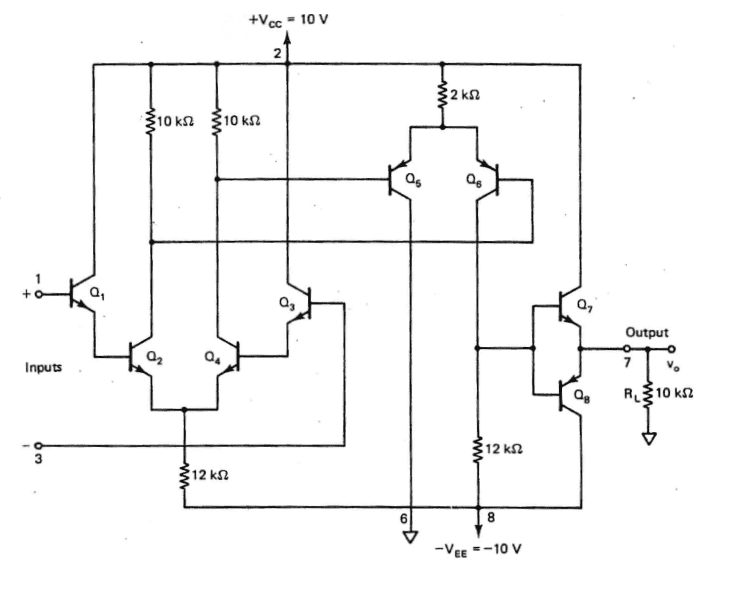
Thank you for reading my post. I'm currently studying Op-amp, and there is a homework about LH 0005 of National Semiconductor for me to do: determine the collector current through each transistor

I'm trying to find the IC2 but don't know how. Please help me with this :)

Homework Statement


Given: β = 100 & VBE = 0.7

Homework Equations

The Attempt at a Solution


I tried to analyze but I'm stuck at the moment. Here are somethings that I've figured out so far:
VC2 = VCC - 10k*IC2
VE6 = VC2 - VBE6 = VC2 - 0.7
VC5 <<<
I2 = (VE2 + VEE) / 12k
I6 = (VE6 + VCC) / 2k

I'm trying to find the IC2 but don't know how. Please help me with this :)
a1d0e395e0.png

I'm looking forward to seeing your response soon :)
 
Last edited by a moderator:
Physics news on Phys.org
Txp2037, you have overlooked that Q6 is pnp (VBE=-0.7V).
 
LvW said:
Txp2037, you have overlooked that Q6 is pnp (VBE=-0.7V).
Thank you for reminding me :) I'm struggling with the problem. By any chance you can give me some hints?
 
txp2037 said:
Thank you for reminding me :) I'm struggling with the problem. By any chance you can give me some hints?

Question: Are you required to find the quiescent collector currents for the shown input voltages?
This will create problems because - assuming VBE=0.7V as mentioned - the base potentials for Q1 and Q3 are equal.
However, this is in contradiction to the given signal voltages.
It is more likely that Q3 will be completely off. However, in this case, we are not in linear mode anymore.
Perhaps you should review the task again (with the dc input voltages)?
 
LvW said:
Question: Are you required to find the quiescent collector currents for the shown input voltages?
This will create problems because - assuming VBE=0.7V as mentioned - the base potentials for Q1 and Q3 are equal.
However, this is in contradiction to the given signal voltages.
It is more likely that Q3 will be completely off. However, in this case, we are not in linear mode anymore.
Perhaps you should review the task again (with the dc input voltages)?
Thank you for your reply. My requirement are (and I quote): Referring to the LH0005 op-amp equivalent circuit shown in figure, determine (a) the collector current through each transistor and (b) the de voltage at the output terminal. (Assume that each transistor has βdc = βac = 100 and VBE = 0.7 V.)
I think I can sort the (b) out, but I don't know how to find the collector current. I've written down some equations so when I know the IC2, I can solve the problem. About the input voltage, there are nothing given :)
 
Oh sorry - I have misinterpreted the drawing. So "1" and "3" are node names and not two different input voltages.
Therefore, I now assume that both open base terminals are grounded, correct?

In this case, it is a simple task to find the voltage at the common emitter node (because of VBE=0.7V for each transistor). This allows to compute the current to the emitter resistor (12k) - and the current is equally splitted between both transistors Q2 and Q4.
 
LvW said:
Oh sorry - I have misinterpreted the drawing. So "1" and "3" are node names and not two different input voltages.
Therefore, I now assume that both open base terminals are grounded, correct?

In this case, it is a simple task to find the voltage at the common emitter node (because of VBE=0.7V for each transistor). This allows to compute the current to the emitter resistor (12k) - and the current is equally splitted between both transistors Q2 and Q4.
You gave something awesome here. So as you said, the VB1 will be 0V. Then VE1 = VB1 - VBE1 = 0 - 0.7 = -0.7V.
VE1 = VB2 = -0.7V ==> VE2 = VB2 - VBE2 = -1.4V
Then I can find the I2 = 2IE2 = (VE2 + VEE) / 12k = (-1.4 + 10) / 12k =~ 0.717mA.
Am I currently on the right way?
 
txp2037 said:
Then I can find the I2 = 2IE2
I rather think that I2=IE/2.
 
  • Like
Likes   Reactions: txp2037
LvW said:
I rather think that I2=IE/2.
Thank you for your help. Under your guide, I've managed to solved the problem completely :) I was misunderstood about the "ground" voltage that should be 0V. With that information, everything was clear :) Thank you sir
 
  • #10
Could you further elaborate how voltage gain, Ri etc are calculated...
 

Similar threads

  • · Replies 8 ·
Replies
8
Views
2K
Replies
15
Views
3K
  • · Replies 1 ·
Replies
1
Views
2K
  • · Replies 13 ·
Replies
13
Views
2K
  • · Replies 17 ·
Replies
17
Views
3K
Replies
7
Views
2K
  • · Replies 16 ·
Replies
16
Views
4K
  • · Replies 7 ·
Replies
7
Views
5K
Replies
2
Views
5K
  • · Replies 5 ·
Replies
5
Views
4K