Solving Partial Derivation Homework Problem

Click For Summary
SUMMARY

This discussion focuses on solving a partial differentiation homework problem, specifically finding the partial derivatives Fx, Fy, and Fz. The participants clarify that when differentiating a function with respect to one variable, other variables are treated as constants. The correct approach is illustrated with examples, such as differentiating the term x^2yz, which results in 2xyz. The conversation concludes with a recommendation to consult the tutorial at Lamar University's website for further understanding of partial derivatives.

PREREQUISITES
  • Understanding of basic calculus concepts, particularly differentiation.
  • Familiarity with partial derivatives and their notation.
  • Knowledge of functions involving multiple variables.
  • Ability to interpret mathematical expressions and equations.
NEXT STEPS
  • Study the rules of partial differentiation in depth.
  • Practice solving problems involving multiple variables and their derivatives.
  • Explore the tutorial on partial derivatives at Lamar University.
  • Learn about applications of partial derivatives in real-world scenarios.
USEFUL FOR

Students studying calculus, particularly those tackling partial differentiation problems, as well as educators seeking to clarify these concepts for their students.

Bman900
Messages
12
Reaction score
0
Now I solved something similar to this problem yesterday (https://www.physicsforums.com/showthread.php?t=447168) thanks to the help of p21bass but this one is really out there and I have no idea where to begin.
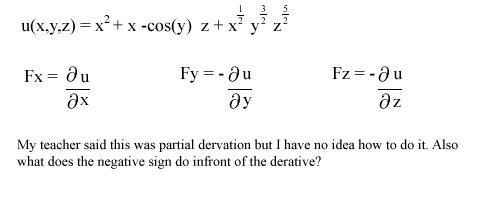
Homework Statement


secondproblem.jpg


Homework Equations


The Attempt at a Solution


I don't know where to even start as this is my first time ever seeing this problem. Where should I start?
 
Physics news on Phys.org
So is the question just asking you to find Fx, Fy, Fz?
If that is the case then its a fairly easy problem.
If you have not met partial differentiation before I won't go through what it is and how it comes about but i'll just tell you how to do it:
To differentiate du/dx (with curly d's to represent partial derivatives) you take all the variables which are not x and treat them as constants so for example d/dx (x^2yz)=2xyz
As with the minus signs you just need to find the derivatives and then multiply it by -1 .
Hopefully that helps a little.
 
robcowlam said:
So is the question just asking you to find Fx, Fy, Fz?
If that is the case then its a fairly easy problem.
If you have not met partial differentiation before I won't go through what it is and how it comes about but i'll just tell you how to do it:
To differentiate du/dx (with curly d's to represent partial derivatives) you take all the variables which are not x and treat them as constants so for example d/dx (x^2yz)=2xyz
As with the minus signs you just need to find the derivatives and then multiply it by -1 .
Hopefully that helps a little.

so like this?

secondproblemqustion.jpg


But since am treating yz as constants wouldn't it be 0 if I take the derivative or am just taking the derivative of x and then multiplying it by yz?
 
Ok so I read up on partial derivatives and came up with this:


secondproblemcopy.jpg


Am I right?
 
Not quite. When you partially differentiate, you're treating the other variables as constant, but you still might be multiplying by the variable you're differentiating with respect to. For instance:

\frac{\partial }{\partial x} ( xyz ) = yz

As you know

\frac{d}{dx} ( \alpha x ) = \alpha

Remember: when you differentiate a constant on its own, you get 0, but a constant multiplying the variable you're differentiating with respect to is not zero!
 
I really do appreciate the help here! Now is this any better?

secondproblemcopy-2.jpg
 
Looks great, nice work!
 

Similar threads

  • · Replies 5 ·
Replies
5
Views
1K
  • · Replies 5 ·
Replies
5
Views
2K
  • · Replies 2 ·
Replies
2
Views
1K
  • · Replies 4 ·
Replies
4
Views
2K
  • · Replies 5 ·
Replies
5
Views
2K
Replies
1
Views
1K
  • · Replies 18 ·
Replies
18
Views
2K
Replies
4
Views
1K
  • · Replies 3 ·
Replies
3
Views
696
  • · Replies 9 ·
Replies
9
Views
1K