Solving Partial Derivation Homework Problem

Click For Summary

Homework Help Overview

The discussion revolves around a homework problem related to partial differentiation, where the original poster expresses uncertainty about how to approach the problem for the first time.

Discussion Character

  • Exploratory, Conceptual clarification, Mathematical reasoning

Approaches and Questions Raised

  • Participants discuss the nature of the problem, questioning whether it simply involves finding the partial derivatives Fx, Fy, and Fz. There are attempts to clarify the process of partial differentiation, with some participants sharing their understanding and examples.

Discussion Status

Several participants provide insights into the concept of partial differentiation, with some guidance on how to treat other variables as constants during differentiation. There is acknowledgment of progress in understanding, but no explicit consensus on the final approach or solution.

Contextual Notes

Participants note the original poster's lack of familiarity with partial differentiation, which may influence their understanding of the problem. There are references to external resources for further clarification.

Bman900
Messages
12
Reaction score
0
Now I solved something similar to this problem yesterday (https://www.physicsforums.com/showthread.php?t=447168) thanks to the help of p21bass but this one is really out there and I have no idea where to begin.
Homework Statement


secondproblem.jpg


Homework Equations


The Attempt at a Solution


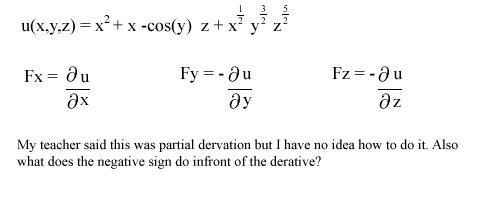
I don't know where to even start as this is my first time ever seeing this problem. Where should I start?
 
Physics news on Phys.org
So is the question just asking you to find Fx, Fy, Fz?
If that is the case then its a fairly easy problem.
If you have not met partial differentiation before I won't go through what it is and how it comes about but i'll just tell you how to do it:
To differentiate du/dx (with curly d's to represent partial derivatives) you take all the variables which are not x and treat them as constants so for example d/dx (x^2yz)=2xyz
As with the minus signs you just need to find the derivatives and then multiply it by -1 .
Hopefully that helps a little.
 
robcowlam said:
So is the question just asking you to find Fx, Fy, Fz?
If that is the case then its a fairly easy problem.
If you have not met partial differentiation before I won't go through what it is and how it comes about but i'll just tell you how to do it:
To differentiate du/dx (with curly d's to represent partial derivatives) you take all the variables which are not x and treat them as constants so for example d/dx (x^2yz)=2xyz
As with the minus signs you just need to find the derivatives and then multiply it by -1 .
Hopefully that helps a little.

so like this?

secondproblemqustion.jpg


But since am treating yz as constants wouldn't it be 0 if I take the derivative or am just taking the derivative of x and then multiplying it by yz?
 
Ok so I read up on partial derivatives and came up with this:


secondproblemcopy.jpg


Am I right?
 
Not quite. When you partially differentiate, you're treating the other variables as constant, but you still might be multiplying by the variable you're differentiating with respect to. For instance:

\frac{\partial }{\partial x} ( xyz ) = yz

As you know

\frac{d}{dx} ( \alpha x ) = \alpha

Remember: when you differentiate a constant on its own, you get 0, but a constant multiplying the variable you're differentiating with respect to is not zero!
 
I really do appreciate the help here! Now is this any better?

secondproblemcopy-2.jpg
 
Looks great, nice work!
 

Similar threads

  • · Replies 5 ·
Replies
5
Views
1K
  • · Replies 5 ·
Replies
5
Views
2K
  • · Replies 2 ·
Replies
2
Views
2K
  • · Replies 4 ·
Replies
4
Views
2K
  • · Replies 5 ·
Replies
5
Views
2K
Replies
1
Views
1K
  • · Replies 18 ·
Replies
18
Views
2K
Replies
4
Views
1K
  • · Replies 3 ·
Replies
3
Views
736
  • · Replies 9 ·
Replies
9
Views
2K