Double D Edd
- 4
- 0
Okay, this should really be a fairly easy problem and my work is below this question:
"A radar station detects an airplane approaching directly from the east. At first observation, the range to the plane is d1 = 384 m at 40° above the horizon. The airplane is tracked for another 123° in the vertical eastwest plane, the range at final contact being d2 = 770 m. Find the displacement of the airplane during the period of observation."
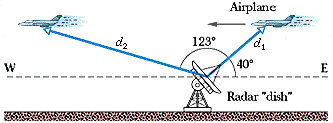
Heres what I did:
I first figured that the resultant R = d1-d2. So, I decided to break that into components.
Rx = d1x - d2x ; Ry = d1y - d2y. Now, to find the magnitude, I would take the square root of the sum of Rx^2 and Ry^2. And the direction would be the inverse tangent of Ry/Rx.
So, Rx = 384*cos(40) - (-770*Cos(57)). I took the other angle 180-123 = 57. So, Rx = 713.53m
Ry = 384*sin(40) - 770*sin(57). Ry = -398.94 (Which I think is totally wrong).
Now, the rest is pretty simple for me to do provided the above is correct, which I think is not.
I solved this and got the answer for the magnitude as 817.48m. Unfortunately, the answer is wrong.
Know what I am doing wrong here? Thanks :)
Edd.
"A radar station detects an airplane approaching directly from the east. At first observation, the range to the plane is d1 = 384 m at 40° above the horizon. The airplane is tracked for another 123° in the vertical eastwest plane, the range at final contact being d2 = 770 m. Find the displacement of the airplane during the period of observation."
Heres what I did:
I first figured that the resultant R = d1-d2. So, I decided to break that into components.
Rx = d1x - d2x ; Ry = d1y - d2y. Now, to find the magnitude, I would take the square root of the sum of Rx^2 and Ry^2. And the direction would be the inverse tangent of Ry/Rx.
So, Rx = 384*cos(40) - (-770*Cos(57)). I took the other angle 180-123 = 57. So, Rx = 713.53m
Ry = 384*sin(40) - 770*sin(57). Ry = -398.94 (Which I think is totally wrong).
Now, the rest is pretty simple for me to do provided the above is correct, which I think is not.
I solved this and got the answer for the magnitude as 817.48m. Unfortunately, the answer is wrong.
Know what I am doing wrong here? Thanks :)
Edd.