Alex Pavel
- 25
- 0
I know that c is the same in all reference frames. I am trying to understand the rail car thought experiment.
I've got it down pretty well except for one part - the difference between an observer moving toward a light source versus an observer moving away from a light source at the same relative velocity.
- We have two observers in a train moving east at, say, 0.3c relative to the track. It is a very long train, two light seconds long.
- We have two synchronized clocks at the two targets, A (Alice) and B (Bob)
- Observer (C) Charlie is on the train in the middle and he controls the light source
- Alice stands 1 light second east, and Bob is 1 light second west (29,972KM) of Charlie and the light source on the train
- An observer is on the track (David) with his own clock.
- When the center point of the train (Charlie) reaches David (on the track) the light source is switched on. At this even, all clocks are set to zero.
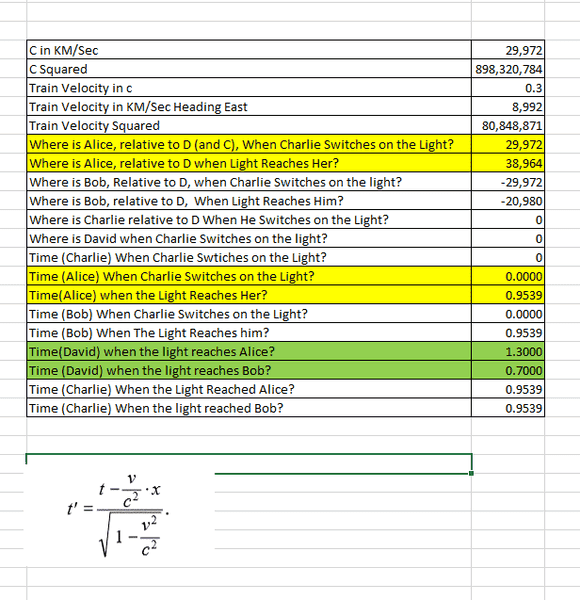
David, located on the track, measures the light reaching Alice at 1.3 seconds on his clock at a distance of 38,964KM east of David. He measures the light reaching Bob at 0.7 seconds, 20,980KM west of David.
- Alice, on the east end of the train, will record the time of light reaching her as 0.95 seconds.
- Bob, on the west end of the train is moving toward the light source at .3c, will also record the time of the light reaching him as: 0.95 on his clock.
Therefore, with Alice and Bob, using synchronized clocks, agree that the light beam has hit them simultaneously.
Whereas David (on the track) sees the light beam hit Bob 0.6 seconds earlier than Alice.
Thus, Alice and Bob at opposite ends of the train show identical time elapsed, while a 3rd party can perceive me meeting the light earlier or later.
This does not 'feel' correct yet I think I have the calculations right. Is this right?
Thank you!
I've got it down pretty well except for one part - the difference between an observer moving toward a light source versus an observer moving away from a light source at the same relative velocity.
- We have two observers in a train moving east at, say, 0.3c relative to the track. It is a very long train, two light seconds long.
- We have two synchronized clocks at the two targets, A (Alice) and B (Bob)
- Observer (C) Charlie is on the train in the middle and he controls the light source
- Alice stands 1 light second east, and Bob is 1 light second west (29,972KM) of Charlie and the light source on the train
- An observer is on the track (David) with his own clock.
- When the center point of the train (Charlie) reaches David (on the track) the light source is switched on. At this even, all clocks are set to zero.
David, located on the track, measures the light reaching Alice at 1.3 seconds on his clock at a distance of 38,964KM east of David. He measures the light reaching Bob at 0.7 seconds, 20,980KM west of David.
- Alice, on the east end of the train, will record the time of light reaching her as 0.95 seconds.
- Bob, on the west end of the train is moving toward the light source at .3c, will also record the time of the light reaching him as: 0.95 on his clock.
Therefore, with Alice and Bob, using synchronized clocks, agree that the light beam has hit them simultaneously.
Whereas David (on the track) sees the light beam hit Bob 0.6 seconds earlier than Alice.
Thus, Alice and Bob at opposite ends of the train show identical time elapsed, while a 3rd party can perceive me meeting the light earlier or later.
This does not 'feel' correct yet I think I have the calculations right. Is this right?
Thank you!
Attachments


Last edited: