Solving trigonometric equations using compound angle formula

Click For Summary
SUMMARY

The discussion focuses on solving the trigonometric equation 2sin(x) = 3cos(x - 60) using the compound angle formula. The user initially attempted to apply cofunction identities but found them inadequate due to the constants involved. The correct approach involves manipulating the equation to isolate tan(θ), leading to the solutions θ = 111.7° and θ = -68.3°, with only the former being valid within the specified range of 0 < x < 180°.

PREREQUISITES
  • Understanding of trigonometric identities, specifically compound angle formulas.
  • Familiarity with solving trigonometric equations.
  • Knowledge of the tangent function and its properties, including periodicity.
  • Ability to manipulate algebraic equations involving trigonometric functions.
NEXT STEPS
  • Study the compound angle formulas in detail, focusing on their applications in solving equations.
  • Learn how to apply the CAST diagram for determining the signs of trigonometric functions in different quadrants.
  • Practice solving various trigonometric equations using both cofunction and compound angle identities.
  • Explore the periodic properties of trigonometric functions to understand how to find all possible solutions within a given range.
USEFUL FOR

Students and educators in mathematics, particularly those studying trigonometry, as well as anyone looking to enhance their problem-solving skills in trigonometric equations.

Tangeton
Messages
62
Reaction score
0
Hello.

I find this whole topic of compound angle formula really confusing. I've been doing equations like cos(60+x) = sinx using the co function identities so far, yet this one seems to be impossible to do using cofunction identities so I need to know how to do it using compound angle formula. And yes this is definitely meant to be done using compound angle formula no double angle since in the book double angle hasnt even been mentioned at this point...

The question is to solve the equation 2sinx = 3cos(x-60) for values of x in the range 0 < x <180. I can't solve using cofunction due to the constants, but if anyone knows how to solve using cofunction identities with the constants this kind of answer is also welcomed.

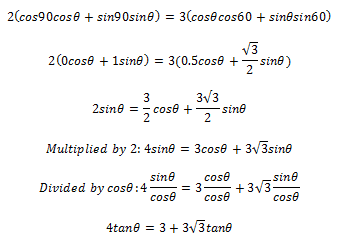
I tried using compound angle formula after using cofunction identities where 2sinx = 2cos(90-x)
29vh0sy.png


I tried to bring everything to the power of 2 but this gave me 11tan^2x = -9 so that is impossible.
I tried to take away 3sqrt3tan from 4tan which equaled 3 but this gave me the wrong answer.

The answer is 111.7.

Ive used x and feta interchangeably as don't know how to place feta symbol on keyboard.

Thanks for help.

EDIT 2: Corrected every typo eveywhere
 
Last edited:
Physics news on Phys.org
Tangeton said:
Hello.

I find this whole topic of compound angle formula really confusing. I've been doing equations like cos(60+x) = sinx using the co function identities so far, yet this one seems to be impossible to do using cofunction identities so I need to know how to do it using compound angle formula. And yes this is definitely meant to be done using compound angle formula no double angle since in the book double angle hasnt even been mentioned at this point...

The question is to solve the equation 2sinx = 3cos(x-60) for values of x in the range 0 < x <180. I can't solve using cofunction due to the constants, but if anyone knows how to solve using cofunction identities with the constants this kind of answer is also welcomed.

I tried using compound angle formula after using cofunction identities where 2sinx = 2cos(90-x)

29vh0sy.png


I tried to take away 3sqrt3tan from 4tan which equaled 3 but this gave me the wrong answer.

The answer is 111.7.

Why did this give you the wrong answer?
 
Nearly there. In your last equation just solve for ##tan \theta##.
 
Tangeton said:
Hello.

I find this whole topic of compound angle formula really confusing. I've been doing equations like cos(60+x) = sinx using the co function identities so far, yet this one seems to be impossible to do using cofunction identities so I need to know how to do it using compound angle formula. And yes this is definitely meant to be done using compound angle formula no double angle since in the book double angle hasnt even been mentioned at this point...

The question is to solve the equation 2sinx = 3cos(x-60) for values of x in the range 0 < x <180. I can't solve using cofunction due to the constants, but if anyone knows how to solve using cofunction identities with the constants this kind of answer is also welcomed.

I tried using compound angle formula after using cofunction identities where 2sinx = 2cos(90-x)

nobot2.jpg


I tried to bring everything to the power of 2

Why? You know what √3 is.
By the way, you lost a "3". After multiplication by 2 , the right hand side is 3cos(θ)+3√3 sin(θ), so you get the equation 4tan(θ)=3+3√3tan(θ) for tan(θ).
Bring the tan(θ) terms on one side, solve for tan(θ).
 
4tan(θ)=3+3√3tan(θ)
3+3√3tan(θ)- 4tan(θ) = 0
3 + (3√3-4)tan(θ) = 0
(3√3-4)Tan(θ) = -3
Tan(θ) = -3/(3√3-4)
θ = Tan^-1(-3/(3√3-4) ) = -68.3 (3sf) but the answer is 111.7...

And upon plugging in x = -68.3 and x = 111.7, it turns out that they both do make the equation 2sinx = 3cos(x-60) equal on both sides, yet x = -68.3 gives equal negative and x = 111.7 gives equal positives. 180 - 68.3 = 111.7. So I found the reason for my result. Would you guys say both answers would be accepted...?

EDIT: I actually got the same answer before making this post but book said it was wrong so I got really confused.
 
Tangeton said:
4tan(θ)=3+3√3tan(θ)
3+3√3tan(θ)- 4tan(θ) = 0
3 + (3√3-4)tan(θ) = 0
(3√3-4)Tan(θ) = -3
Tan(θ) = -3/(3√3-4)
θ = Tan^-1(-3/(3√3-4) ) = -68.3 (3sf) but the answer is 111.7...

And upon plugging in x = -68.3 and x = 111.7, it turns out that they both do make the equation 2sinx = 3cos(x-60) equal on both sides, yet x = -68.3 gives equal negative and x = 111.7 gives equal positives. 180 - 68.3 = 111.7. So I found the reason for my result. Would you guys say both answers would be accepted...?

Not if ##0 < x < 180## as was stated in your original post.
 
PeroK said:
Not if ##0 < x < 180## as was stated in your original post.

Ahh okay I forgot about that bit.. I guess I would have to remember to use the CAST diagram for my answer. Thanks for all help, everyone.
 
Tangeton said:
4tan(θ)=3+3√3tan(θ)
3+3√3tan(θ)- 4tan(θ) = 0
3 + (3√3-4)tan(θ) = 0
(3√3-4)Tan(θ) = -3
Tan(θ) = -3/(3√3-4)
θ = Tan^-1(-3/(3√3-4) ) = -68.3 (3sf) but the answer is 111.7...

You know that the tangent function is periodic with period of 180°. And you need to find solution in the range 0<θ<180°. Adding 180° to your result is also solution, just in the desired range.
 

Similar threads

  • · Replies 42 ·
2
Replies
42
Views
4K
  • · Replies 6 ·
Replies
6
Views
3K
  • · Replies 25 ·
Replies
25
Views
3K
  • · Replies 9 ·
Replies
9
Views
4K
  • · Replies 6 ·
Replies
6
Views
2K
  • · Replies 9 ·
Replies
9
Views
12K
  • · Replies 1 ·
Replies
1
Views
2K
  • · Replies 3 ·
Replies
3
Views
2K
  • · Replies 6 ·
Replies
6
Views
911
  • · Replies 3 ·
Replies
3
Views
2K