MHB Some help on a matrix question please.

  • Thread starter Thread starter khehrap
  • Start date Start date
  • Tags Tags
    Matrix
Click For Summary
The discussion revolves around matrix operations, specifically the meanings of A^TB (transpose of A) and A^-1 (inverse of A) in the context of solving systems of equations. The user initially struggles with understanding A^TB and calculating the inverse of a non-square matrix. They later realize that filling in zeros allows them to work with a usable matrix for their equations. However, they encounter a calculation error when determining p2, leading to confusion about the expected results. The conversation emphasizes the importance of accurate calculations and understanding matrix properties in solving linear equations.
khehrap
Messages
3
Reaction score
0
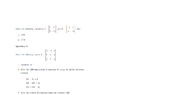
View attachment 2019
Hi. I am wondering if I can get some help on one or two questions on the sheet attached. I have worked out A^2B but am a bit puzzled on the meaning of A^TB. It is probably something very simple but I am struggling could someone help me possibly by listing out steps?.

Also I have worked out A^-1 but am stuck on solving the system of equations. As I though that you have to work out the inverse of a matrix when doing it for equations (AX=B format). although when I work out A ((2,-1)(3,2)(5,3) it is a 3x2 matrix therefore I am unable to get an inverse. Although the numbers are the same as the A^-1 question but just missing 0's therefore I think it may be something to do with that. Could someone help me please.

Thanks
Prab
 

Attachments

  • Untitled.png
    Untitled.png
    12.2 KB · Views: 85
Physics news on Phys.org
Hi I think I may have solved the equations (entering 0s where p1 p2 or p3 do not exist in the equation)

Could someone please still help to see if I have done it correct.
 
khehrap said:
I have worked out A^2B but am a bit puzzled on the meaning of A^TB.
$A^T$ denotes the transpose of $A$.

khehrap said:
Hi I think I may have solved the equations (entering 0s where p1 p2 or p3 do not exist in the equation)
Yes, in problem 2, the matrix of the system of equations is $A$.

khehrap said:
Could someone please still help to see if I have done it correct.
Please post your results so that we can check.
 
Evgeny.Makarov said:
$A^T$ denotes the transpose of $A$.

Yes, in problem 2, the matrix of the system of equations is $A$.

Please post your results so that we can check.

Hi Evgeny
I ralised that filling in the 0's gives me a matrix that I can use. Although I had already worked out the A^-1 in the first part of the question. therefore working row by row as normal.
The only problem I am facing (must be a calculation error - been doing this assignment for a while :)) is that when I try to work out p2 using matrix inversion shown below:

[1.250 x 2] + [0.375 x 16] + [-0.500 x 21] I am getting -4 not +4. Whereas the answer is +4 (calculation works correctly for both p1 and p3 giving me 3 and 2 respectively.)

I am using the figures above as a-1 gives the figures stated.

I have answered the cramers part too and been given the results 3 4 and 2 for p1 p2 p3.

Thanks
 
khehrap said:
[1.250 x 2] + [0.375 x 16] + [-0.500 x 21] I am getting -4 not +4.
The middle number in $A^{-1}$ is $6/8=0.75$, not 0.375. See WolframAlpha.
 
Thread 'How to define a vector field?'
Hello! In one book I saw that function ##V## of 3 variables ##V_x, V_y, V_z## (vector field in 3D) can be decomposed in a Taylor series without higher-order terms (partial derivative of second power and higher) at point ##(0,0,0)## such way: I think so: higher-order terms can be neglected because partial derivative of second power and higher are equal to 0. Is this true? And how to define vector field correctly for this case? (In the book I found nothing and my attempt was wrong...

Similar threads

  • · Replies 2 ·
Replies
2
Views
2K
  • · Replies 20 ·
Replies
20
Views
3K
  • · Replies 5 ·
Replies
5
Views
3K
Replies
3
Views
2K
  • · Replies 3 ·
Replies
3
Views
2K
  • · Replies 2 ·
Replies
2
Views
3K
  • · Replies 2 ·
Replies
2
Views
3K
Replies
2
Views
2K
  • · Replies 11 ·
Replies
11
Views
3K
  • · Replies 14 ·
Replies
14
Views
3K