Rotate Functions with Derivatives: A Quantum Mechanics Homework

Click For Summary
SUMMARY

The discussion centers on the application of rotation operators in quantum mechanics, specifically how to rotate a wave function Ψ using derivatives and the rotation matrix. The rotation operator R is defined, and the infinitesimal angle δφ is introduced to facilitate the rotation of functions. The conversation highlights the connection between infinitesimal rotations and the momentum operator as the generator of translations, culminating in the expression for finite rotations as ##e^{- i \hat{L}_z \varphi / \hbar}##. Participants also explore the implications of these concepts when considering wave functions in different spaces, such as ##\mathbb{C}^2##.

PREREQUISITES
  • Understanding of quantum mechanics principles, particularly wave functions and operators.
  • Familiarity with rotation matrices and their application in physics.
  • Knowledge of complex analysis, especially in relation to functions in ##\mathbb{C}^2##.
  • Basic grasp of infinitesimal calculus and its role in quantum mechanics.
NEXT STEPS
  • Study the properties and applications of the rotation operator in quantum mechanics.
  • Learn about the mathematical derivation of the rotation matrix and its implications for wave functions.
  • Explore the concept of momentum as the generator of translations in quantum mechanics.
  • Investigate the behavior of wave functions in higher-dimensional complex spaces, such as ##\mathbb{C}^2##.
USEFUL FOR

Students and professionals in quantum mechanics, physicists working with wave functions and rotation operators, and anyone interested in the mathematical foundations of quantum theory.

Oliver321
Messages
59
Reaction score
5
TL;DR
How is it possible to rotate a function (for example the 3D wave function) by an infinitesimal angle by using derivatives?
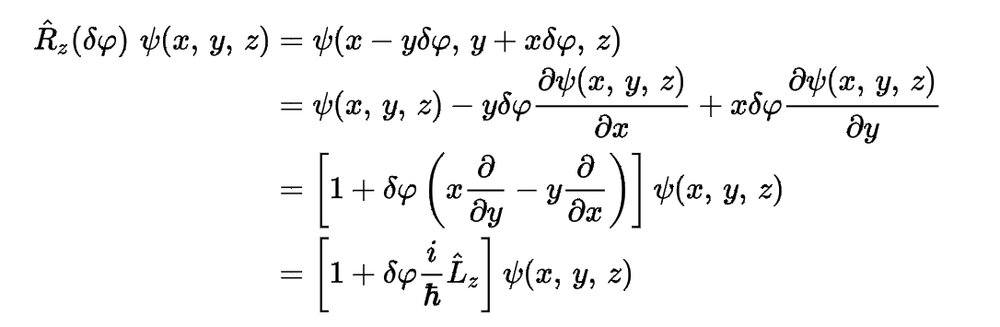
I was solving a problem for my quantum mechanics homework, and was therefore browsing in the internet for further information. Then I stumbled upon this here:
F5F459AD-E4C6-4951-A918-DA2E8E80B8D9.jpeg

R is the rotation operator, δφ an infinitesimal angle and Ψ is the wave function.
I know that it is able to rotate a curve, vector... with a rotation matrix. But how is it possible to rotate a function only with derivatives? I tried to rephrase a function f(x) as a curve, applying the 2D rotation matrix and small angle approximation and convert it back to an explicit function f(x). But I did not get the same answer.
My question is now: how does this work and what’s the connection to the rotation matrix?

I am really thankful for every help!
 
  • Like
Likes   Reactions: jk22
Physics news on Phys.org
I was around the same problem but outside of course material is this correct ?

Suppose ##\psi\in C^\infty(\mathbb{R}^3,\mathbb{C})## then the rotation of coordinates should correspond to a phase : ##e^{i\phi}\psi(\vec{x})=\psi(R\vec{x})\Rightarrow \phi=i(log(\psi(\vec{x})-log(\psi(R\vec{x})))## ?

I asked myself : What about if ##\psi(\vec{x})\in \mathbb{C}^2## ?
 

Similar threads

  • · Replies 1 ·
Replies
1
Views
3K
  • · Replies 3 ·
Replies
3
Views
5K
  • · Replies 1 ·
Replies
1
Views
1K
  • · Replies 1 ·
Replies
1
Views
3K
  • · Replies 2 ·
Replies
2
Views
1K
  • · Replies 1 ·
Replies
1
Views
2K
  • · Replies 8 ·
Replies
8
Views
2K
  • · Replies 1 ·
Replies
1
Views
3K
  • · Replies 3 ·
Replies
3
Views
2K
  • · Replies 16 ·
Replies
16
Views
3K