Graduate Something about configuration manifolds in classical mechanics

Click For Summary
SUMMARY

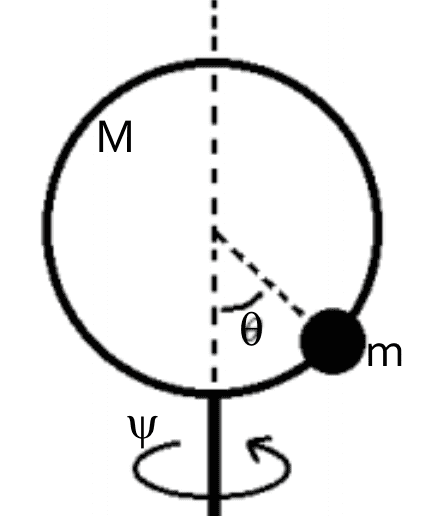
This discussion focuses on the configuration manifolds in classical mechanics, specifically analyzing a mechanical system involving a circle of mass M that rotates about a vertical axis. The system includes a bead of mass m that can slide along the circle, with its position defined by the angle ##\theta##. The Lagrangian of the system is defined on the tangent bundle ##T\mathbb{T}^2## when M>0, while it shifts to the tangent bundle ##TS^2## when M=0. The distinction between the toroidal manifold ##\mathbb{T}^n=S^1\times\ldots\times S^1## and the spherical manifold ##S^2## is emphasized, highlighting that ##S^1\times S^1\ne S^2##.

PREREQUISITES
  • Understanding of Lagrangian mechanics
  • Familiarity with tangent bundles in differential geometry
  • Knowledge of configuration spaces, specifically toroidal and spherical manifolds
  • Basic concepts of rotational dynamics in classical mechanics
NEXT STEPS
  • Study the properties of tangent bundles in differential geometry
  • Explore Lagrangian mechanics in depth, focusing on systems with constraints
  • Investigate the differences between toroidal and spherical manifolds
  • Learn about the implications of mass in mechanical systems and its effect on Lagrangian formulations
USEFUL FOR

Students and professionals in physics, particularly those specializing in classical mechanics, differential geometry, and mathematical physics, will benefit from this discussion.

wrobel
Science Advisor
Insights Author
Messages
1,237
Reaction score
1,040
I think it could be interesting.

Consider a mechanical system
Screenshot from 2021-02-25 09-30-39.png
A circle of mass M can rotate about the vertical axis. The angle of rotation is coordinated by the angle ##\psi##. A bead of mass m>0 can slide along this circle. The position of the bead relative the circle is given by the angle ##\theta##.

It is interesting to note that if M>0 the Lagrangian of this system is defined on the tangent bundle ##T\mathbb{T}^2##. But if M=0 then the Lagrangian is defined on the tangent bundle ##TS^2##.
 
Last edited:
Physics news on Phys.org
how is define the set ##\mathbb{T}##?
 
##\mathbb{T}^n=S^1\times\ldots\times S^1,\quad \mathbb{T}^1=S^1##
but
##S^1\times S^1\ne S^2##!
 
Last edited:

Similar threads

  • · Replies 15 ·
Replies
15
Views
2K
  • · Replies 9 ·
Replies
9
Views
2K
  • · Replies 10 ·
Replies
10
Views
3K
  • · Replies 9 ·
Replies
9
Views
3K
  • · Replies 5 ·
Replies
5
Views
2K
  • · Replies 9 ·
Replies
9
Views
4K
  • · Replies 17 ·
Replies
17
Views
3K
  • · Replies 11 ·
Replies
11
Views
4K
  • · Replies 1 ·
Replies
1
Views
1K
  • · Replies 6 ·
Replies
6
Views
2K